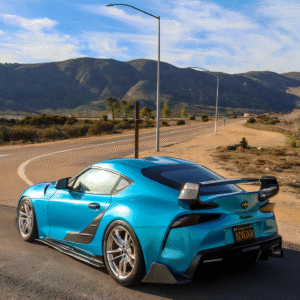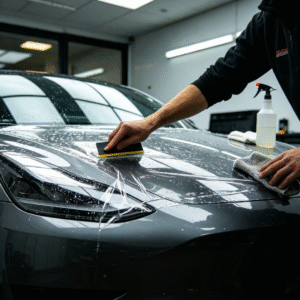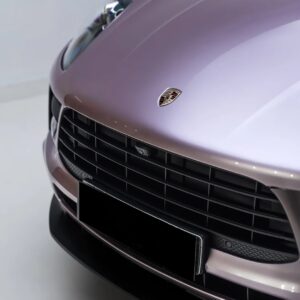
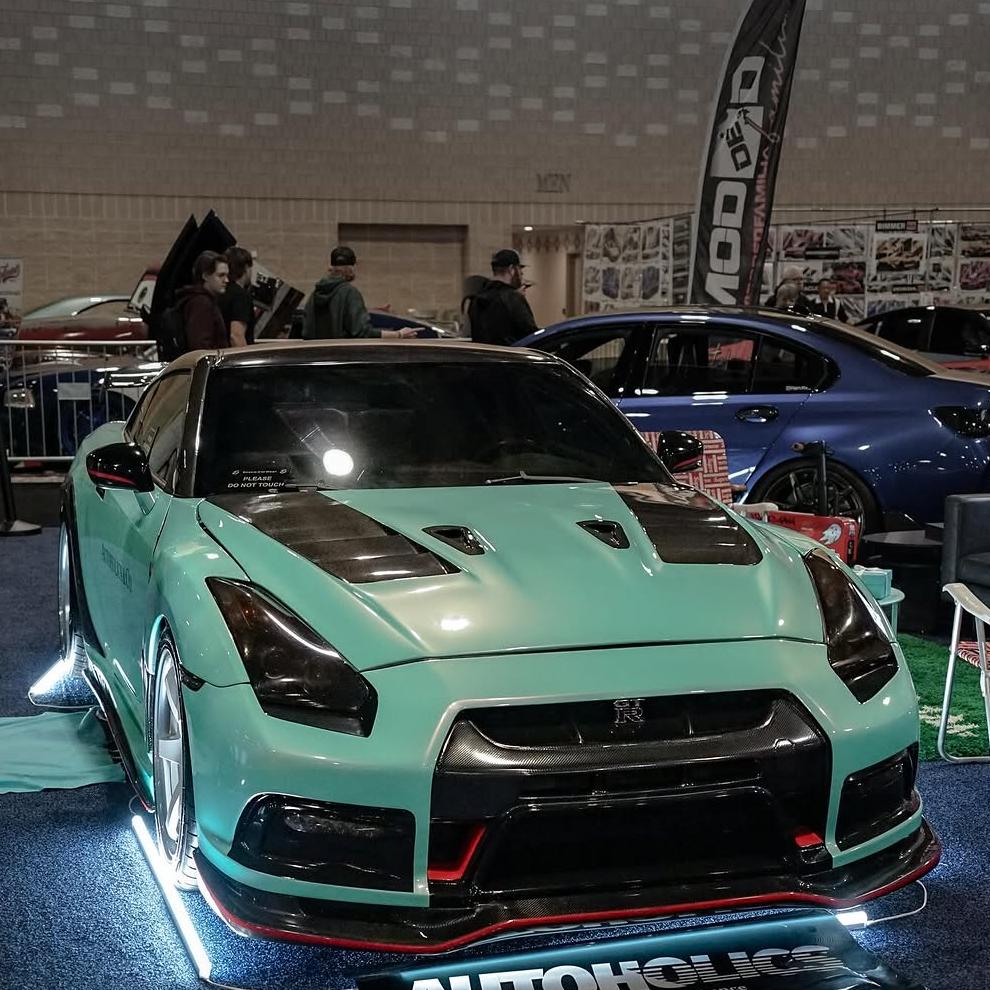
“PET wrap car” searches are rising because detailers and installers want paint-like gloss with lower orange peel and strong dimensional stability. Meanwhile, traditional PVC (vinyl) wraps remain the benchmark for deep 3D conformability. This guide clarifies what’s really changing in 2025—and how to choose the right material for your project.
What “PET vs PVC” means in wraps
PVC (vinyl) wraps have long dominated vehicle customization, especially cast films designed for complex curves. In parallel, PVC-free families—including PET-based and other non-PVC constructions—are gaining traction for sustainability credentials and optical clarity (for example, 3M’s non-PVC Envision line). Note: many “PET liner” products still use a PVC face film but employ a PET release liner to improve surface smoothness; true PET-based face films also exist.
On your site, shoppers looking for a broad style overview can start with vinyl wrap, while buyers specifically comparing PET solutions can jump straight to PET car wrap. We’ll reference both paths below to map choices to real-world use cases.
Material science: strength, stretch & shrink
PET vs PVC, at a glance: unplasticized PET generally exhibits higher tensile strength and modulus than flexible, plasticized PVC. Plasticizers—needed to soften PVC for wrapping—lower PVC’s modulus and raise elongation, improving stretch but also introducing the potential for plasticizer migration over time (one cause of shrink or edge-lift on poorly formulated or aged films).
Because PET doesn’t rely on external plasticizers to achieve its stiffness profile, well-engineered PET-based constructions can offer strong dimensional stability and resist shrink. In adjacent packaging films, PET-G’s clarity and controlled shrink are well documented compared with PVC, a trend that helps explain why PET-based technologies are attractive to wrap makers aiming for stable, glassy finishes.
Finish quality & the “orange-peel” discussion
Detailers often choose PET-based (or PET-liner) systems to approach a “wet-paint” gloss with minimal orange peel. Multiple manufacturers explicitly market PET-liner or PET-based wraps as delivering smoother, more mirror-like surfaces than standard paper-liner PVC films. Some premium PET-based black finishes even advertise self-healing clearcoats. (As always, performance varies by brand and installer technique.)
If your goal is a show-car gloss that photographs like paint, a modern PET car wrap is a strong option. If you plan a satin, matte or textured aesthetic across complex bodywork, classic cast PVC lines still offer vast color/finish libraries with proven installability.
Conformability & installation technique
PVC (cast) wraps remain the king of compound curves, deep channels and bumper inlets because plasticized PVC can safely stretch more before whitening or tension build-up—one reason cast is preferred for full color-change installs on highly contoured vehicles.
PET-based wraps can feel stiffer and typically reward a “low- or no-stretch” approach: float, squeegee from center, and rely on panel templating rather than aggressive pull. Many installers demonstrate zero-stretch methods specifically when working with PET films to protect finish quality and long-term stability.
Note that not all PVC-free films are PET; some are proprietary non-PVC chemistries engineered to be highly conformable and install in a wider temperature range than typical PVC. This shows how quickly non-PVC wrap tech is evolving beyond “stiff = hard to install.”
Sustainability & regulations
Recycling reality: PET (#1) is widely accepted in recycling streams, while PVC (#3) is generally not curbside-friendly and presents challenges due to its chlorine content in end-of-life processing. That’s a key reason brands promote PVC-free options in fleet graphics and architectural wraps.
Chemicals & compliance: the EU’s REACH framework restricts several phthalate plasticizers commonly used in flexible PVC, reinforcing market momentum toward PVC-free or low-migration systems where feasible. (Automotive wraps are not food-contact materials, but the regulatory direction is clear across sectors.)
When to choose PET vs PVC
- You want “paint-like” gloss for a show build or content shoot: choose PET-based (or PET-liner) systems to minimize orange peel and maximize surface reflectivity. Pair with meticulous prep (iron decon, clay, panel wipe) for best results. Consider PET car wrap selections for ultra-gloss projects.
- Your vehicle has complex curves and deep channels: a high-quality cast PVC wrap is still the easiest to install cleanly across difficult geometry, with excellent long-term hold when installed within spec.
- You prioritize greener materials or low odor: explore modern PVC-free wraps (including PET-based and other non-PVC chemistries) that tout certifications and broader temperature windows.
Bottom line
For maximum, paint-like gloss and dimensional stability, the PET route is compelling in 2025—especially on flatter panels and moderate curves. For the fastest path through complex compound curves, cast PVC remains the seasoned pro. The smartest installers mix both as needed (for example, PET on hoods/doors, cast on bumpers) to balance finish quality and install efficiency. Start your selection with Aluko’s vinyl wrap overview and then drill into PET car wrap options to match your color, finish, and project scope.