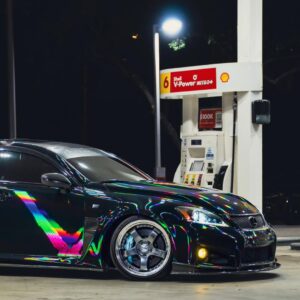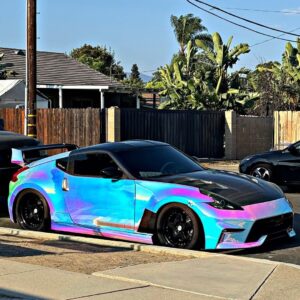

Carbon fibre has long been associated with performance engineering, lightweight construction, and motorsport-inspired design. Today, vehicle owners can recreate its distinctive woven appearance without replacing factory body panels.
But not every carbon-look automotive film offers the same level of protection.
Carbon fibre PPF wrap combines the appearance of carbon fibre with the protective functions of paint protection film. Unlike conventional carbon fibre vinyl, which is primarily used for styling, TPU-based carbon PPF is designed to provide an additional barrier against scratches, road debris, and everyday surface damage.
However, carbon fibre PPF is not automatically the best choice for every vehicle. It generally costs more than decorative vinyl, requires careful installation, and should not be confused with genuine structural carbon fibre.
This guide examines how carbon fibre PPF works, its advantages and disadvantages, technical specifications, real vehicle applications, and how products from ALUKOVINYL, 3M, Tinybot, and TeckWrap compare.
What Is Carbon Fibre PPF Wrap?
Carbon fibre PPF wrap is an automotive paint protection film designed to reproduce the woven appearance of carbon fibre while protecting the painted surface underneath. Most premium versions use thermoplastic polyurethane (TPU), although products marketed as hybrid PPF may have different constructions.
Unlike genuine carbon fibre components, carbon fibre PPF does not add meaningful structural reinforcement or reduce vehicle weight.
Its primary functions are:
- Recreating a woven carbon fibre appearance
- Helping protect the original painted surface
- Reducing minor scratches and everyday surface wear
- Providing a removable styling alternative to carbon fibre body panels
- Offering different visual finishes, including gloss, matte, and transparent carbon effects
A carbon-look film can be applied to selected areas such as the hood, roof, mirrors, and side skirts, or used across larger sections of a vehicle.
For owners considering a complete appearance change, traditional car wrap products offer additional finishes and graphic customization options.
How Does TPU Carbon Fibre PPF Work?
A TPU carbon fibre PPF typically combines a flexible polyurethane-based film with a decorative carbon pattern and a protective surface coating.
The exact construction varies by manufacturer.
A typical protective film may contain a top coat, a TPU substrate, decorative or optical components, an adhesive system, and a removable liner.
The TPU layer provides flexibility and toughness, while the surface coating determines characteristics such as gloss, stain resistance, and scratch recovery.
One important technical distinction is that carbon fibre appearance and paint protection are separate performance characteristics.
A realistic carbon pattern does not prove that a film has excellent impact resistance. Likewise, a film marketed as TPU does not automatically have the same mechanical properties as another manufacturer’s TPU product.
For reference, 3M’s Paint Protection Film Series 150 is designed to protect automotive paint against stone chips, scratches, stains, insects, road tar, and outdoor weathering. Its published documentation also describes self-healing technology and an optimized adhesive system.
Source: 3M Paint Protection Film Series 150.
These are useful industry benchmarks, but they do not independently establish the performance of every carbon fibre PPF product.
Carbon Fibre PPF vs Carbon Fibre Vinyl Wrap
The biggest difference between these materials is their primary engineering purpose.
Carbon fibre vinyl is designed mainly to create a decorative appearance. Carbon fibre PPF combines a similar visual effect with a protective-film construction.
| Feature | Carbon Fibre PPF | Carbon Fibre Vinyl |
|---|---|---|
| Main purpose | Protection and styling | Primarily styling |
| Typical material | TPU or hybrid construction | PVC-based vinyl |
| Stone-chip resistance | Designed for improved protection | Limited |
| Self-healing | Available on certain products | Not universal |
| Carbon appearance | Gloss, matte, transparent | Wide variety |
| Material cost | Generally higher | Generally lower |
| Installation | Film-dependent | Film-dependent |
| Best application | Styling with paint protection | Budget-conscious customization |
Which offers better protection?
A properly engineered TPU PPF is generally more suitable for impact-prone areas than conventional decorative vinyl.
However, protection depends on film thickness, impact resistance, top-coat performance, adhesive properties, and installation quality.
Which looks more realistic?
Neither material is automatically more realistic.
The visual result depends on pattern scale, weave alignment, gloss level, surface texture, and how the film behaves around curves.
A high-quality carbon vinyl may look more convincing than a poorly manufactured carbon PPF.
Which offers better value?
For purely cosmetic applications, vinyl often makes more financial sense.
For areas where the owner wants both carbon styling and paint protection, TPU carbon PPF may justify the additional expense.
The Advantages of Carbon Fibre PPF Wrap
1. Carbon styling without replacing body panels
Real carbon fibre hoods, roofs, and aerodynamic components can be expensive.
Carbon PPF offers a visual alternative without requiring permanent modifications.
This is particularly useful for owners who want to preserve original body panels.
2. Additional protection against everyday damage
A protective film can help reduce damage from light abrasions, environmental contamination, and minor road debris.
However, no PPF should be described as completely scratch-proof or stone-chip-proof.
A sufficiently severe impact can penetrate the film.
3. Self-healing surface technology
Some TPU carbon PPF products incorporate heat-responsive top coats.
For example, 3M confirms that minor scratches on its Series 150 PPF can recover when heat is applied.
This provides a useful reference for the technology, but buyers should verify the self-healing performance of the specific carbon PPF they intend to purchase.
4. Multiple carbon fibre appearances
Carbon PPF is not limited to conventional glossy black weave.
Available styling categories include:
- Gloss black carbon fibre
- Matte carbon fibre
- Transparent carbon fibre
- Silver carbon fibre
- Forged carbon-inspired patterns
Transparent carbon-pattern PPF is especially interesting for owners who want the factory paint color to remain partially visible beneath the decorative effect.
5. Removable customization
Properly installed film can often be professionally removed from suitable, sound automotive paint.
Nevertheless, removability is not guaranteed on damaged paint, poorly repaired panels, or deteriorating clear coat.
The Disadvantages: What Buyers Should Know
Higher material cost
Carbon fibre PPF generally costs more than standard decorative carbon vinyl.
The extra cost should be justified by actual protective performance, not merely the use of the term “PPF.”
No structural carbon fibre benefits
Carbon-pattern film does not make a hood lighter, improve chassis stiffness, or increase aerodynamic performance.
It reproduces appearance rather than engineering function.
Difficult pattern alignment
A carbon weave creates a repeating visual pattern.
Incorrect film orientation can make the weave appear inconsistent between adjacent panels.
This is particularly noticeable across a hood, front fenders, and bumper.
Complex installation
Deep recesses, sharp corners, mirror housings, and aggressive body kits can require substantial stretching.
Excessive stretching may distort the weave or affect the film’s surface appearance.
Limited independent product comparisons
Although manufacturers publish technical specifications, standardized head-to-head laboratory comparisons between individual carbon PPF products remain difficult to find.
Buyers should distinguish manufacturer-reported performance from independently verified results.
Carbon Fibre PPF Wrap: Technical Specifications That Matter
Thickness is often one of the first specifications buyers examine, but it should never be the only one.
ALUKOVINYL’s TPU Glossy Carbon Fiber PPF product page currently lists a film thickness of approximately 3.7–4.1 mil, with an additional adhesive thickness of 1.6 mil.
One mil equals 0.001 inch, or 25.4 micrometers. Therefore, 3.7–4.1 mil corresponds to approximately 94–104 micrometers.
These figures are manufacturer-published specifications, not independently verified test results.
For context, 3M’s published PPF comparison brochure lists an overall thickness of approximately 190 micrometers for Series 150 and 200 micrometers for Scotchgard Pro Series 200.
These numbers are not directly interchangeable: ALUKOVINYL’s listing separates film and adhesive thickness, whereas the 3M brochure reports overall thickness. Different measurement methods and layer definitions can make direct comparisons misleading.
A meaningful technical evaluation should examine:
| Property | Why it matters |
|---|---|
| Total film thickness | Influences physical barrier construction |
| Tensile strength | Indicates resistance to pulling forces |
| Elongation | Helps evaluate conformability |
| Impact resistance | Relevant to road-debris protection |
| Adhesive peel strength | Influences bonding and removal |
| Shrinkage | Relevant to edge retention |
| UV weathering | Helps assess outdoor stability |
| Top-coat performance | Influences staining and scratch recovery |
The strongest evidence comes from comparable tests performed under documented conditions.
Carbon Fibre PPF Brand Comparison: Price, Materials and Verified Evidence
Choosing a carbon fibre PPF wrap involves more than comparing advertised prices. Products marketed as carbon PPF may differ in film construction, thickness, protective coatings, installation methods, and warranty coverage.
To avoid misleading comparisons, the following table distinguishes publicly advertised starting prices from confirmed same-size quotations.
Carbon Fibre PPF Price and Feature Comparison
| Brand / Product | Published Price | Size and Price Basis | Material / Positioning |
|---|---|---|---|
| ALUKOVINYL Glossy Carbon Fiber PPF | From $259 USD | Starting price; selected-size USD quote requires confirmation | TPU carbon-pattern PPF |
| TeckWrap Gloss Sable Carbon CPX601 | From $249 USD | Starting price; matching-size quote not confirmed | Carbon Color PPF |
| Tinybot Gloss 6D Carbon Fiber Hybrid PPF | From $36 USD | Starting price; matching-size quote not confirmed | Hybrid carbon PPF |
| 3M Series 150 | Distributor quotation required | No directly comparable carbon-pattern retail quote | Clear polyurethane PPF |
Pricing note: These are advertised starting prices, not quotations for identical quantities. They should not be used to rank brands by price per square foot or full-roll value.
What Can We Actually Verify?
ALUKOVINYL: The published product specifications include a film thickness of 3.7–4.1 mil and an adhesive thickness of 1.6 mil. These are manufacturer-reported values. Publicly available independent laboratory results validating this specific product’s long-term durability and impact resistance have not been established in this comparison.
TeckWrap: Gloss Sable Carbon CPX601 is marketed as a carbon-pattern Color PPF. Its published starting price and product characteristics provide useful purchasing information, but they do not establish superior performance over competing products.
Tinybot: Gloss 6D Carbon Fiber Hybrid PPF is marketed as a hybrid product. Tinybot reports a total thickness of 7.78 mil excluding the release liner, with individual construction layers disclosed. These specifications are more informative than a general thickness claim, but independent verification of the product’s performance has not been established here.
3M: Series 150 provides a useful technical benchmark for conventional clear PPF. Its published technical documentation supports comparison of test methods, construction, and protective functions. However, it is not a direct carbon-pattern alternative.
Why Same-Size Pricing Matters
A meaningful price comparison requires the same coverage area.
For example, a 5 ft × 10 ft section provides 50 square feet of material, while a 5 ft × 49 ft roll provides 245 square feet.
A smaller piece can have a lower total price while costing more per square foot.
For comparable products, buyers should calculate:
Material cost per square foot = Selected product price ÷ Total film area
This calculation should use the actual selected size and exclude shipping, taxes, and installation unless those charges are consistently included across all brands.
What Evidence Would Support a Stronger Comparison?
An evidence-based evaluation should ideally include independent or standardized testing for:
-
Stone-chip resistance, using a documented test method such as SAE J400
-
Tensile strength and elongation
-
UV and accelerated-weathering resistance
-
Adhesive peel strength and removal behavior
-
Scratch recovery under controlled temperatures
-
Color and carbon-pattern stability after outdoor exposure
These tests must use comparable procedures and conditions.
Until equivalent independent results are available, no manufacturer should be declared the best-performing carbon fibre PPF solely because it advertises greater thickness, a longer warranty, or more advanced self-healing technology.
Our Assessment
ALUKOVINYL, TeckWrap, and Tinybot provide different carbon-pattern styling options. Their advertised prices are useful starting points, but differences in product construction and selected roll sizes prevent a reliable price-performance ranking.
3M provides an established reference for conventional protective-film technology, although its clear Series 150 is not a direct carbon-fibre styling competitor.
The most reliable purchasing decision comes from comparing identical material quantities, documented technical specifications, installation requirements, warranty conditions, and verified test results—not advertised starting prices alone.
Which Cars Look Best With Carbon Fibre PPF?
Carbon PPF is especially effective when the weave complements the vehicle’s existing styling.
The following are recommended applications, not claims that ALUKOVINYL has personally installed and tested every example.
BMW M4: Carbon Fibre Hood and Roof

The BMW M4’s sculpted hood and aggressive roofline make it a strong candidate for carbon styling.
A glossy carbon PPF can create contrast against white, gray, blue, or red paint.
For a more restrained appearance, wrapping only the roof and mirror caps may provide better visual balance than covering the entire vehicle.
Installation consideration: Maintain consistent weave direction across the hood and avoid unnecessary stretching near sculpted edges.
Tesla Model 3: Carbon Roof and Mirror Accents
The Tesla Model 3 has relatively clean exterior surfaces, making it suitable for selective carbon styling.
A carbon roof treatment can create a contrasting appearance without overwhelming the vehicle’s minimalist design.
Mirror accents can also work well, although the compound curves require careful installation.
Installation consideration: Confirm the condition and compatibility of the roof substrate before applying film. Glass surfaces require specific evaluation rather than assumptions based on painted-panel installation.
Porsche 911: Carbon Hood and Aerodynamic Accents

The Porsche 911 benefits from a restrained approach.
Carbon-look hood accents, mirrors, and selected aerodynamic components can complement the vehicle’s performance-oriented appearance.
A full carbon-pattern exterior may visually compete with the 911’s distinctive body lines.
Installation consideration: Complex bumper shapes and tightly curved surfaces can make weave distortion more noticeable.
Dodge Challenger: Carbon Hood and Widebody Details

The Challenger’s broad hood and muscular proportions provide substantial space for carbon-pattern styling.
A carbon hood can contrast effectively with bright body colors, while side skirts and splitter accents can create a coordinated appearance.
Installation consideration: Widebody extensions and sharp edges may require separate pieces and careful seam planning.
Is Full-Body Carbon Fibre PPF Better Than Partial Wrapping?
Not necessarily.
A full-body carbon-pattern finish can create a dramatic appearance, but it also increases cost, material consumption, and installation complexity.
Partial applications often provide a better balance between appearance and practicality.
A hood, roof, mirrors, and side skirts can create a coherent carbon styling package without covering every painted surface.
For daily-driven vehicles, owners should also consider where physical protection matters most.
The front bumper, leading hood edge, rocker panels, and lower doors experience different exposure levels.
If the goal is maximum paint preservation, a combination of clear PPF on vulnerable painted areas and carbon-pattern PPF on selected styling panels may be more appropriate.
Carbon Fibre PPF Installation: Professional Considerations
Installation quality directly influences the final appearance.
1. Inspect the paint
Identify repainting, clear-coat damage, contamination, and existing scratches before application.
2. Confirm film direction
Carbon weave is visually directional. Plan the layout before cutting.
3. Use the approved installation method
Some products support wet installation, dry installation, or both.
Never assume that instructions for one brand apply to another.
4. Control stretching and heat
Stretch only as needed. Excessive heat and tension can distort the carbon pattern.
5. Inspect edges and seams
Poor edge finishing may lead to lifting, contamination, or visible pattern interruptions.
3M’s published installation guidance for its PPF products recommends controlled working temperatures, but installers should follow the exact technical instructions for their selected material.
How to Maintain Carbon Fibre PPF
Routine care helps preserve both the film and its appearance.
Use pH-neutral automotive shampoo and soft microfiber towels. Avoid aggressive scrubbing, harsh solvents, and directing high-pressure water at vulnerable film edges.
Remove bird droppings, insects, and other contaminants promptly.
Self-healing top coats may recover from minor surface marks, but deep cuts and torn film generally require replacement.
Avoid assuming that all carbon PPF can be polished, ceramic-coated, or heated in the same way. Always confirm compatibility with the manufacturer’s care instructions.
Frequently Asked Questions
Is carbon fibre PPF better than carbon vinyl wrap?
Carbon PPF is generally more suitable when paint protection is a priority. Carbon vinyl often provides better value for purely cosmetic customization.
Does carbon fibre PPF contain real carbon fibre?
Most carbon-look PPF uses a printed, textured, or optical carbon pattern rather than structural carbon-fibre reinforcement.
Can carbon fibre PPF protect against rock chips?
A properly engineered PPF is designed to help resist common road impacts, but protection depends on the specific film and impact severity.
Is carbon fibre PPF self-healing?
Some products feature self-healing top coats. Buyers should verify the exact product specification rather than assuming every carbon-pattern film has this capability.
Can carbon PPF be removed without damaging paint?
Professional removal from sound factory paint is often possible, but the outcome depends on paint condition, adhesive behavior, film age, and removal technique.
Can I apply carbon fibre PPF to an entire car?
Yes, provided the selected film is suitable for full-body application. However, full coverage requires more material, careful pattern alignment, and greater installation expertise.
How much carbon fibre PPF do I need for a hood?
Many automotive hoods can be covered using approximately 5 ft × 6–10 ft of film, but the required size depends on vehicle dimensions, curvature, and installation allowance.
Does carbon fibre PPF increase vehicle resale value?
There is no reliable basis for guaranteeing an increase in resale value. It may help preserve covered paint, but buyers’ styling preferences and the vehicle’s condition will influence resale outcomes.
Final Verdict: Is Carbon Fibre PPF Wrap Worth It?
Carbon fibre PPF wrap is worth considering when you want carbon-inspired styling and a protective film in the same application.
Its main advantage over conventional carbon vinyl is the potential for stronger paint protection, depending on the film’s actual construction and tested performance.
Its limitations are equally important: higher cost, installation complexity, weave distortion risk, and the fact that it does not provide the structural benefits of genuine carbon fibre.
For a budget-focused cosmetic project, conventional carbon vinyl may be the more rational choice.
For owners seeking both appearance and protection, a properly specified TPU carbon PPF can offer a compelling alternative.
At ALUKOVINYL, we recommend evaluating the material’s construction, installation requirements, warranty, and appearance before committing to a full vehicle project.
Explore our tpu wrap options, discover the broader color ppf range, or review the carbon fibre ppf wrap product for available sizes and finish details.
Choose the material that matches your vehicle, protection priorities, and budget—not simply the one with the most impressive product photography.
Technical References
- 3M Paint Protection Film Series 150 — protective-film performance and self-healing.
- 3M PPF Technical Bulletin — product construction and technical information.
- TeckWrap Carbon PPF — current carbon-pattern PPF offerings.
- Tinybot Carbon Fiber Collection — carbon fibre styling and hybrid-film products.
Editorial disclosure: ALUKOVINYL sells automotive wrap and PPF products. Brand-specific specifications and warranties discussed here originate from their respective manufacturers unless otherwise identified. The vehicle examples are application recommendations, not independently documented installation trials. Prices and availability may change.