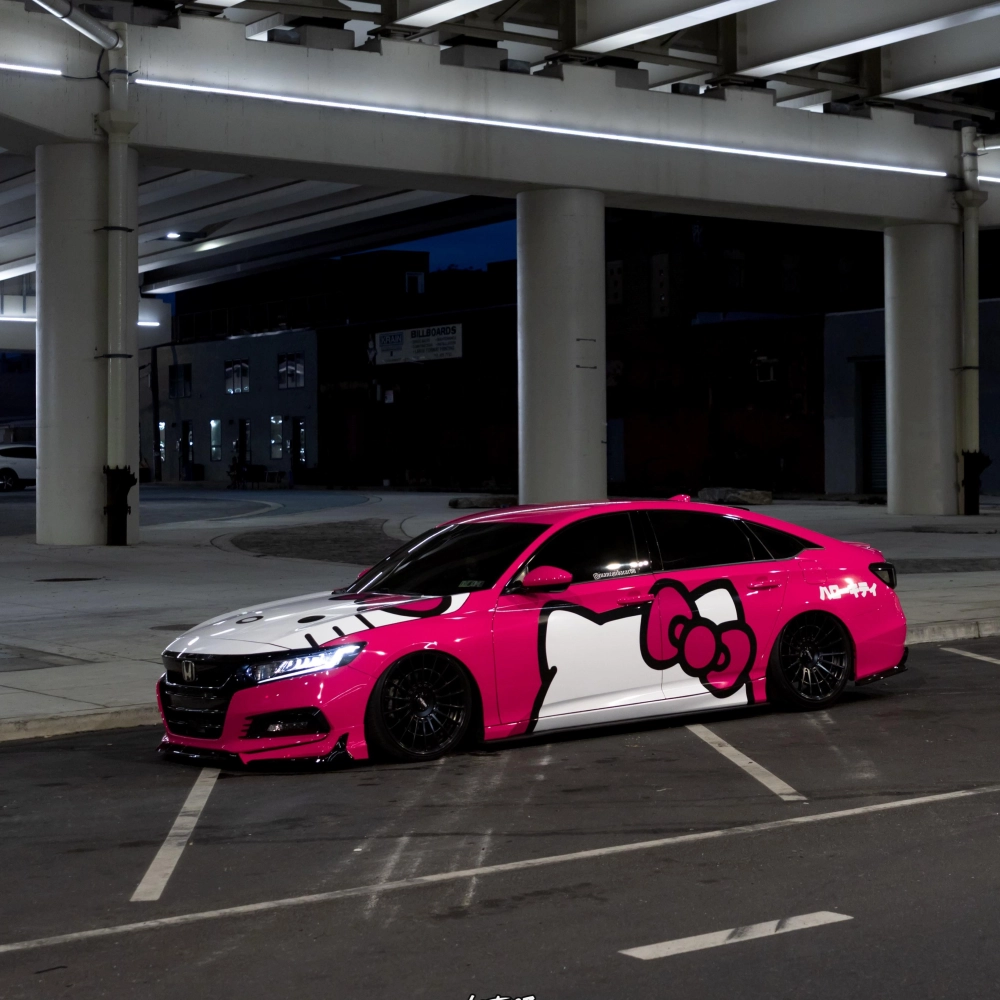
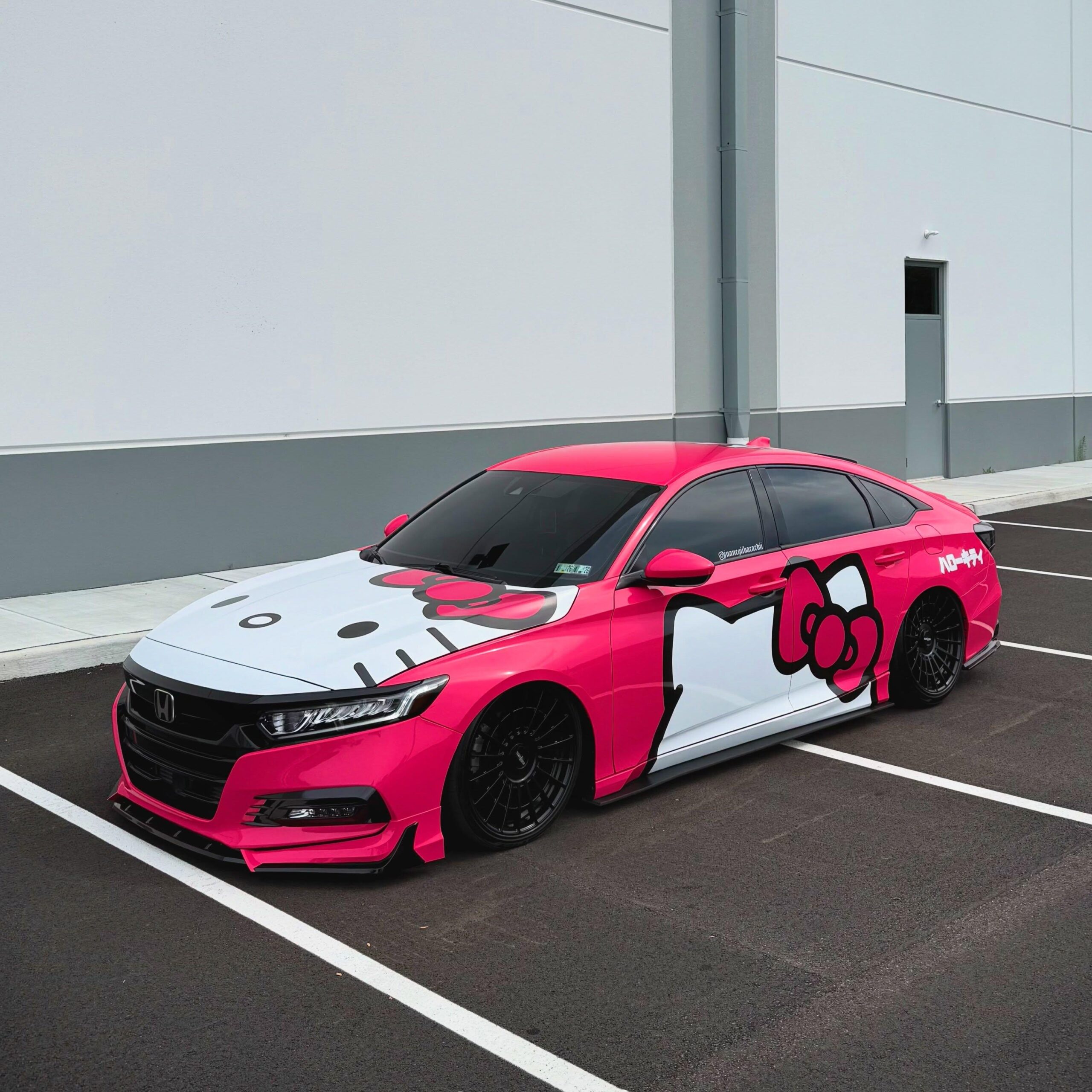
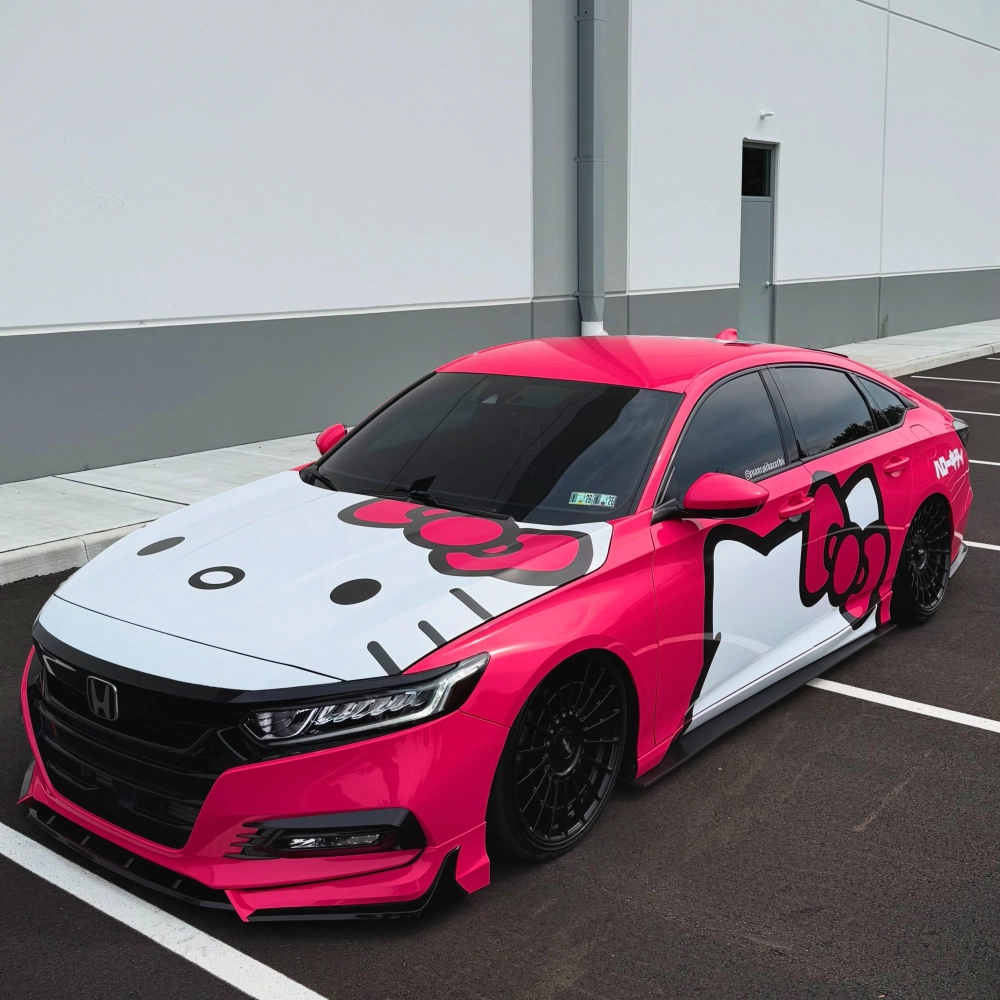
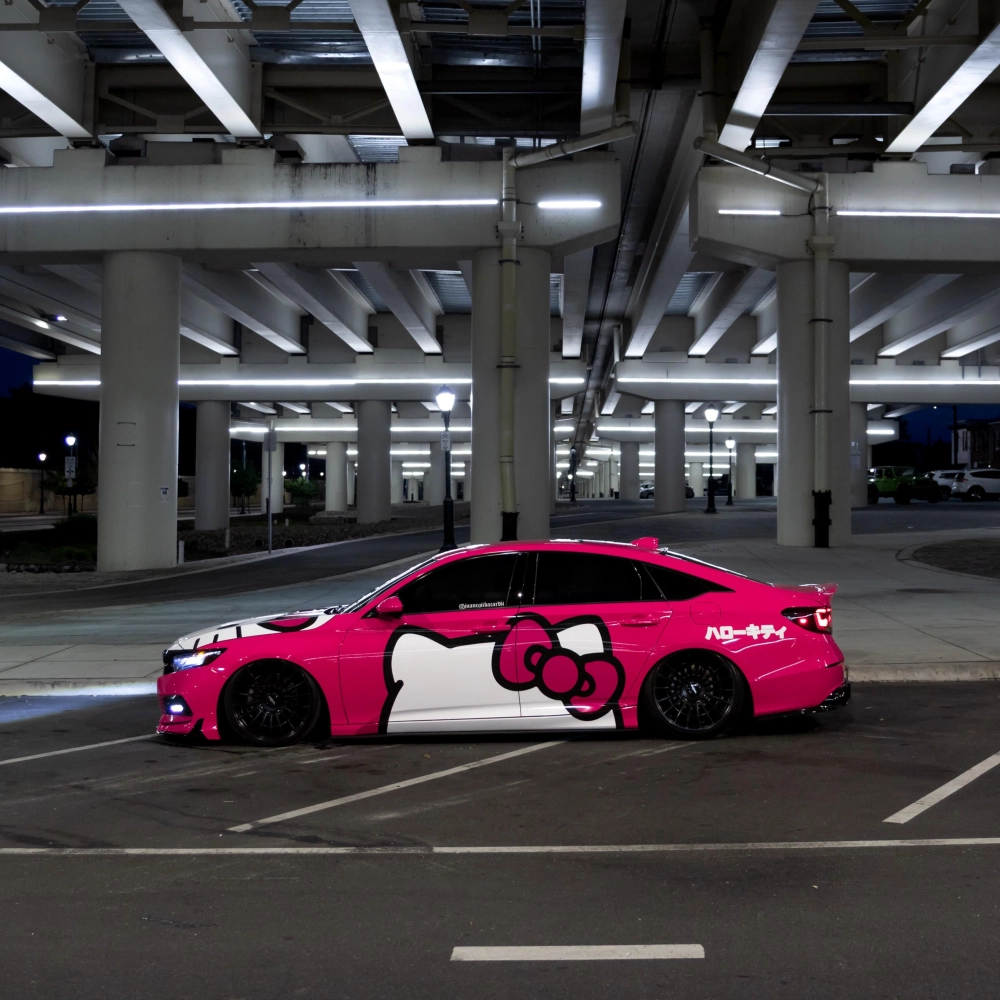
A car covered in pastel pink graphics, playful bows, and adorable character artwork is more than just another color change. It is a rolling expression of personality. That is exactly why the hello kitty itasha aesthetic has become such an appealing choice for drivers who love Japanese pop culture, kawaii fashion, and personalized automotive styling.
Unlike conventional car wraps that focus on a single color or finish, a Hello Kitty-inspired itasha combines illustration, color coordination, and vehicle-specific graphic placement. The result can range from a subtle pink daily driver to an elaborate show car with large character illustrations and decorative details.
But before transforming your vehicle, several practical questions deserve attention: Which cars suit this aesthetic? Is a full wrap better than partial graphics? Should you choose gloss, matte, or satin vinyl? And how do you create a design that looks cohesive rather than overcrowded?
This guide explores the design possibilities, material considerations, installation challenges, and customization decisions behind a successful kawaii-inspired car wrap.
What Is a Hello Kitty Itasha Car Wrap?
A hello kitty itasha is a Japanese-inspired vehicle customization style featuring Hello Kitty-themed graphics, pink color palettes, bows, hearts, and kawaii decorative elements. Designs can use full printed vinyl wraps or partial decals, depending on the desired appearance, budget, and vehicle shape. Authentic Hello Kitty character artwork requires appropriate intellectual property authorization for commercial production.
The word itasha refers to vehicles decorated with illustrations of characters associated with anime, manga, games, and related Japanese pop culture. Although Hello Kitty originates from Sanrio rather than an anime series, Hello Kitty-themed cars are frequently discussed within the broader itasha and kawaii car customization communities.
A successful design typically combines three visual elements:
- Character-focused graphics: Licensed Hello Kitty artwork or appropriately authorized character illustrations.
- Coordinated colors: Pink, white, lavender, red, and other complementary shades.
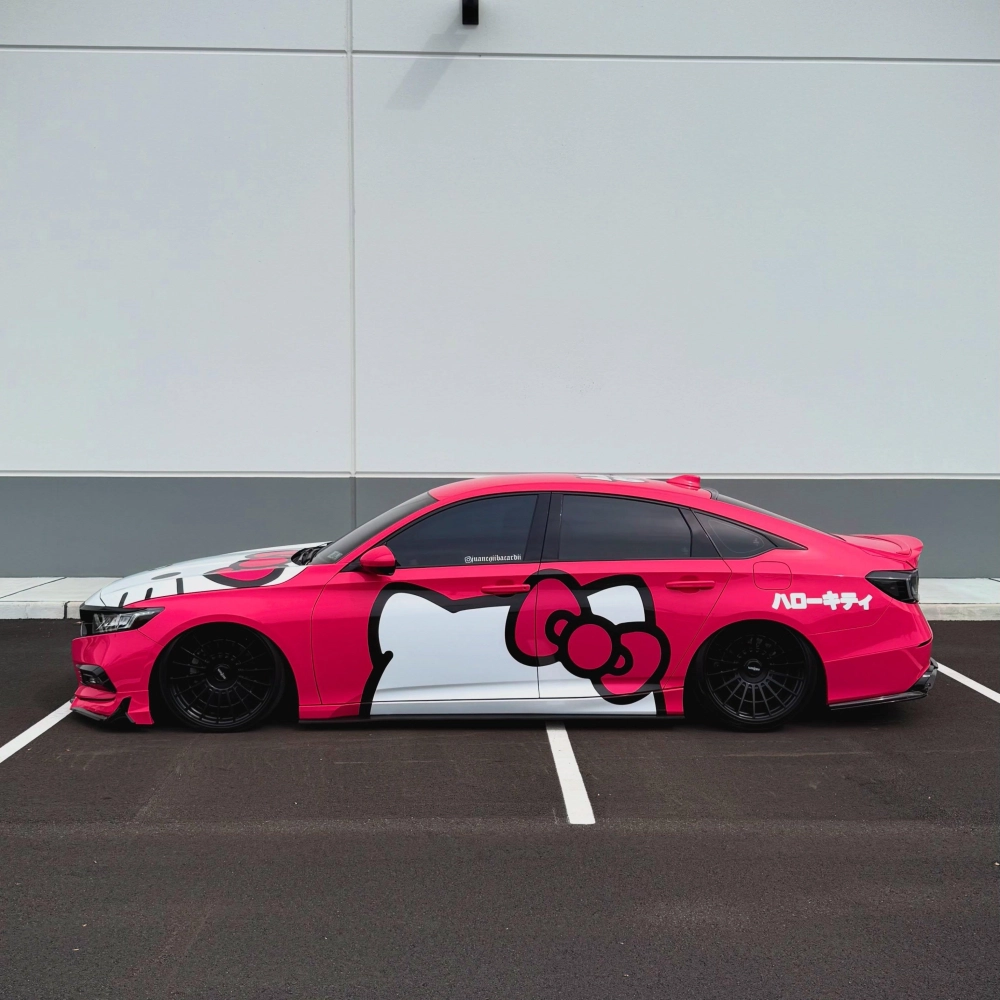
- Vehicle-specific composition: Graphics arranged around doors, windows, wheel arches, and body lines.
For drivers who want a personalized look without permanently repainting their vehicles, a professionally installed custom car wrap provides a flexible starting point.
Why Are Hello Kitty Itasha Cars So Appealing?
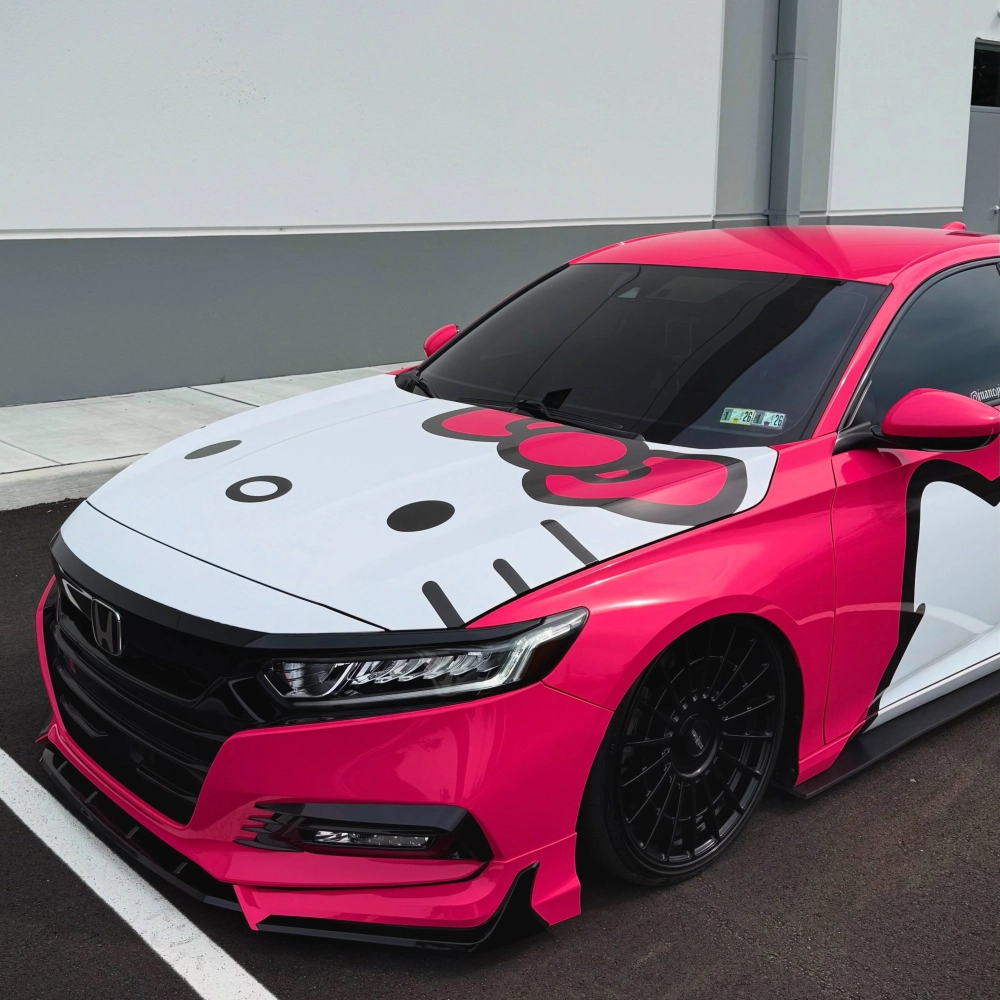
The appeal of a Hello Kitty-inspired car goes beyond the character itself. It brings together recognizable pop-culture aesthetics and a form of automotive personalization that can be adapted to almost any vehicle category.
1. A Recognizable Kawaii Aesthetic
Soft colors, rounded shapes, hearts, ribbons, and playful illustrations give kawaii car wraps a distinctive visual identity.
Instead of relying on aggressive racing stripes or dark performance-inspired finishes, these designs create a softer and more expressive appearance.
2. Creative Freedom Beyond Factory Colors
Factory paint colors are limited, but custom-printed vinyl makes it possible to combine illustrations, gradients, patterns, and decorative details in a single coordinated design.
For example, a pink-and-white wrap can feature a gradient background, oversized ribbon graphics, and small repeating heart patterns without requiring a permanent paint job.
3. Suitable for Both Subtle and Bold Builds
Not every Hello Kitty itasha car needs full-body artwork.
A minimal design might include pink mirror caps, ribbon decals, and a matching hood accent. A more elaborate build can incorporate large-scale graphics across the doors, hood, and rear quarter panels.
The most effective approach depends on how frequently the vehicle is driven and how much attention the owner wants the design to attract.
5 Hello Kitty Itasha Design Ideas Worth Considering
The following concepts demonstrate how the same kawaii theme can produce noticeably different results.
1. Pastel Pink and White — Classic Kawaii
A pastel pink base with white accents creates a soft, approachable appearance.
Design elements may include small bows, delicate hearts, white roof accents, and authorized character artwork positioned on the doors.
Best suited to: Volkswagen Beetle, MINI Cooper, Fiat 500, and other compact cars with rounded body shapes.
This design works particularly well when the vehicle already has a friendly, curved silhouette.
2. Black and Hot Pink — Sporty Itasha
For drivers who prefer a stronger contrast, hot pink graphics over a black or dark charcoal background can create a dramatic appearance.
Consider pink diagonal accents, large illustrated side graphics, and subtle racing-inspired typography.
Best suited to: Toyota GR86, Subaru BRZ, Nissan 370Z, and other sports coupes.
A useful design principle is to preserve some dark negative space around the artwork. This prevents detailed graphics from competing with the vehicle’s body lines.
3. Lavender and Pink — Dreamy Kawaii
Lavender provides a softer alternative to conventional bright pink.
A lavender-to-pink gradient can be paired with stars, clouds, bows, and delicate illustrations to create a dreamy aesthetic.
Best suited to: Tesla Model 3, Honda Civic, and Hyundai Ioniq 5.
This direction works especially well on vehicles with broad, relatively uninterrupted side panels.
4. White and Red — Minimalist Character-Inspired Styling
A white base with carefully placed red ribbons and pink decorative accents offers a cleaner appearance.
Instead of filling every panel with graphics, the design focuses on a few recognizable visual motifs.
Best suited to: Honda Fit, Toyota Corolla, Mazda MX-5 Miata, and MINI Cooper.
This is a practical option for drivers who want an expressive daily driver without committing to a visually dense full-body design.
5. Pink Racing Livery — Kawaii Meets Motorsport
A racing-inspired itasha combines playful graphics with motorsport styling.
Possible elements include checkered patterns, racing numbers, bold typography, and diagonal color blocking.
Best suited to: Toyota GR86, Subaru WRX, Honda Civic Type R, and Nissan Z.
The strongest versions balance motorsport-inspired structure with kawaii decoration rather than simply layering unrelated graphics over the vehicle.
Which Cars Look Best With a Hello Kitty Itasha Wrap?
The ideal vehicle is not necessarily the smallest or most expensive. What matters most is how its proportions, panel shapes, and existing styling complement the intended graphics.
| Vehicle | Recommended design | Why it works |
|---|---|---|
| Volkswagen Beetle | Classic pastel pink | Rounded silhouette complements playful graphics |
| MINI Cooper | Pink and white kawaii | Compact body supports a cohesive design |
| Toyota GR86 / Subaru BRZ | Black and pink racing itasha | Coupe proportions suit bold side artwork |
| Honda Civic | Pink and lavender graphics | Offers flexibility for sporty or subtle designs |
| Tesla Model 3 | Minimalist pink gradient | Smooth panels support clean visual layouts |
| Mazda MX-5 Miata | White and red accents | Small body works well with selective graphics |
| Nissan 370Z / Z | Full graphic itasha | Sculpted panels create dramatic presentation |
These are design recommendations, not documented ALUKOVINYL customer installations.
Expert Design Insight: Match Artwork to Body Geometry
A frequent mistake in custom itasha projects is selecting artwork before considering the vehicle’s panel layout.
A character illustration that looks excellent on a flat computer screen may become distorted when placed across a door handle, deep body crease, or wheel arch.
For better results, keep important facial features and fine details away from severe curves and panel transitions. Position primary artwork where it can be viewed clearly from the side.
This is especially important for vehicles with sculpted doors, complex bumpers, or large wheel arches.
Full Hello Kitty Itasha Wrap vs Partial Graphics
A full wrap is not always necessary to achieve a recognizable kawaii aesthetic.
| Feature | Full Custom Wrap | Partial Graphics |
|---|---|---|
| Visual impact | High | Moderate to high |
| Design coverage | Most exterior panels | Selected areas |
| Customization | Extensive | Targeted |
| Material cost | Generally higher | Generally lower |
| Installation complexity | Higher | Usually lower |
| Best use | Show cars and complete transformations | Daily drivers and first-time customization |
| Design flexibility | Integrated overall composition | Easier to update individual accents |
Which should you choose?
A full printed wrap is appropriate when the entire vehicle needs a consistent theme, including coordinated backgrounds, large artwork, and matching accents.
Partial graphics are better when the factory paint already complements the design or when the owner wants to experiment before committing to a complete transformation.
For example, a white MINI Cooper could achieve a kawaii appearance using pink door graphics, roof accents, and decorative ribbons without changing every painted surface.
Gloss vs Matte vs Satin: Which Finish Works Best?
The finish affects how a Hello Kitty-inspired design looks under sunlight, indoor lighting, and everyday driving conditions.
| Finish | Visual effect | Advantages | Limitations |
|---|---|---|---|
| Gloss | Bright, reflective colors | Vibrant pinks and strong color contrast | Reflections can compete with detailed graphics |
| Matte | Soft, non-reflective appearance | Contemporary, understated aesthetic | Requires finish-appropriate cleaning |
| Satin | Gentle sheen | Balances softness and visual depth | Finish consistency matters across panels |
Gloss for Vibrant Pink Graphics
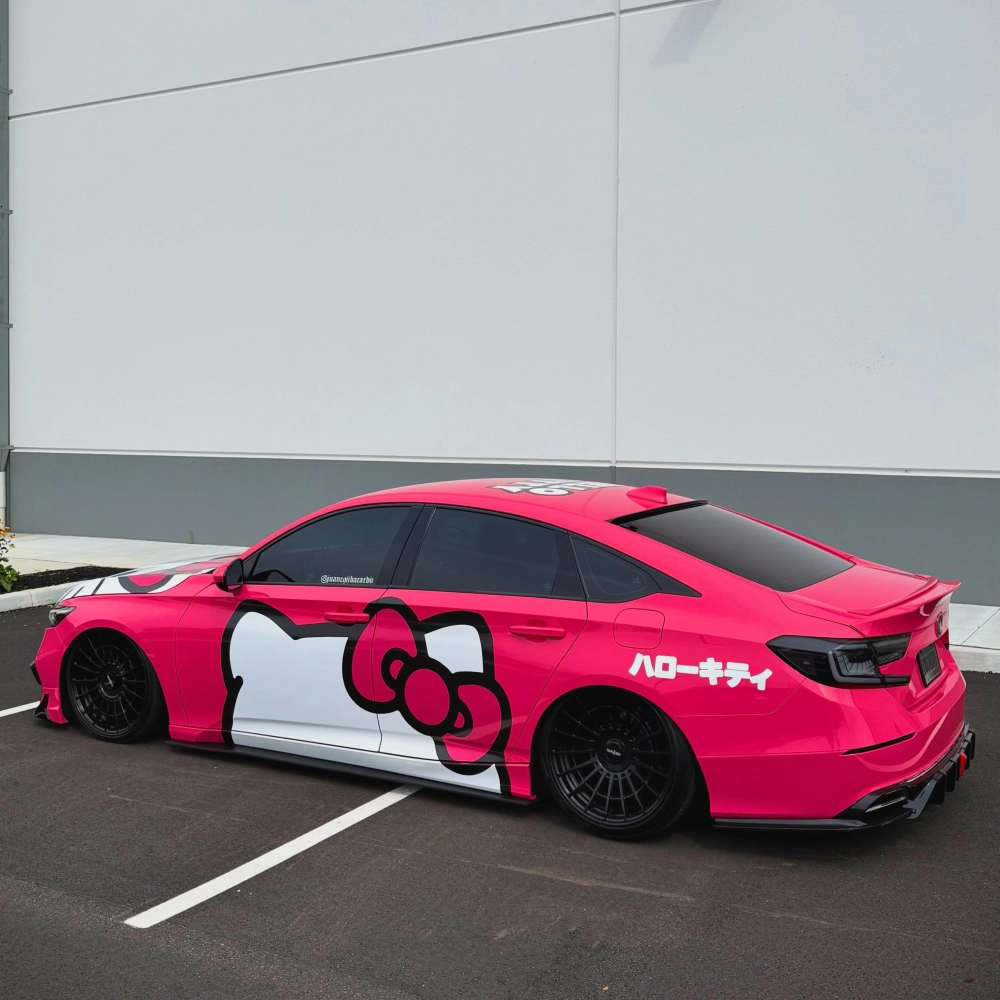
Gloss can enhance the brightness of pink, red, and white printed designs. It is a strong choice for drivers who want vivid colors and a polished appearance.
Matte for Soft Pastel Styling
Matte finishes can make pastel gradients and minimalist illustrations feel more subdued.
However, matte surfaces should not be polished like conventional glossy paint, since inappropriate products may alter their appearance.
Satin for Balanced Visual Depth
Satin offers a middle ground between high gloss and a fully matte finish.
For a pastel pink and lavender itasha, satin can provide a soft sheen without creating the strong reflections associated with gloss.
The final appearance depends on the printed film, protective laminate, ink system, and lighting conditions. Always confirm available finishes for the specific custom project.
Hello Kitty Itasha Wrap: Pros and Cons
Before investing in a custom character-themed wrap, consider both its creative advantages and practical limitations.
Advantages
- Highly personalized appearance: Allows owners to create a vehicle that reflects their aesthetic preferences.
- Extensive design flexibility: Combines gradients, patterns, illustrations, and multiple colors.
- Non-permanent alternative to paint: Suitable automotive wraps can be removed professionally, subject to paint condition and film limitations.
- Flexible coverage: Owners can choose a complete transformation or smaller accent graphics.
- Potential paint preservation: Properly installed vinyl can shield covered areas from some minor environmental exposure, although it is not equivalent to dedicated paint protection film.
Disadvantages
- Higher design complexity: Detailed graphics require careful scaling, placement, and print preparation.
- More demanding installation: Complex bumpers, curves, and panel transitions require professional skill.
- Maintenance requirements: Printed graphics need suitable washing and protection from prolonged environmental exposure.
- Potential resale considerations: Highly personalized designs may not appeal to every buyer.
- Intellectual property restrictions: Commercial use of recognizable protected characters requires proper authorization.
Practical recommendation: If the vehicle is used daily, choose a design with a manageable amount of fine detail, clear panel boundaries, and a finish that matches your maintenance habits.
Important: Can You Legally Use Hello Kitty Artwork on a Car Wrap?
Hello Kitty is a protected character owned by Sanrio. A character’s popularity does not make its artwork free to reproduce.
Sanrio’s official intellectual property guidance explains that its character names and images are protected, and commercial products featuring them require authorization.
For a custom project, distinguish between two situations:
Licensed character artwork: Reproducing official Hello Kitty illustrations for commercial printing or sale requires appropriate rights.
Original kawaii-inspired artwork: Pink gradients, hearts, ribbons, stars, and independently created decorative patterns can capture a similar playful aesthetic without copying protected character designs.
A customer-supplied image or a personal-use intention does not automatically establish the right to reproduce protected artwork.
For businesses and wrap suppliers, the safer approach is to verify artwork permissions before accepting production and to offer original, independently designed kawaii graphics when licensing is unavailable.
How to Design a Custom Kawaii Itasha Wrap
ALUKOVINYL offers custom printed vehicle wraps, including anime-inspired designs, gradients, personalized graphics, and vehicle-specific layouts. Its customization process includes artwork review and design approval before production.
A successful project should follow these stages.
Step 1: Choose Your Vehicle and Coverage
Start with the vehicle’s year, make, model, and body style.
Decide whether you want a full wrap, partial graphics, or a combination of a solid-color vinyl base and printed artwork.
Step 2: Build a Consistent Color Palette
Rather than combining every available shade of pink, choose a small group of complementary colors.
For example:
- Main color: pastel pink
- Secondary color: white
- Accent color: red
- Supporting color: lavender
This creates visual consistency across the doors, hood, roof, and rear panels.
Step 3: Prepare Original or Authorized Artwork
For detailed printing, vector artwork is ideal for shapes, lettering, and scalable graphics.
High-resolution raster files can also work, provided their effective resolution at final print size is sufficient.
Avoid enlarging small internet images for full-size vehicle graphics, as this can produce blurred edges and visible pixelation.
Step 4: Review the Vehicle-Specific Mockup
A digital mockup should show the graphics from multiple angles.
Check whether character faces, typography, and decorative elements overlap handles, mirrors, seams, or wheel arches.
A visually attractive mockup should also be evaluated for real-world installation feasibility.
Step 5: Approve the Artwork Before Production
Confirm the colors, dimensions, finish, artwork rights, and panel layout before authorizing printing.
For custom-made products, carefully review the supplier’s approval and return conditions.
Step 6: Arrange Professional Installation
A qualified installer can assess paint condition, prepare the surface, align printed graphics, and manage complex curves.
Professional installation is especially valuable when large illustrations need to align across adjacent body panels.
Explore personalized car wrap options to learn more about artwork preparation and customization.
How Much Vinyl Do You Need for a Hello Kitty Itasha?
The required material depends on vehicle size, wrap coverage, body geometry, and whether the artwork is printed in individual panels or as a complete wrap.
ALUKOVINYL publishes the following starting sizes for custom wrap ordering:
| Vehicle category | Reference roll length |
|---|---|
| Sedan | 59 ft (18 m) |
| SUV | 69 ft (21 m) |
| Pickup | 79 ft (24.1 m) |
These are general ordering references, not guaranteed quantities for every vehicle. Actual requirements can vary substantially.
Why Printed Itasha Wraps Need Extra Planning
Unlike a solid-color wrap, a printed design may need exact graphic alignment between panels.
Installers must account for:
- Panel dimensions and body curvature
- Graphic orientation and alignment
- Printing and trimming margins
- Installation overlap requirements
- Material waste and possible replacement panels
A design with a large illustration spanning two doors requires more careful layout planning than a repeating heart pattern.
Expert tip: Finalize the vehicle template and panel layout before confirming print dimensions. Buying extra material cannot always correct artwork that has been printed at the wrong scale.
Installation and Care: Keeping Your Itasha Looking Its Best
Printed vinyl requires regular care to preserve its appearance.
3M recommends gentle hand washing, prompt removal of contaminants, and avoiding abrasive brushes. Its vehicle wrap care instructions also advise waiting at least 72 hours after installation before washing.
Avery Dennison similarly emphasizes appropriate cleaning methods and cautions against using unsuitable chemicals or abrasive products on vehicle graphics.
Recommended Maintenance Practices
- Wash the vehicle regularly with a mild, wrap-compatible automotive cleaner.
- Use clean microfiber towels and soft washing materials.
- Remove bird droppings, insects, and tree sap promptly.
- Avoid automatic brush car washes that may scratch the film or lift edges.
- Park in covered or shaded areas when practical.
- Inspect panel edges and seams periodically.
- Follow the specific film and laminate manufacturer’s care instructions.
For matte or satin graphics, avoid applying gloss-enhancing polishes unless explicitly approved for that finish.
A well-maintained wrap can retain its appearance longer, but actual service life depends on film quality, exposure, installation, and care.
Frequently Asked Questions About Hello Kitty Itasha
1. What does Hello Kitty itasha mean?
Hello Kitty itasha refers to a vehicle decorated with Hello Kitty-themed artwork and kawaii graphics in a style associated with Japanese character-car customization. Designs often feature pink, white, ribbons, hearts, and character illustrations.
2. Can I put a Hello Kitty wrap on any car?
Most vehicles with suitable exterior surfaces can receive custom vinyl graphics. However, the design must be adapted to the specific vehicle’s dimensions and body shape. Commercial reproduction of protected Hello Kitty artwork also requires appropriate authorization.
3. How much does a Hello Kitty itasha car wrap cost?
Pricing depends on vehicle size, material selection, artwork preparation, printing, coverage, and installation labor. Partial graphics are generally less expensive than a full custom-printed wrap. Request a project-specific quote rather than relying on a universal price.
4. Is a pink car wrap better than a printed itasha?
A solid pink car wrap is generally simpler to design and install. A printed itasha offers greater personalization through illustrations, gradients, patterns, and decorative graphics. The better option depends on the owner’s desired appearance and budget.
5. How long does an itasha vinyl wrap last?
There is no single guaranteed lifespan. Longevity depends on the film and laminate specifications, installation quality, climate, UV exposure, and maintenance. Request product-specific durability information before purchasing.
6. Can I remove an itasha wrap without damaging my paint?
Automotive vinyl wraps are designed to be removable, but removal results depend on paint condition, adhesive characteristics, installation history, and film age. Factory paint in good condition is generally a better candidate than poorly repaired or peeling paint.
7. What is the best color combination for a kawaii car wrap?
Pastel pink and white create a classic soft aesthetic. Black and hot pink provide a sportier look, while lavender and pink work well for dreamy gradient designs. The best combination should complement the vehicle’s proportions and existing trim.
8. Can I create an itasha without using copyrighted characters?
Yes. Original artwork featuring ribbons, hearts, stars, pastel gradients, original mascots, and other independently developed kawaii elements can create a distinctive itasha-inspired appearance without reproducing protected character imagery.
9. Is a full itasha wrap suitable for a daily driver?
Yes, provided the material, installation, and design are appropriate for everyday use. A daily-driven vehicle may benefit from simpler graphics around high-wear areas and a finish that is easy to maintain.
10. Can ALUKOVINYL help create a custom itasha design?
ALUKOVINYL offers custom printed wraps and vehicle-specific design services. Customers can submit design concepts and artwork for review before production. Any protected character artwork must have the necessary usage rights.
Final Thoughts: Make Your Kawaii Car Wrap Truly Personal
A successful hello kitty itasha is not simply about placing cute illustrations on a pink vehicle. It is about creating a cohesive design that complements the car’s shape, uses an appropriate vinyl finish, and remains practical for the owner’s lifestyle.
Compact cars can benefit from playful pastel graphics, sports coupes can carry bold racing-inspired artwork, and modern sedans can achieve a cleaner look through carefully balanced gradients and accents.
For the best results, prioritize original or properly licensed artwork, vehicle-specific graphic placement, quality printing, and professional installation.
The goal is a personalized vehicle that looks intentional from every angle.