
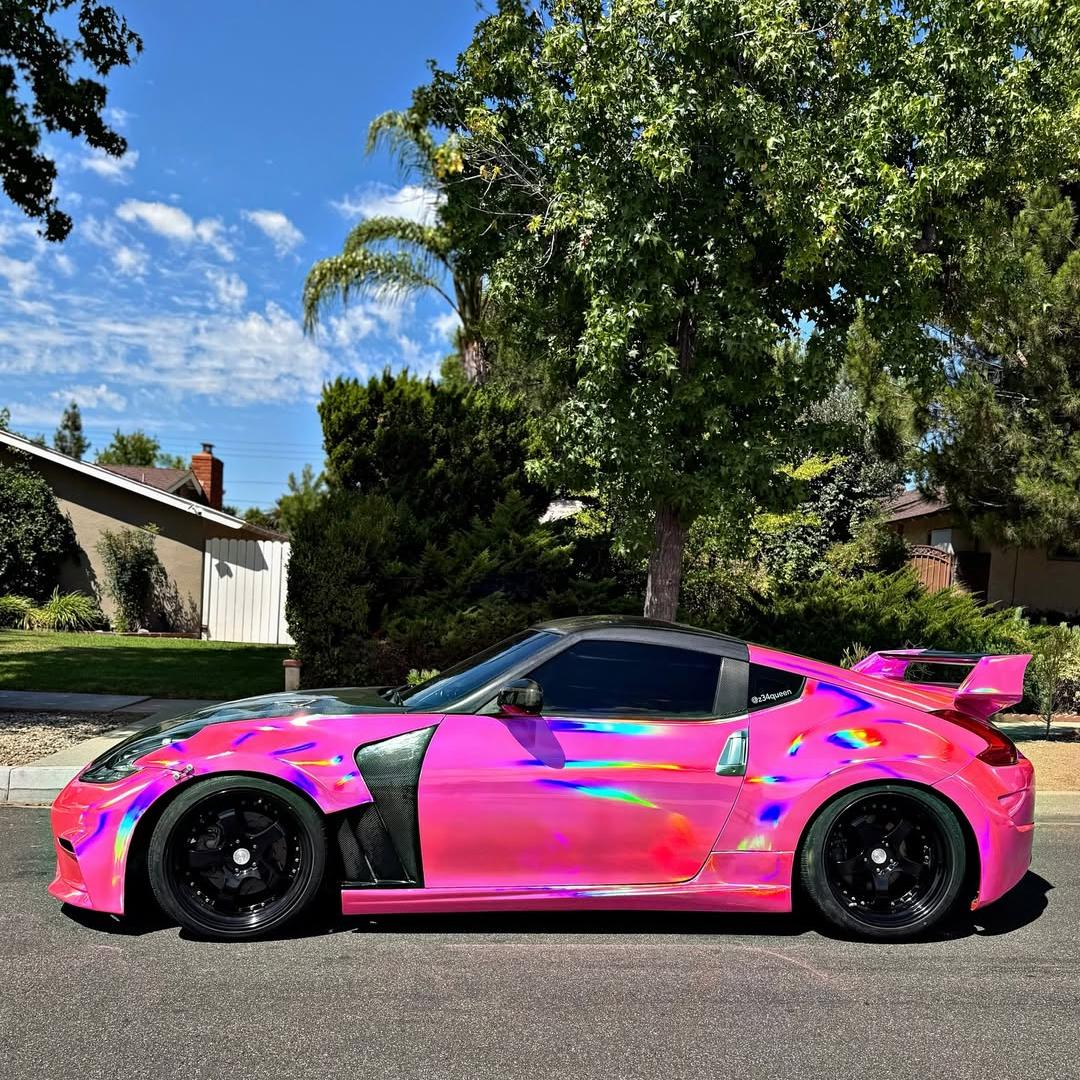
“Pink” isn’t just a color—it’s a light effect. On vehicles and product surfaces, vinyl wrap films can create pink in dramatically different ways, especially when you compare “holographic pink” with traditional “metallic pink.” Below, we unpack how the optics, measurement standards, and film constructions diverge, and how to pick the right finish for your brand or build.
What makes holographic pink look so different?
Holographic finishes use micro- or nano-structured patterns (think fine diffraction gratings) that split white light into spectral colors. As the viewing or lighting angle changes, different wavelengths constructively interfere, producing a dynamic rainbow “color travel” that sits atop the base pink tone—this is why holographic pink looks alive even when stationary.
In consumer films this effect is typically achieved by embossing a prismatic pattern into a clear layer and laminating it over a reflective substrate. Because the color shift comes from diffraction (structure), not dye alone, the appearance varies strongly with angle and light intensity—an intentional feature for bold, kinetic aesthetics.
How “metallic pink” builds its look
Metallic finishes rely on flat, reflective platelets—often aluminum or effect pigments dispersed in the coating/film—that reflect light in many mini-mirrors. You perceive sparkle, depth and a consistent hue, but without the rainbow diffraction of holographic films. Pearlescent and metallic systems can also use mica or coated flakes to tune flop and flash, yet they remain reflection-dominated rather than diffractive.
Objective ways to describe the difference
Because effect finishes change with angle, professionals quantify appearance using multi-angle spectrophotometers. These devices capture color, sparkle and coarseness at several geometries to ensure batch-to-batch consistency—critical when color-matching body kits, spoilers, or replacement panels.
Gloss is specified separately. The international method uses 20°/60°/85° geometries (high/semigloss/matte) defined in ISO 2813 and ASTM D523, so you can compare a high-gloss holographic chrome to a satin metallic on the same scale. If you’re deciding between high-shine “show car” looks and lower-gloss “design studio” vibes, these numbers matter.
Film construction & install realities
For complex curves, channels and tight recesses, cast vinyl typically outperforms calendered films: it’s thinner, more conformable, and built for longer service life. Calendered films suit flatter panels or short- to mid-term projects. Typical ranges cited by industry sources: cast ~5–12 years vs. calendered ~3–7 years, with thickness and flexibility varying accordingly (always check the specific TDS).
Quick comparison: holographic pink vs. metallic pink
| Attribute | Holographic Pink | Metallic Pink |
|---|---|---|
| Light behavior | Diffractive rainbow shift; strong angle dependence | Specular sparkle from metallic/pearlescent flakes; more uniform hue |
| Perceived depth | High “color travel” and kinetic dimensionality | Deep lustre and flake pop without rainbow shift |
| Measurement | Best characterized with multi-angle color/sparkle metrics | Also benefits from multi-angle metrics for flop and sparkle |
| Gloss spec | Often high-gloss chrome; verify via 20°/60°/85° gloss | Available in gloss/satin/matte; verify via same standards |
| Best use cases | Show builds, attention-grabbing branding, nightlife lighting | Premium OEM-like elegance, daily drivers, brand fleets |
When should you choose each?
Choose holographic pink when your goal is maximum motion and spectacle—think event cars, pop-ups, content creators, or brands that trade on kinetic, future-forward energy. It amplifies under spot lighting and sunsets, creating content-ready highlights with minimal post-production.
Choose metallic pink if you want upscale depth without the rainbow effect: elegant fashion fleets, hospitality, or daily drivers that need a refined, consistent identity under diverse lighting. You’ll still get flake pop and depth, just in a more controlled, uniform hue.
Spec & QA checklist (what to ask before you buy)
- Film type: Cast vs. calendered (project duration, curves, and climate).
- Gloss units: Request 20°/60°/85° readings per ISO 2813 / ASTM D523 for apples-to-apples shine comparisons.
- Color control: For fleets or replacements, ask for multi-angle spectrophotometer data (color, sparkle, coarseness).
- Adhesive & liner: Repositionability, slideability and low initial tack help on complex installs.
- TDS & warranty: Outdoor durability, cleaning chemistry compatibility, and removal/adhesive residue terms.
Shop curated options on ALUKO
Ready to explore finishes? Start with a modern overview of vinyl wrap solutions, then compare pink car wrap families for subtle to statement looks. If you want the rainbow-shift effect discussed above, browse our holographic car wrap collection; and for the exact aesthetic of this article, see our holographic pink wrap pick for show-stopping builds.