Black wraps are common. White wraps are common. A finish that visually transitions between white and Eclipse Black across the body is something very different.
TPU Eclipse Black Color PPF sits between two established vehicle-restyling categories: cosmetic color-change film and paint protection film. Instead of using conventional PVC primarily to change appearance, this film uses a TPU-based construction designed to provide a distinctive white-to-black gradient while adding a sacrificial layer over the original paint.
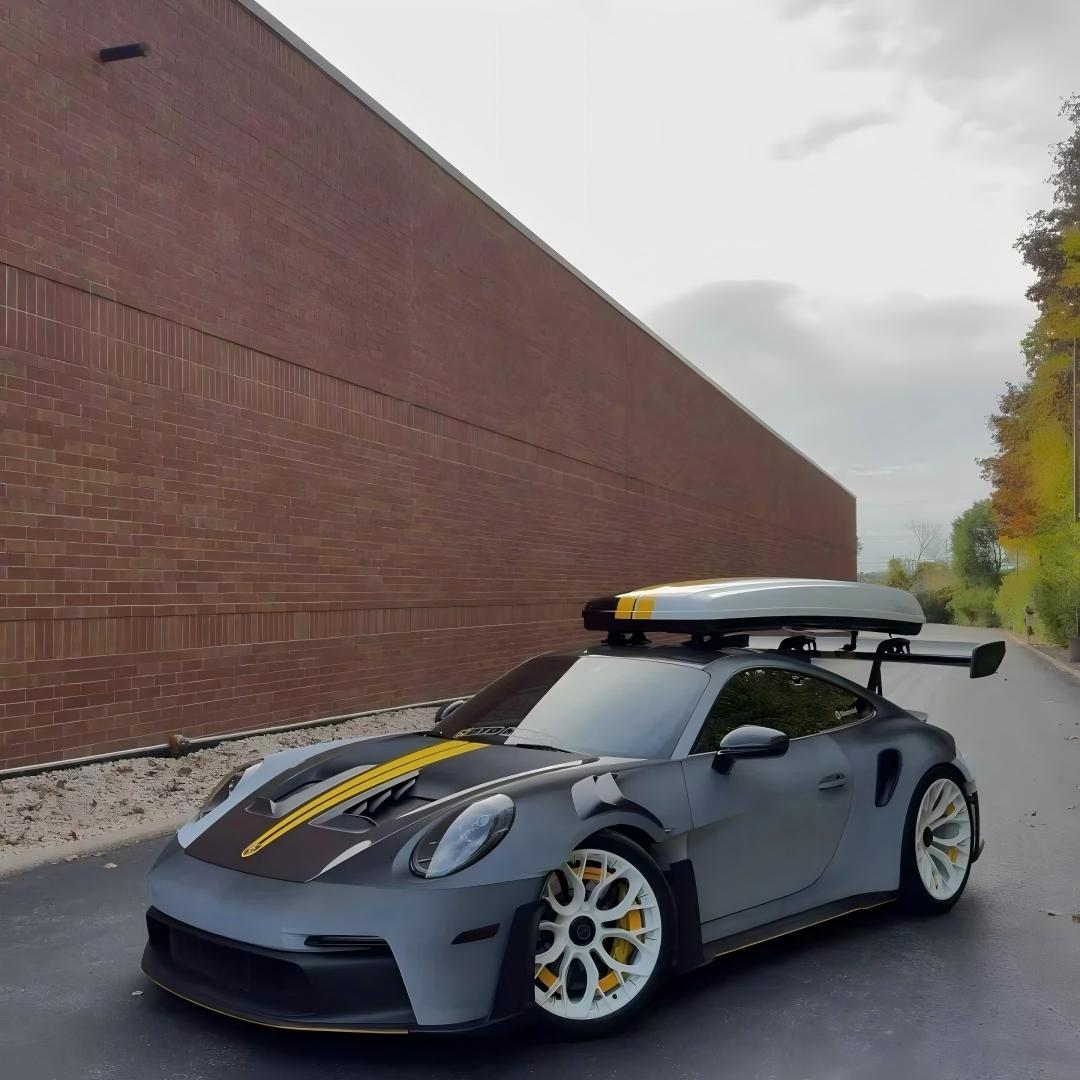
That combination makes it particularly interesting on highly sculpted cars such as the Porsche 911 GT3 RS, where the hood, fenders, doors, rear quarters and enormous rear wing allow the gradient to appear differently from every viewing angle.
But is it actually better than an ordinary wrap? And how should buyers compare it with established PPF technology from companies such as 3M, Avery Dennison and XPEL?
This guide looks at the published specifications rather than relying only on marketing claims.
Quick Answer: What Is TPU Eclipse Black Color PPF?
TPU Eclipse Black Color PPF is a satin-finish thermoplastic polyurethane film designed to create a white-to-deep-black gradient while covering the vehicle’s original paint. ALUKO lists the film with more than 200% breaking-strength elongation, acrylic repositionable adhesive, 4.5 N/25 mm peel strength, a +15°C to +40°C application range and self-healing/hydrophobic characteristics.
Unlike a conventional car wrap, whose main purpose is usually visual customization, colored PPF attempts to combine restyling and surface protection in one installation.
ALUKO currently lists an expected durability of one year for Eclipse Black. That figure is important because buyers should not automatically assume every TPU product carries the same service life as premium clear PPF products with long manufacturer warranties.
For drivers comparing materials before a full-body installation, see ALUKO’s tpu wrap range and broader color ppf selection.
Why Eclipse Black Works Especially Well on a Porsche 911 GT3 RS
The Porsche 911 GT3 RS is almost an ideal demonstration vehicle for a directional gradient film.
Porsche’s published specifications for the 992-generation GT3 RS list a body length of approximately 180.0 inches, an overall width of 74.8 inches, a height of 52.1 inches, and a curb weight around 3,268 lb for the referenced U.S.-market example. Its naturally aspirated 4.0-liter engine produces 518 hp in the U.S. specification cited by Porsche.
Those numbers matter less to a film installer than the body geometry.
The GT3 RS has unusually complicated surfaces: vented front fenders, large hood extraction openings, deep side sculpting, aggressive rear quarters and one of the most prominent rear wings fitted to a road-going 911.
A simple solid black finish can visually hide some of those shapes. A white-to-black transition does the opposite.
Front three-quarter view
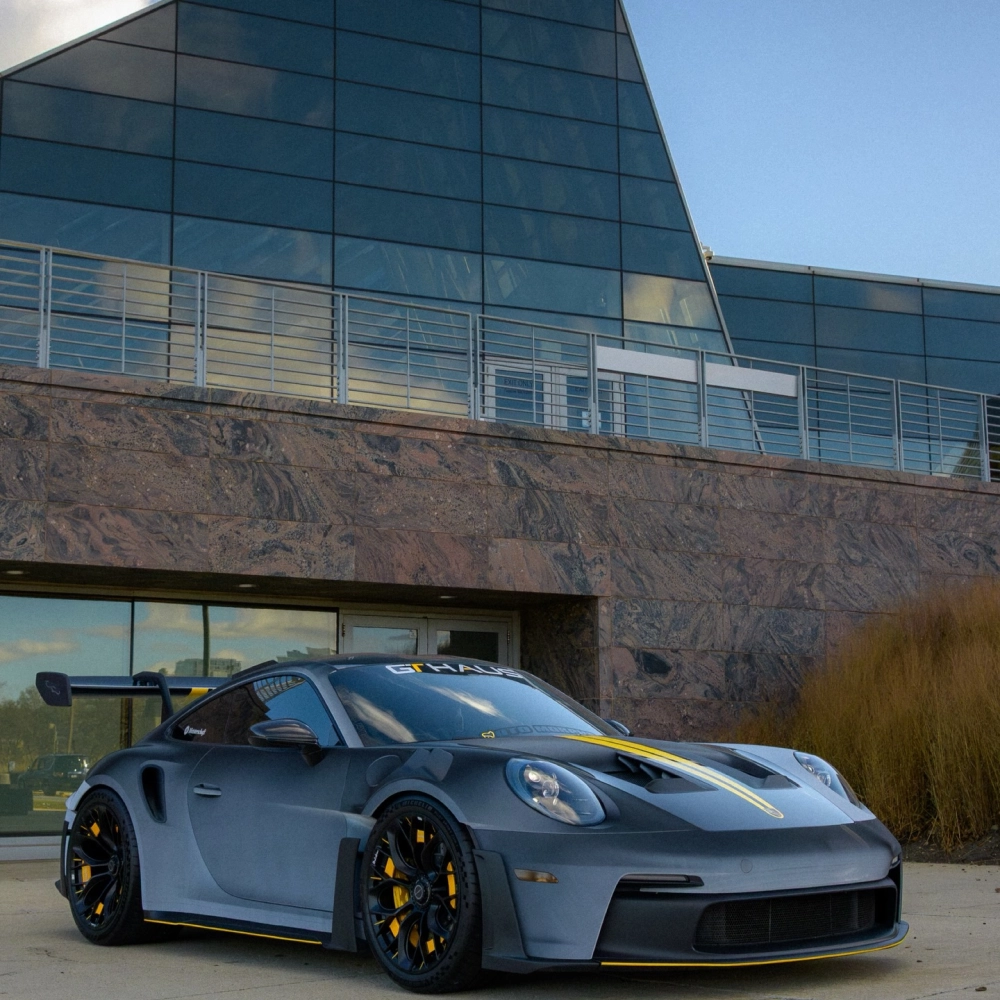
From the front, the lighter portion can preserve the visual separation between the GT3 RS’s hood vents, headlights and dark aerodynamic components.
The contrast is particularly effective because the GT3 RS already uses extensive black aerodynamic detailing.
Side profile
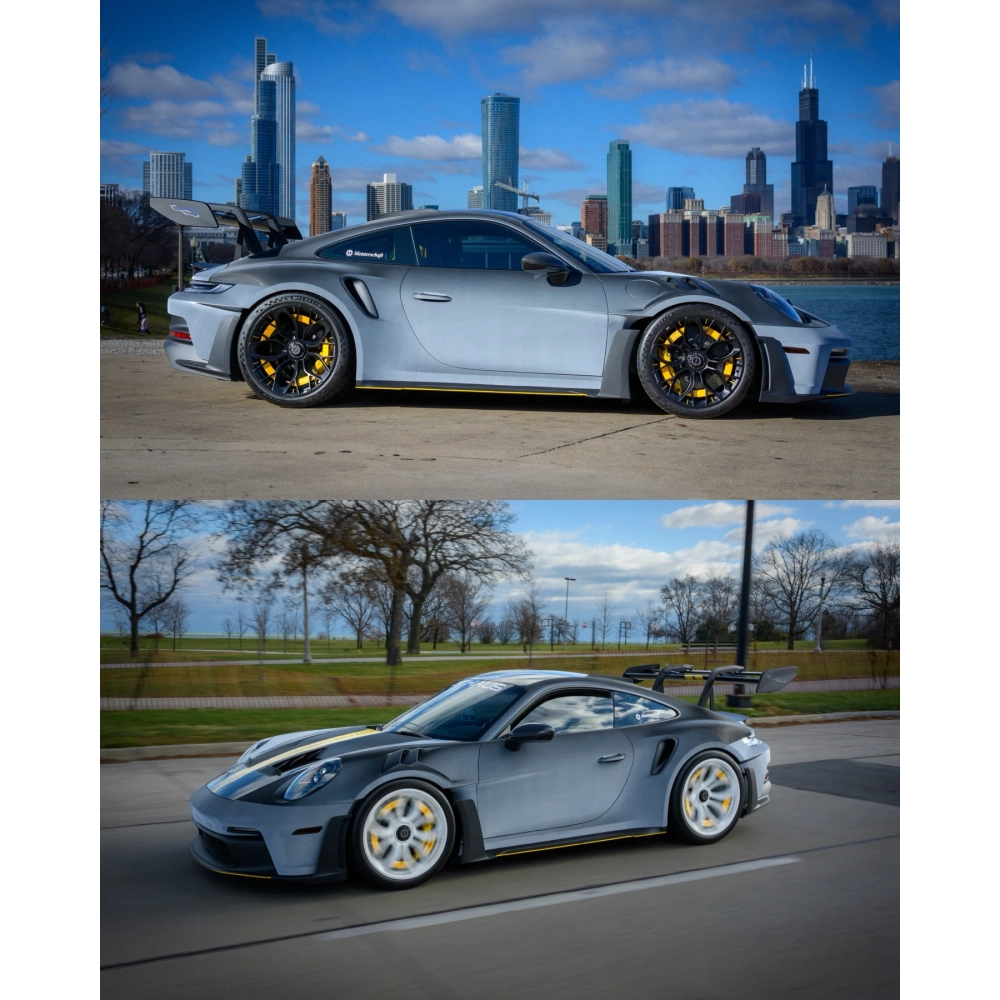
The side profile is arguably the most important photograph for this film because it reveals whether the gradient flows naturally with the 911’s silhouette.
Installers should plan panel orientation before cutting. A gradient film is less forgiving than a solid color because reversing or misaligning material on a door or quarter panel can interrupt the transition.
Rear three-quarter view
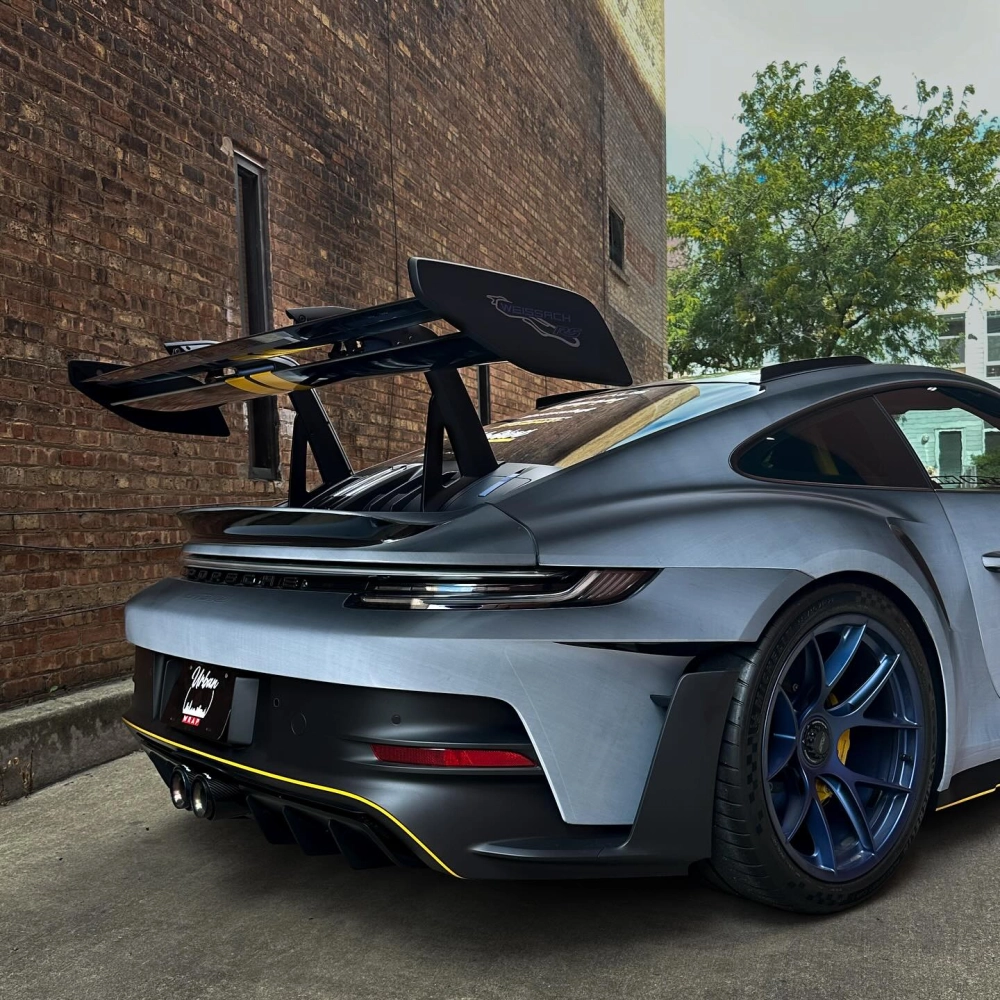
Recommended image: darker Eclipse Black section dominating the rear quarter, bumper and wing area.
At the rear, Eclipse Black can visually integrate the diffuser, vents and wing assembly into a darker overall appearance.
Low front angle
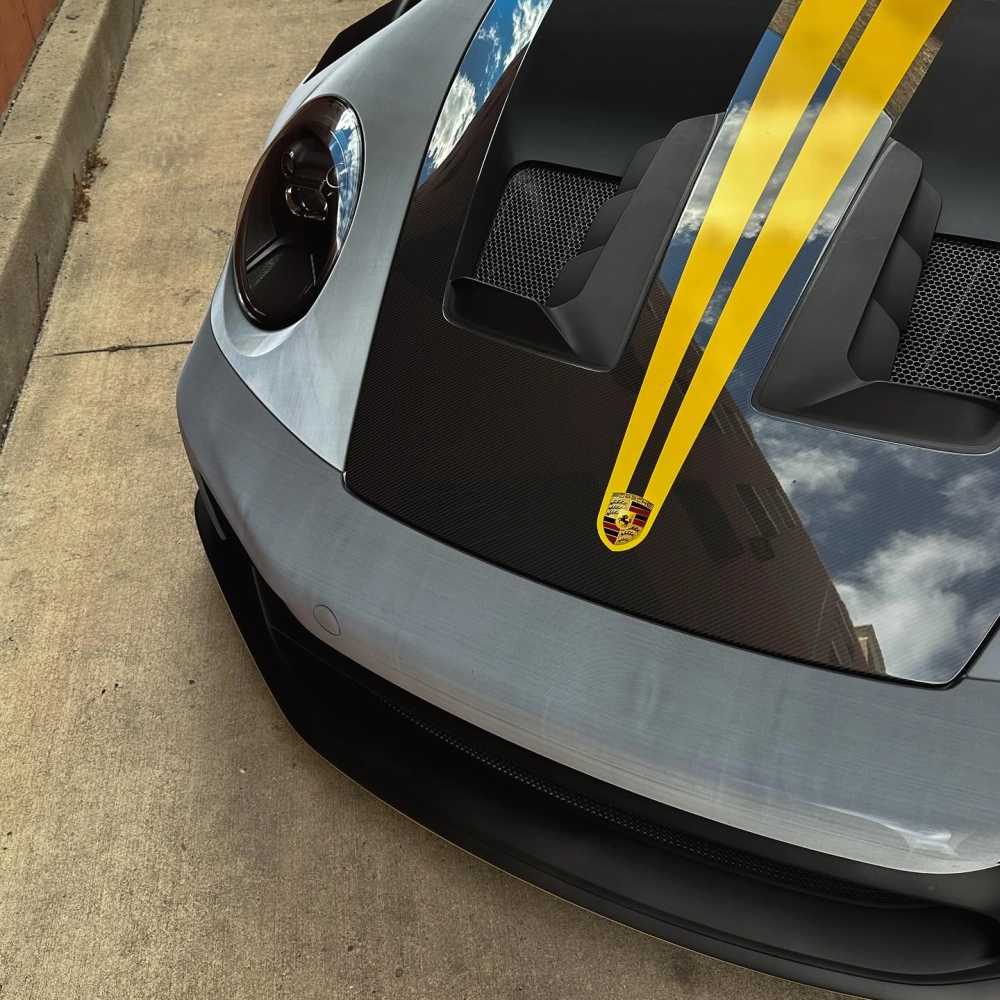
A low-angle photograph is particularly useful for showing how ambient light changes the perceived gradient. Customers evaluating this type of film should always examine outdoor photos as well as studio photography before choosing it.
Reference images above illustrate the complex body geometry and viewing angles of the 992 GT3 RS; they are not presented as photographs of the ALUKO Eclipse Black film.
Technical Check: What Do the Published Numbers Actually Tell Us?
Rather than simply calling a product “premium TPU,” it is more useful to examine measurable specifications.
ALUKO currently publishes the following values for tpu eclipse black color ppf:
| Published Specification | ALUKO Eclipse Black |
|---|---|
| Material family | TPU |
| Finish | Satin |
| Effect | White-to-Eclipse-Black gradient |
| Application | Dry |
| Application temperature | +15°C to +40°C |
| Breaking strength / elongation | >200% |
| Adhesive | Acrylic-based, repositionable/slideable |
| Initial tack | 903 g/25 mm |
| Peel strength | 4.5 N/25 mm |
| Holding power | 75.09 h |
| Release force | 0.13 N/25 mm |
| Published expected durability | 1 year |
| Aftercare | pH-neutral; avoid wax/solvents |
Source: ALUKO’s currently published product specifications.
The >200% elongation figure is particularly relevant because highly contoured vehicles require substantial conformability.
For perspective, Avery Dennison’s published Supreme Defense PPF data lists >200% elongation, while 3M reports 290% elongation at break for Scotchgard PPF Pro Series 200 Matte. These are not direct laboratory comparisons—the films, test methods and intended products differ—but they provide useful reference points for what established manufacturers publicly disclose.
ALUKO vs TeckWrap vs Tinybot vs INOZETEK: What Are You Actually Comparing?
One of the biggest mistakes in online wrap comparisons is putting every color-changing film into the same category.
They are not necessarily equivalent.
| Brand | Relevant Market Position | Material / Product Type Considered | Color Customization | Protection Focus | Key Point |
| ALUKO | Colored TPU / vehicle restyling | Eclipse Black TPU Color PPF | White → black gradient | Yes | Combines color transformation with TPU PPF concept |
| TeckWrap | Color-change wrap specialist | Color Shift Vinyl Wrap | Extensive color-shift choices | Primarily cosmetic wrap | Strong choice for dramatic vinyl color changes |
| Tinybot | Specialty automotive wrap | Color-change / specialty wraps | Broad styling focus | Primarily restyling | Alternative for visual customization |
| INOZETEK | Premium restyling + PPF | SuperGloss plus INOCOLOR PPF ranges | 200+ finishes advertised | Depends on series | Offers both vinyl and dedicated color-PPF categories |
| 3M | Global film manufacturer | Scotchgard PPF Pro Series 200 | Primarily protection-oriented | Strong | Extensive published technical documentation |
| Avery Dennison | Global graphics/film manufacturer | Supreme Defense PPF | Clear/protection-focused references | Strong | Detailed technical data and installer ecosystem |
| XPEL | PPF-focused brand | COLOR PPF / Ultimate series | Dedicated color PPF available | Strong | Established PPF product and installer ecosystem |
This distinction is important.
TeckWrap’s Color Shift collection currently emphasizes cosmetic color-shifting vinyl, with pearl and multi-tone finishes. Its role is therefore closer to traditional color-change wrapping than a direct specification-for-specification competitor to TPU PPF.
INOZETEK USA, meanwhile, now lists both conventional SuperGloss products and INOCOLOR Gloss/Satin Color PPF categories. Its published SuperGloss specifications show approximately 3.7–4.1 mil face-film thickness plus 1.6 mil adhesive, a PET liner and dry application.
Tinybot is another useful reference for buyers researching specialty vehicle finishes, although buyers should compare the technical sheet of the exact product rather than assuming all visually similar films have identical TPU construction or protective performance.
That is the more meaningful question:
Are you buying primarily a color-changing wrap, or are you buying a protective film that also changes the vehicle’s color?
How Does It Compare With Established PPF Technology?
For a technical benchmark, 3M, Avery Dennison and XPEL are more useful references than vinyl-only products.
3M Scotchgard Paint Protection Film Pro Series 200 Gloss is designed for protection against stone chips, scratches, bug damage, road tar, staining and outdoor exposure. 3M also documents polyurethane construction, acrylic pressure-sensitive adhesive, hydrophobic characteristics and heat-assisted self-healing of minor surface marks.
For its Matte version, 3M publishes a film-with-adhesive thickness of 7.9 mil (0.20 mm), 290% elongation at break and an installation temperature of 60–85°F (16–30°C).
Avery Dennison Supreme Defense PPF publishes a 6.5-mil face film plus 1.5-mil adhesive, >200% elongation and measured adhesion values.
XPEL technical specifications also provide separate technical documentation for COLOR PPF Gloss, COLOR PPF Satin, ULTIMATE FUSION, ULTIMATE PLUS and STEALTH films.
These references illustrate an important EEAT principle: TPU alone does not prove identical protection performance.
Film thickness, topcoat chemistry, adhesive behavior, weathering, stain resistance, elongation, installation method and warranty all matter.
Advantages of TPU Eclipse Black Color PPF
1. A genuinely unusual visual effect
The biggest reason to choose Eclipse Black is not that black is rare—it obviously isn’t.
The unusual feature is the controlled transition from a lighter white appearance into deep black.
On cars with long or highly sculpted profiles, this can produce a much more dimensional result than a uniform finish.
2. TPU construction rather than cosmetic-only vinyl
For owners already considering PPF, a colored TPU film can eliminate the need to choose between leaving transparent protection over the original color and changing the appearance with conventional car wrap material.
3. More than 200% published elongation
ALUKO’s >200% figure indicates substantial flexibility, which matters around GT3 RS fenders, bumpers and aerodynamic surfaces.
4. Repositionable acrylic adhesive
The published adhesive specification describes the film as repositionable and slideable, potentially helping installers manage large panels before final adhesion.
5. Hydrophobic and self-healing surface characteristics
These features can make routine maintenance easier and reduce the visibility of light surface marks. However, “self-healing” should not be interpreted as repairing deep cuts, punctures or severe stone impacts.
Limitations Buyers Should Know Before Ordering
The disadvantages deserve equal attention.
First, gradient installation requires more planning. A solid-color film can often be rotated or repositioned without dramatically changing the finished appearance. Directional gradient material cannot.
Second, complex cars increase installation difficulty. The GT3 RS has vents, compound curves, exposed aerodynamic elements and a large rear wing. Installer experience becomes especially important.
Third, published durability matters. ALUKO currently states an expected durability of one year for this specific Eclipse Black product. That is significantly different from assuming the long warranties associated with some established clear PPF systems automatically apply to every colored TPU film.
Fourth, TPU PPF is not damage-proof. It is a sacrificial surface layer, not armor. Severe impacts can penetrate the film.
Finally, repair matching can be more complicated. If one body panel needs replacement film later, the installer must reproduce the original gradient direction and position.
Which Cars Suit Eclipse Black Best?
The effect tends to work best on vehicles with strong body lines and enough uninterrupted panel area for the gradient to develop.
Porsche 911 GT3 / GT3 RS: Probably one of the strongest combinations. White areas emphasize the front geometry while Eclipse Black can visually merge into the rear aero package.
Porsche Taycan: Its long, smooth side surfaces provide a large canvas for a gradual transition.
Chevrolet Corvette C8: Mid-engine proportions and large side surfaces make front-to-rear gradients visually obvious.
BMW M3 / M4: The long hood and muscular rear quarter panels provide natural transition zones.
Tesla Model 3 / Model S: Minimal exterior ornamentation means the color itself becomes the dominant design feature.
For small vehicles with many short panels, the effect may feel more fragmented, so a conventional solid-color film can sometimes look cleaner.
What Should a Professional Installer Check?
Color PPF should not be approached exactly like ordinary PVC wrapping.
Before installation, the shop should inspect paint condition, repainted panels, stone chips, contamination and previous repair work. Film does not hide poor substrate preparation; in some lighting it can make defects more visible.
For a GT3 RS specifically, installer and owner should agree on:
- where the white-to-black transition begins and ends;
- gradient direction across both sides;
- treatment of hood and fender vents;
- whether the rear wing is wrapped;
- seam locations;
- edge wrapping versus visible cuts;
- removal of badges and trim;
- replacement-film strategy if a panel is damaged later.
ALUKO specifies a +15°C to +40°C application range for Eclipse Black. After installation, maintenance guidance calls for pH-neutral cleaning and avoiding waxes or solvents.
Finding a PPF Installer in the United States
For a specialty film like this, installer capability may matter as much as material selection.
In Southern California, examples of shops currently listing wrap and/or PPF services include Elevated Auto Concepts in Pasadena, which focuses on vehicle wraps and PPF; Master Protection Films in West Los Angeles, which lists clear and specialty/color PPF work; Motorsport Wraps in Monrovia, which offers vehicle wraps and PPF; and PPF Pros in North Hollywood, which works with established PPF brands.
These shops are examples of U.S. installers found in current local listings, not a claim that they are authorized ALUKO installers or that they currently stock Eclipse Black. Contact the shop first and ask whether it will install customer-supplied color TPU PPF.
For an unusual gradient film, request examples of previous full-body PPF work—ideally on Porsche, Ferrari, Lamborghini or similarly complex vehicles—before selecting an installer.
TPU Eclipse Black PPF vs Traditional Vinyl: Which Makes More Sense?
Choose conventional vinyl wrap when your priority is primarily changing color, experimenting with finishes or achieving a restyle without making PPF-style protection the central requirement.
Consider TPU Eclipse Black when you specifically want the white-to-black gradient appearance plus the characteristics of a TPU protective film.
The choice should therefore be based on the job rather than on the assumption that one material category is universally superior.
For a leased vehicle that will change appearance frequently, conventional vinyl may make more economic sense.
For a Porsche owner specifically seeking a rare gradient finish while adding a sacrificial protective surface over expensive paint, colored TPU PPF is the more relevant category.
FAQ
Is TPU Eclipse Black Color PPF actually black?
Not entirely. Its defining feature is a white-to-Eclipse-Black gradient rather than a uniform black finish. The perceived transition can also change with panel orientation, viewing angle and lighting.
Is TPU Eclipse Black the same as vinyl wrap?
No. Conventional automotive vinyl is generally used primarily for cosmetic color changes. Eclipse Black is positioned as TPU-based colored PPF, combining a visual change with paint-protection characteristics.
Does self-healing PPF repair rock chips?
No. Self-healing technology generally addresses light surface scratches and marks in the film’s topcoat. It should not be interpreted as the ability to regenerate after deep cuts or severe impact damage. 3M similarly describes self-healing in terms of minor scratches or marks when heat is applied.
How long does ALUKO Eclipse Black last?
ALUKO’s current product specification lists one year expected durability. Actual service life can vary with climate, UV exposure, storage, installation quality, maintenance and driving conditions.
Is it suitable for a Porsche 911 GT3 RS?
Visually, yes. The GT3 RS is especially suitable because its long side profile, wide rear quarters, contrasting aerodynamic elements and dramatic wing give the gradient multiple surfaces on which to develop. Installation, however, should be performed by a shop experienced with complex PPF applications.
Final Verdict: A Specialty Finish, Not a Universal PPF Replacement
TPU Eclipse Black Color PPF makes the most sense when its unusual appearance is the primary reason for choosing it.
Its white-to-black transition can transform a Porsche 911 GT3 RS in a way that ordinary gloss black, satin black or white film cannot. Published specifications such as >200% elongation, acrylic repositionable adhesive, 4.5 N/25 mm peel strength and TPU construction also provide more useful technical information than appearance photographs alone.
At the same time, buyers should keep the comparison fair.
3M, Avery Dennison and XPEL publish extensive PPF technical documentation, while TeckWrap, Tinybot and INOZETEK cover different combinations of vinyl restyling and protective films. A dramatic finish does not automatically mean identical longevity or laboratory performance.
For that reason, the best buying process is simple: compare the exact film construction, published test data, warranty or expected durability, installer experience and desired appearance—not just the brand name.
For a standard daily driver, a conventional solid-color wrap or clear PPF may remain the more practical choice.
For a Porsche 911 GT3 RS build where the objective is to make the body appear to transition from light to darkness as the viewing angle changes, Eclipse Black occupies a much more distinctive niche.
Research date: August 2026. Product specifications should be rechecked before purchase because manufacturers may revise formulations, specifications and warranty terms.