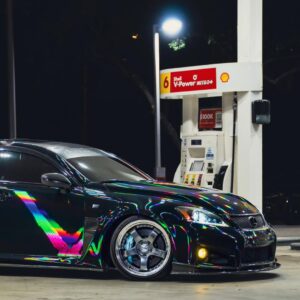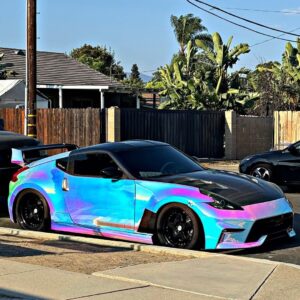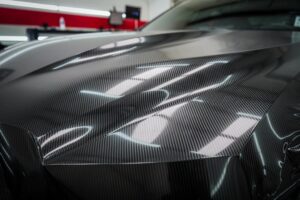

Transparent carbon fiber PPF is a TPU-based paint protection film featuring a visible carbon-fiber-inspired pattern that allows some of the underlying paint color to show through. It combines decorative styling with a protective film layer, making it suitable for hoods, roofs, mirrors, spoilers, rocker panels, and full-body applications. However, transparency, weave visibility, and protection depend on the specific product.
A transparent carbon fiber finish can look dramatically different on a black BMW, silver Porsche, or red Chevrolet Corvette. It also introduces questions that ordinary clear PPF buyers rarely face: Will the original paint remain visible? Can the weave distort around curved panels? Should the entire car be covered, or only selected sections?
This guide examines those decisions using published manufacturer specifications, automotive PPF technical references, and practical installation considerations.
Editorial disclosure: ALUKOVINYL manufactures and sells automotive films, including transparent carbon fiber PPF. Product-specific specifications are manufacturer-reported unless otherwise stated. The vehicle examples below are proposed applications, not claims of completed installations or independently tested results.
What Is Transparent Carbon Fiber PPF?
Transparent carbon fiber PPF is a decorative paint protection film that combines a carbon-fiber-inspired visual pattern with a partially transparent appearance.
Unlike conventional opaque carbon fiber vinyl, transparent carbon fiber PPF allows the underlying vehicle color to influence the final appearance.
For example:
- On black paint, the weave may appear darker and more subtle.
- On silver paint, the pattern may create stronger visual contrast.
- On red paint, the underlying color can remain visible between patterned areas.
- On white paint, the carbon pattern may become especially noticeable.
Actual results depend on film transparency, pattern density, finish, lighting, and the original paint color.
An important distinction: Transparent carbon fiber PPF does not turn a painted panel into structural carbon fiber. It creates a decorative carbon-fiber appearance over the existing surface.
ALUKOVINYL’s published transparent carbon fiber products use TPU construction and are offered in gloss and matte finishes.
Transparent Carbon Fiber PPF vs. Real Carbon Fiber
These materials are often compared visually, but they serve different purposes.
Real carbon-fiber composite components use reinforcing carbon fibers within a resin system. Their structural properties depend on fiber orientation, resin, layup, and manufacturing processes.
Carbon-fiber-patterned PPF, by comparison, is a surface film.
| Property | Real Carbon Fiber | Transparent Carbon Fiber PPF |
|---|---|---|
| Primary function | Structural or decorative component | Styling and surface protection |
| Construction | Fiber-reinforced composite | TPU-based film with decorative pattern |
| Original paint visible | Usually not applicable | Partially, depending on film |
| Installation | Component replacement or overlay | Applied over compatible surfaces |
| Reversibility | Component-dependent | Potentially removable |
| Adds structural strength | Can, depending on design | No meaningful structural reinforcement |
| Common uses | Hoods, roofs, aero parts | Hoods, roofs, mirrors, spoilers, full body |
Transparent carbon fiber PPF is therefore a practical styling option for owners who want the visual character of carbon fiber without replacing body panels.
It should not be marketed as a substitute for the structural properties of real carbon-fiber components.
Which Car Parts Look Best With Transparent Carbon Fiber PPF?
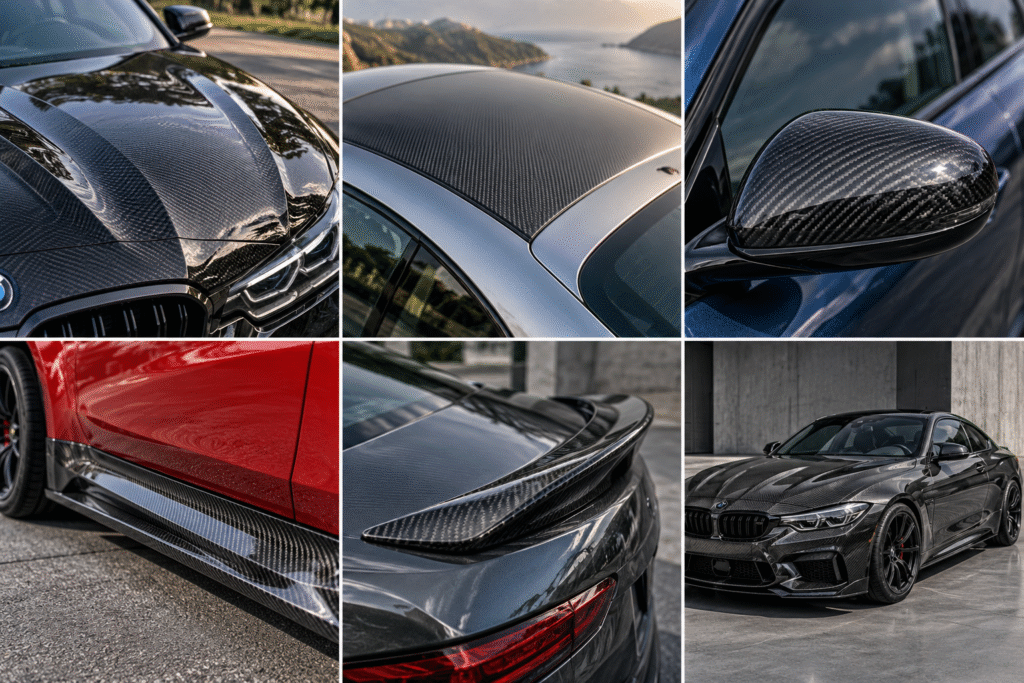
The most useful application depends on three factors: the panel’s visibility, its exposure to road hazards, and how the carbon pattern interacts with its shape.
1. Hood: BMW M3 and M4
The hood is one of the strongest candidates for transparent carbon fiber PPF.
On a BMW M3 or M4, the broad hood surface provides enough space for the weave to become recognizable without excessive visual interruption.
A gloss finish can emphasize reflections and the underlying paint color. Matte carbon fiber PPF can create a more restrained motorsport-inspired appearance.
Installation consideration: BMW hood contours and raised sections may affect weave alignment. The installer should inspect how the pattern changes across sculpted areas before committing to the full panel.
For highway-driven vehicles, the hood is also exposed to airborne debris. A properly engineered protective film may help reduce damage from minor road hazards.
However, buyers should not assume that a decorative carbon pattern provides better impact protection than conventional clear PPF of equivalent construction.
2. Roof: Porsche 911
A Porsche 911 roof offers a different design opportunity.
Applying transparent carbon fiber PPF to the roof creates a strong contrast between the upper body and surrounding painted panels.
This approach can work particularly well on silver, gray, white, or dark blue vehicles.
Why roof applications are interesting:
The roof is a relatively large visual area but usually receives less direct road-debris impact than the front bumper.
This makes roof applications primarily a styling decision.
The main challenge is maintaining consistent weave orientation over the roof’s curvature and along the windshield and rear-window edges.
For a Porsche 911, a matte finish may produce a restrained technical appearance, while gloss can better complement highly reflective factory paint.
3. Mirror Caps: Mercedes-AMG C63
Mirror caps are an attractive option for customers who want to experiment with transparent carbon fiber PPF without covering large panels.
On a Mercedes-AMG C63, carbon-patterned mirror caps can complement dark wheels, black trim, and other performance-oriented styling elements.
Because mirror caps are relatively small, they are also suitable for evaluating how the material responds to complex curves.
Professional consideration: Tight compound curves can distort patterned films when stretched. Installers should use controlled tension and avoid excessive heat.
4. Spoiler: Toyota GR Supra
A rear spoiler is another natural location for carbon-fiber-inspired styling.
On a Toyota GR Supra, a transparent carbon fiber PPF spoiler treatment can create a motorsport appearance without requiring replacement of the original component.
However, spoiler geometry matters.
Thin edges, sharp corners, and complex aerodynamic surfaces can make film installation more difficult.
A successful application depends on proper surface preparation, material conformity, and edge finishing.
5. Rocker Panels and Side Skirts: Chevrolet Corvette
Rocker panels and side skirts combine styling potential with practical exposure to road debris.
On a Chevrolet Corvette, transparent carbon fiber PPF can create a visual connection between lower bodywork, wheels, and aerodynamic elements.
These areas may also encounter debris thrown from the tires.
A protective film can serve as a sacrificial layer over the original finish, although its actual impact resistance must be evaluated through product-specific testing.
Key limitation: Lower panels collect dirt, road salt, and contamination. Maintenance and edge inspection become especially important.
Full-Body Transparent Carbon Fiber PPF: Is It a Good Idea?
A full-body transparent carbon fiber PPF installation creates a substantially different result from applying film to selected panels.
Instead of using carbon fiber as an accent, the pattern becomes the dominant visual characteristic of the entire vehicle.
Consider a black BMW M4 or Nissan GT-R.
With a full-body application, the weave may remain relatively subtle in shaded areas while becoming more noticeable under direct lighting.
On a white or silver vehicle, the same material could produce a much more prominent patterned appearance.
Advantages of Full-Body Installation
Visual consistency: A coordinated application can create a unified appearance across the vehicle.
Broad surface coverage: More painted panels receive a protective film layer.
Distinctive styling: Full-body carbon-fiber-inspired finishes are less conventional than standard solid-color wraps.
Disadvantages of Full-Body Installation
Higher material consumption: Full-body coverage requires significantly more material than a hood, roof, or mirror-cap project.
Pattern alignment: Adjacent panels may reveal changes in weave direction.
More installation complexity: Bumpers, door handles, fenders, and deep recesses require careful handling.
Repair matching: Replacing one damaged panel may introduce differences in pattern orientation or production batch.
Stronger visual commitment: A carbon pattern across every body panel can be overwhelming for customers who prefer understated styling.
Our Editorial Assessment
For many owners, a partial installation is the more balanced starting point.
A hood, roof, mirror-cap, or spoiler treatment can provide a recognizable carbon-fiber appearance without making the entire vehicle visually busy.
Full-body transparent carbon fiber PPF makes more sense for a dedicated show build or a customer who specifically wants the pattern to dominate the vehicle’s appearance.
This is a design recommendation, not a claim that partial installations are mechanically superior.
Gloss vs. Matte Transparent Carbon Fiber PPF
Finish selection affects how the carbon pattern interacts with reflected light.
Gloss Transparent Carbon Fiber PPF
Gloss finishes produce stronger reflections and can emphasize the visual depth of the weave.
They are especially suitable for customers who want a polished, high-contrast appearance.
Gloss may work well on:
- BMW M4 hoods
- Porsche 911 roof panels
- Mercedes-AMG mirror caps
- Chevrolet Corvette spoilers
Explore ALUKOVINYL’s gloss transparent carbon fiber ppf for product-specific information.
Matte Transparent Carbon Fiber PPF
Matte finishes scatter reflected light, creating a softer and more understated appearance.
This can make the pattern look less reflective while retaining its woven visual character.
Matte may work well on:
- Porsche 911 roofs
- Nissan GT-R hoods
- BMW M3 side accents
- Performance SUV trim
Explore matte transparent carbon fiber ppf for the corresponding finish.
Gloss vs. Matte Comparison
| Feature | Gloss | Matte |
|---|---|---|
| Reflections | Stronger | Softer |
| Visual depth | More pronounced | More subdued |
| Appearance | Polished, sporty | Technical, understated |
| Fingerprints | May be more noticeable | Depends on coating |
| Cleaning | Standard compatible PPF care | Matte-compatible care |
| Best styling use | High-contrast accents | Stealth-inspired accents |
Neither finish is universally better.
The most reliable approach is to compare physical samples on the vehicle under sunlight, shade, and artificial lighting.
What Do Technical Specifications Actually Tell Us?
ALUKOVINYL publishes specifications for its gloss and matte transparent carbon fiber PPF products.
The currently listed specifications include:
| Specification | ALUKOVINYL Published Value |
|---|---|
| Base film | TPU |
| Nominal thickness | 7.5 mil ±3% |
| Tensile strength | 22.32 MPa |
| Elongation at break | 370.23% |
| Application temperature | 15–40°C |
| UV resistance claim | 98.5% |
| Published expected durability | 5–7 years |
| Available finishes | Gloss and matte |
These values are manufacturer-reported and should not be interpreted as independently verified laboratory results.
For reference, 7.5 mil is approximately 0.1905 mm.
Thickness alone does not establish protection quality.
A film’s performance also depends on the TPU formulation, top coat, adhesive, environmental exposure, and installation quality.
For a broader comparison of TPU-based automotive film options, visit the tpu wrap collection.
What Can We Learn From 3M’s Published PPF Testing?
3M provides a useful technical benchmark because it publishes detailed specifications for certain automotive PPF products.
Its June 2025 Series 150 Gloss product bulletin reports:
- Film and adhesive thickness: 0.19 mm
- Elongation at break: 400%
- Tensile strength: 17.2 MPa
- Initial adhesion after 20 minutes: 6.6 N/cm
- Final adhesion after 24 hours: 7.9 N/cm
3M also describes the product as a transparent polyurethane film designed for automotive paint protection.
These figures are valuable because they show the types of measurements professional buyers can request when comparing PPF products.
However, the comparison has important limitations.
3M Series 150 Gloss is a conventional clear PPF, not a transparent carbon-fiber-patterned film.
Its specifications cannot establish that ALUKOVINYL carbon fiber PPF performs better or worse in stone-chip resistance, optical stability, or long-term wear.
Tensile strength and elongation alone are insufficient to rank overall PPF performance.
For a meaningful comparison, the products would need testing under equivalent methods and conditions.
ALUKOVINYL vs. 3M, TeckWrap and Tinybot
Several automotive film brands offer relevant comparison points, although their products are not necessarily direct substitutes.
| Brand | Relevant Product Category | Published Positioning | Main Limitation of Comparison |
|---|---|---|---|
| ALUKOVINYL | Transparent carbon fiber TPU PPF | Gloss/matte decorative PPF | Product-specific independent testing not established |
| 3M | Series 150 clear PPF | Transparent paint protection | No carbon-fiber pattern |
| TeckWrap | Carbon Fiber Color PPF | Carbon styling with protective film | Different designs and specifications |
| Tinybot | Carbon Fiber PPF | Decorative carbon-inspired finishes | Product-by-product specifications vary |
| INOZETEK | Automotive styling films | Premium appearance customization | Not all products are TPU carbon PPF |
TeckWrap’s Carbon Fiber PPF collection includes a Gloss Sable Carbon product advertised from $249, but the starting price should not be treated as a comparable full-roll price without confirming the selected size.
Tinybot lists multiple carbon-fiber-inspired products, including Gloss 6D Carbon Fiber PPF and other carbon finishes. Buyers should verify construction, application method, and dimensions before comparing them with ALUKOVINYL.
For 3M and INOZETEK, directly comparable public full-roll prices were not established for the exact same product category and dimensions.
A fair price comparison requires identical roll dimensions, currency, film construction, and purchase conditions.
A lower advertised starting price does not necessarily indicate better value.
Transparent Carbon Fiber PPF vs. Carbon Fiber Vinyl Wrap
Traditional carbon fiber vinyl and transparent carbon fiber PPF are related in appearance but different in intended function.
| Factor | Carbon Fiber Vinyl | Transparent Carbon Fiber PPF |
|---|---|---|
| Primary purpose | Decorative styling | Styling and protection |
| Common material | PVC-based vinyl | TPU-based film |
| Original paint visibility | Usually covered | Partially visible |
| Stone-chip protection | Limited | Protective-film function |
| Self-healing | Not generally standard | Depends on top coat |
| Pattern choices | Very broad | Product-dependent |
| Cost | Often lower | Often higher |
For custom graphics, frequent style changes, and cost-sensitive projects, a conventional car wrap may be the more appropriate solution.
For buyers who specifically want a protective TPU film with a carbon-fiber-inspired appearance, transparent carbon fiber PPF offers a different balance of features.
Installation Challenges Professionals Should Consider
A carbon-fiber-patterned film requires more than good adhesion.
The installer must also preserve the visual consistency of the pattern.
Pattern Direction
The weave should be planned before cutting panels.
Adjacent sections with inconsistent orientation can appear mismatched even when the material comes from the same roll.
Stretch Distortion
Stretching may change the apparent spacing or angle of the carbon pattern.
This is particularly relevant around mirror caps, bumper corners, and recessed sections.
Substrate Condition
Transparent film can reveal underlying paint defects.
Scratches, paint chips, inconsistent repainting, and surface contamination should be assessed before installation.
Application Method
ALUKOVINYL’s transparent carbon fiber product pages list wet application specifications. Installers should follow the instructions for the exact film supplied rather than assuming all TPU products use identical installation methods.
Edge Management
Edges and seams can be more visible on patterned films than on conventional clear PPF.
Planning seam positions and reducing unnecessary tension can improve the finished appearance.
Repair Planning
Retaining material from the original production batch may help with future panel repairs, although it does not guarantee an invisible match.
Pros and Cons of Transparent Carbon Fiber PPF
Advantages
- Creates a carbon-fiber-inspired appearance without replacing body panels.
- Allows some original paint color to remain visible.
- Offers gloss and matte styling options.
- Can be applied to individual panels or entire vehicles.
- Uses TPU protective-film construction.
- May provide self-healing and hydrophobic properties where supported by the specific product.
- Offers a different styling approach from opaque carbon fiber vinyl.
Disadvantages
- More expensive than many conventional decorative vinyl wraps.
- Pattern alignment increases installation complexity.
- Stretching may distort the carbon weave.
- Underlying paint defects can remain visible.
- Full-body applications require substantial material and labor.
- Damaged-panel replacement may produce pattern or batch differences.
- Carbon-patterned film does not provide structural carbon-fiber strength.
- Manufacturer claims do not replace independent durability or impact testing.
How to Maintain Transparent Carbon Fiber PPF
Maintenance should follow the specific manufacturer’s instructions.
General precautions include using pH-neutral automotive shampoo, avoiding harsh solvents, and cleaning bird droppings or insect contamination promptly.
Do not direct high-pressure water aggressively toward exposed film edges.
For matte finishes, avoid products designed to create a glossy shine unless the manufacturer explicitly approves them.
Regularly inspect complex areas such as mirrors, bumper corners, and rocker-panel edges for lifting or contamination.
Self-healing claims should also be interpreted carefully. Minor top-coat marks may recover with suitable heat, but deep scratches, cuts, and punctures generally require repair or replacement.
Frequently Asked Questions
Is transparent carbon fiber PPF actually transparent?
It is partially transparent rather than completely invisible. The carbon-fiber-inspired pattern remains visible while allowing some underlying paint color to influence the final appearance.
Does transparent carbon fiber PPF protect paint?
It is designed as a protective film, but the degree of protection depends on construction and verified performance. No PPF makes automotive paint damage-proof.
Is transparent carbon fiber PPF real carbon fiber?
No. It is a decorative film with a carbon-fiber-inspired pattern, not a structural carbon-fiber composite.
Can I apply transparent carbon fiber PPF to the whole car?
Yes, provided the film is suitable for the relevant painted surfaces and professionally installed. Full-body applications require careful planning for pattern alignment, material quantity, and complex curves.
Is gloss or matte better for a black car?
Gloss generally produces stronger reflections and visual depth. Matte creates a softer, more restrained appearance. Physical samples are the best way to compare them.
Can transparent carbon fiber PPF be removed?
PPF is generally designed to be removable under appropriate conditions, but safe removal depends on adhesive condition, paint quality, age, and removal technique. Repainted or damaged surfaces may present additional risks.
How long does transparent carbon fiber PPF last?
ALUKOVINYL lists an expected durability range of 5–7 years for its gloss and matte transparent carbon fiber products. This is a manufacturer expectation, not a verified guarantee for every climate or installation. Actual performance can vary.
Is it better to wrap the hood or the entire vehicle?
For many customers, hood or roof coverage offers a more controlled styling change and lower material consumption. Full-body installation is better suited to customers seeking a highly distinctive, uniform carbon-inspired appearance.
Final Verdict: Choose the Right Coverage Before Choosing the Finish
Transparent carbon fiber PPF is most compelling when the application is chosen deliberately.
A BMW M4 hood can highlight the weave across a broad sculpted panel. A Porsche 911 roof can create a technical contrast. Mercedes-AMG mirror caps and Toyota GR Supra spoilers offer smaller, more targeted styling opportunities.
A full-body application creates the strongest visual transformation, but also introduces greater cost, installation complexity, and repair-matching considerations.
Our recommendation is to begin with the intended vehicle panels, evaluate physical samples over the actual paint color, and then choose gloss or matte.
ALUKOVINYL offers transparent carbon fiber PPF for customers seeking a combination of decorative carbon styling and TPU protective-film construction. Buyers who prefer a solid-color protective appearance can also explore our color ppf options.
Before ordering, confirm the correct film, finish, installation method, required roll length, and applicable warranty conditions.
Choose the pattern for its appearance, the film for its documented performance, and the coverage for your actual driving needs.
References and Evidence Classification
3M — Paint Protection Film Series 150 Gloss, Product Bulletin, June 2025. Manufacturer technical documentation. Provides measured properties and installation specifications for a conventional clear PPF benchmark.
3M — Scotchgard Paint Protection Film Pro Series 200. Manufacturer product documentation. Supports general discussion of protective-film technology, self-healing, and application considerations.
ALUKOVINYL — TPU Glossy Transparent Carbon Fiber PPF, TPU024. Manufacturer product specifications. Supports stated thickness, material, tensile strength, elongation, and expected durability.
ALUKOVINYL — TPU Matte Transparent Carbon Fiber PPF, TPU032. Manufacturer product specifications. Supports matte finish and published product characteristics.
TeckWrap — Carbon Fiber PPF Collection. Competitor manufacturer information. Supports product-category and advertised starting-price comparisons, not independent superiority claims.
Tinybot — Carbon Fiber Collection. Competitor product catalogue. Supports availability of alternative carbon-fiber-inspired film designs.
Editorial analysis — Vehicle coverage and finish selection. Reasoned application guidance based on panel geometry, appearance, and installation considerations. Not a substitute for documented installation trials.
Evidence limitations: No independent side-by-side testing of the specific ALUKOVINYL gloss and matte transparent carbon fiber films against 3M, TeckWrap, Tinybot, or INOZETEK is presented here. No original customer installation or long-term field test is claimed.