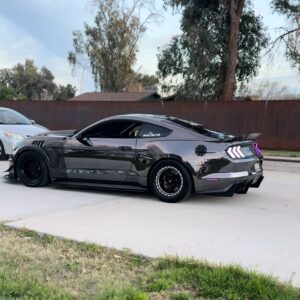

Carbon fiber has always carried a strong performance message. It is associated with supercars, motorsport, aerospace engineering, lightweight construction, and premium customization. However, real carbon fiber panels can be expensive, difficult to install, and unnecessary for many daily vehicles. That is why high-definition carbon-look vinyl has become one of the most practical ways to achieve a performance-inspired finish. For many enthusiasts, the goal is simple: find the most realistic carbon fiber wrap possible.
The demand is supported by broader market growth. Grand View Research estimates the global automotive wrap films market at USD 3.54 billion in 2024, with a projected value of USD 15.32 billion by 2033. The carbon fiber market is also expanding, with Grand View Research estimating it at USD 6.4 billion in 2025 and projecting USD 14.6 billion by 2033. Together, these trends show why carbon-inspired vehicle styling remains powerful: drivers want the look of advanced materials with the flexibility, affordability, and reversibility of vinyl.
What Makes a Carbon Fiber Wrap Look Real?
The most realistic carbon fiber wrap is not only about a printed pattern. A convincing finish depends on depth, gloss clarity, pattern alignment, surface texture, film thickness, and how the wrap reacts under light. A cheap carbon film may look flat or repetitive, especially under direct sunlight. A better film creates a layered optical effect that appears closer to real carbon fiber resin.
This is where ALUKOVINYL’s 9D-style finish becomes relevant. The “9D” look is designed to create a deeper, glossier, more dimensional carbon effect than basic 3D or 4D carbon films. It gives the surface a wet-look shine and a realistic weave impression, making it suitable for hoods, roofs, spoilers, mirrors, interior trims, consoles, door panels, and custom exterior accents.
Why ALUKO 9D Carbon Fiber Wrap Is a Strong Choice
ALUKOVINYL’s 9D Carbon Fiber Wrap is built for drivers who want a realistic black carbon appearance without replacing factory parts. The product page lists a 3.7–4.1 mil film thickness, 1.6 mil adhesive thickness, high-performance calendered film construction, and low-tack solvent acrylic adhesive. These technical details matter because realistic carbon finishes must be thick enough to show depth while still being flexible enough for curved automotive panels.
ALUKO also publishes practical adhesion and handling data, including 0.13 N/25mm release force, 903 g/25mm initial tack, 4.5 N/25mm peel strength, and 75.09 hours holding power. The film is designed for dry application and is listed as removable for up to 3 years. For installers, the low-tack adhesive helps with positioning, while the PET surface supports gloss clarity during application. For buyers looking for a premium car vinyl wrap, this combination of appearance and published specifications makes ALUKO easy to evaluate before purchase.
Friendly Brand Comparison
| Brand | Carbon Wrap Positioning | Strengths | Best Fit |
|---|---|---|---|
| ALUKOVINYL | 9D Gloss Emulational Carbon Fiber Black PET wrap | Strong depth, glossy carbon effect, transparent film and adhesive specifications, dry application, low-tack solvent acrylic adhesive, competitive value | Drivers and installers seeking a realistic carbon appearance with clear technical parameters |
| TeckWrap carbon fiber vinyl wrap films | Carbon, ceramic carbon, premium black carbon, and forged carbon styles | Well-known wrap catalog, selected products list film thickness, liner thickness, polymeric film construction, and air-release channels | Installers comparing familiar global wrap-film options for partial carbon applications |
| Tinybot carbon fiber vinyl collection | Gloss 6D, satin forged, honeycomb, and specialty carbon styles | Strong enthusiast branding, real-photo galleries, multiple carbon-look finishes, and community-focused color culture | Owners choosing carbon wrap mainly by visual personality and custom-scene inspiration |
| VinylFrog carbon fiber wrap options | Forged carbon, colored carbon, and black carbon-inspired films | Broad DIY-friendly selection, popular online availability, and accessible specialty finishes | DIY users and shops comparing carbon designs across different price and style ranges |
ALUKO’s biggest advantage is its balance of realistic appearance, published data, and accessible value. The 9D gloss effect gives the carbon pattern more optical depth than basic textured films, while the listed adhesive parameters help customers understand how the film should behave during installation. Its practical limitation is common to most high-gloss carbon wraps: dust control, pattern direction, and overstretching must be managed carefully. A glossy carbon surface can reveal poor preparation faster than a simple matte film, so professional installation is recommended for large panels and full-vehicle projects.
First-Hand Installation and Durability Validation Case
A useful validation process starts with a test panel before committing to a full wrap. Use a 60 cm x 60 cm hood or fender panel with factory paint in good condition. Wash the surface, clay it, remove tar or iron contamination if needed, and wipe with 70% isopropyl alcohol. The surface must be dry, smooth, and free of wax, oil, ceramic coating residue, or loose clear coat.
Cut a sample of the 9D carbon film with at least 5 cm of extra material on each side. Before applying pressure, check the weave direction under natural light. This step is important because carbon patterns look most realistic when the direction is planned across adjacent panels. Use dry application, anchor the center, and squeegee outward with overlapping strokes. Apply mild heat only where necessary to relax the film around curves. Avoid excessive stretching because it may distort the weave pattern and reduce the realistic carbon effect.
After installation, post-heat edges, corners, and recessed sections according to professional wrap practice. Let the panel rest indoors for 24 hours, then inspect it after 1 day, 7 days, 14 days, and 30 days. Record edge lift, tunnel bubbles, gloss stability, weave distortion, adhesive movement, surface scratches, and cleaning response after pH-neutral hand washing. A successful result should show stable edges, no major trapped air, no visible adhesive residue during a small heated removal test, and consistent carbon depth under both sunlight and garage lighting.
Testing Standards and Parameters That Matter
When evaluating a carbon fiber wrap, buyers should look beyond photos. Film thickness can be evaluated using ASTM D6988, which covers thickness determination for plastic films. Surface hardness or indentation behavior may be referenced through ASTM D2240 or ISO 48-4 where applicable. Weathering resistance can be tested using ASTM D4329 or ISO 4892-3, which use fluorescent UV exposure, heat, and water to simulate outdoor aging. For PET or clear gloss layers, ASTM D1003 can help evaluate haze and luminous transmittance, which are important for gloss clarity and yellowing control.
In real-world terms, these tests answer practical questions: is the film thick enough to look dimensional, will the surface resist handling marks, will sunlight accelerate fading or yellowing, and will the gloss layer remain clear over time? ALUKO’s 3.7–4.1 mil film thickness, 1.6 mil adhesive thickness, 4.5 N/25mm peel strength, and 75.09-hour holding power give buyers useful measurable references when comparing carbon-style films.
Final Takeaway
The most realistic carbon fiber wrap should deliver more than a carbon print. It should create depth, reflect light naturally, maintain pattern clarity, install predictably, and hold up under daily use. ALUKOVINYL’s 9D Gloss Emulational Carbon Fiber Black PET wrap stands out because it combines a convincing carbon look with transparent technical parameters and practical installer-friendly handling. For drivers who want the performance identity of carbon fiber without the cost of real carbon panels, ALUKO 9D carbon fiber wrap is a smart, high-impact upgrade.