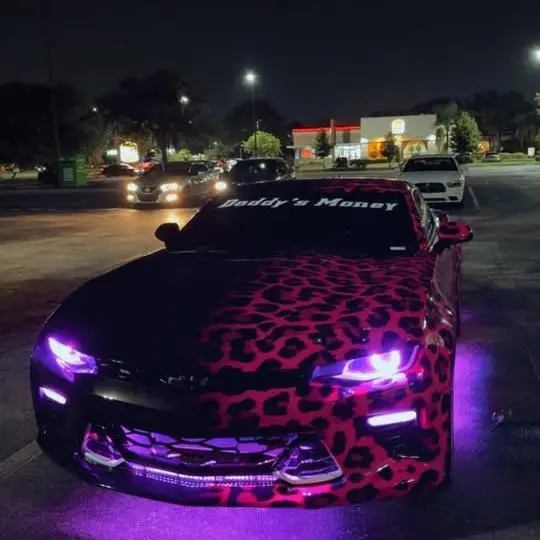
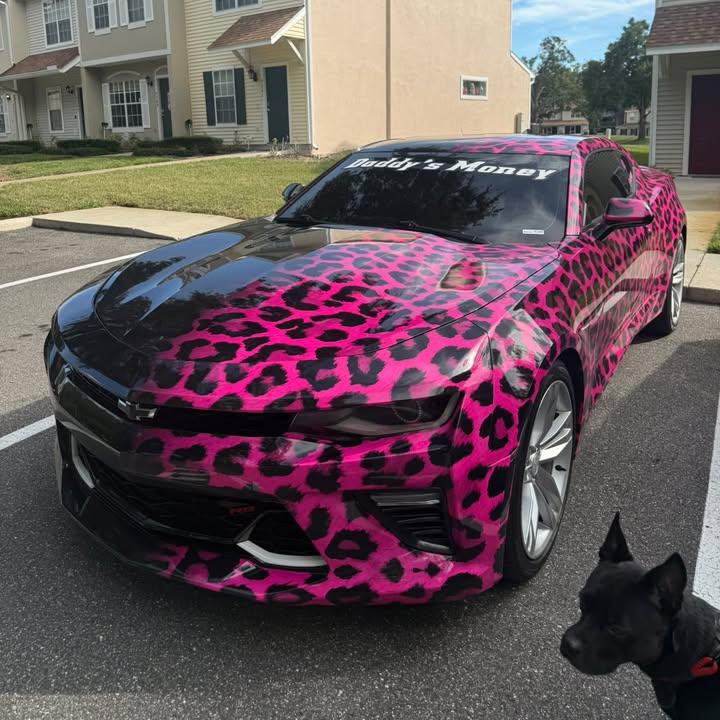
A leopard print wrap is more than a bold automotive trend. It is a way to transform an ordinary vehicle into a distinctive design statement, combining animal-inspired patterns with personalized colors, finishes, and graphic placement.
From classic brown leopard spots to pink-and-black gradients, modern leopard print car wraps offer possibilities that traditional single-color vinyl cannot achieve. However, choosing the right pattern scale, vehicle coverage, and installation method makes the difference between a stylish custom build and a visually overwhelming result.
Whether you drive a BMW coupe, a Tesla Model 3, or a Jeep Wrangler, this guide explores the best leopard print wrap styles, suitable vehicles, material considerations, advantages, disadvantages, and practical design decisions.
What Is a Leopard Print Wrap?
A leopard print wrap is a decorative automotive vinyl film featuring leopard-inspired spots or animal patterns. It can cover an entire vehicle or selected panels, including the hood, roof, doors, and mirrors. Available in traditional, colorful, and custom-printed designs, leopard print vinyl wraps offer a removable alternative to permanent custom paintwork on suitable vehicle surfaces.
Unlike standard solid-color vinyl, leopard print designs rely on the relationship between background color, spot shape, pattern density, and vehicle body lines.
For example, a beige-and-black leopard design can create a classic fashion-inspired appearance, while a pink gradient with black spots delivers a more dramatic, contemporary aesthetic.
The flexibility of custom printing also means that the pattern can be adjusted to suit individual preferences rather than being limited to a single ready-made design.
Why Are Leopard Print Car Wraps So Distinctive?
Animal print has long been associated with expressive fashion, individuality, and statement styling. Applied to automotive design, leopard patterns introduce visual movement and contrast that traditional colors cannot replicate.
However, the appeal of a leopard print wrap depends on more than simply covering a vehicle with spots.
Three design factors are especially important.
1. Pattern Scale Changes the Vehicle’s Appearance
Large leopard spots create a bold graphic effect that is easier to recognize from a distance.
Smaller spots produce a more detailed texture, especially on compact vehicles and curved panels.
For a large SUV, oversized patterns can prevent the design from looking excessively busy. On a small sports coupe, medium-sized spots may provide better visual balance.
2. Color Contrast Determines Visual Impact
Traditional leopard patterns usually combine warm neutral backgrounds with dark spots.
Modern designs can use almost any color combination, including pink, purple, white, silver, or black.
Higher contrast makes the pattern more noticeable, while lower contrast produces a more understated appearance.
3. Placement Can Enhance Body Lines
A leopard pattern does not need to cover every exterior panel.
Strategic placement on the hood, roof, rear quarter panels, or lower doors can highlight the vehicle’s proportions.
For drivers who prefer a more restrained look, combining leopard graphics with a solid-color car wrap can create a more balanced design.
6 Leopard Print Wrap Styles Worth Considering
Not every leopard print vehicle wrap creates the same visual impression. The following six styles offer different approaches to color, pattern, and overall appearance.
1. Classic Brown Leopard Print Wrap
The traditional combination of tan, caramel, brown, and black is one of the most recognizable animal print designs.
Its warm color palette creates a distinctive fashion-inspired appearance without relying on fluorescent colors or dramatic gradients.
Best suited for: Jeep Wrangler, MINI Cooper, Volkswagen Beetle, and compact SUVs.
Design recommendation: Choose medium-sized spots with a warm beige background. Matte or satin-style finishes can create a softer visual effect.
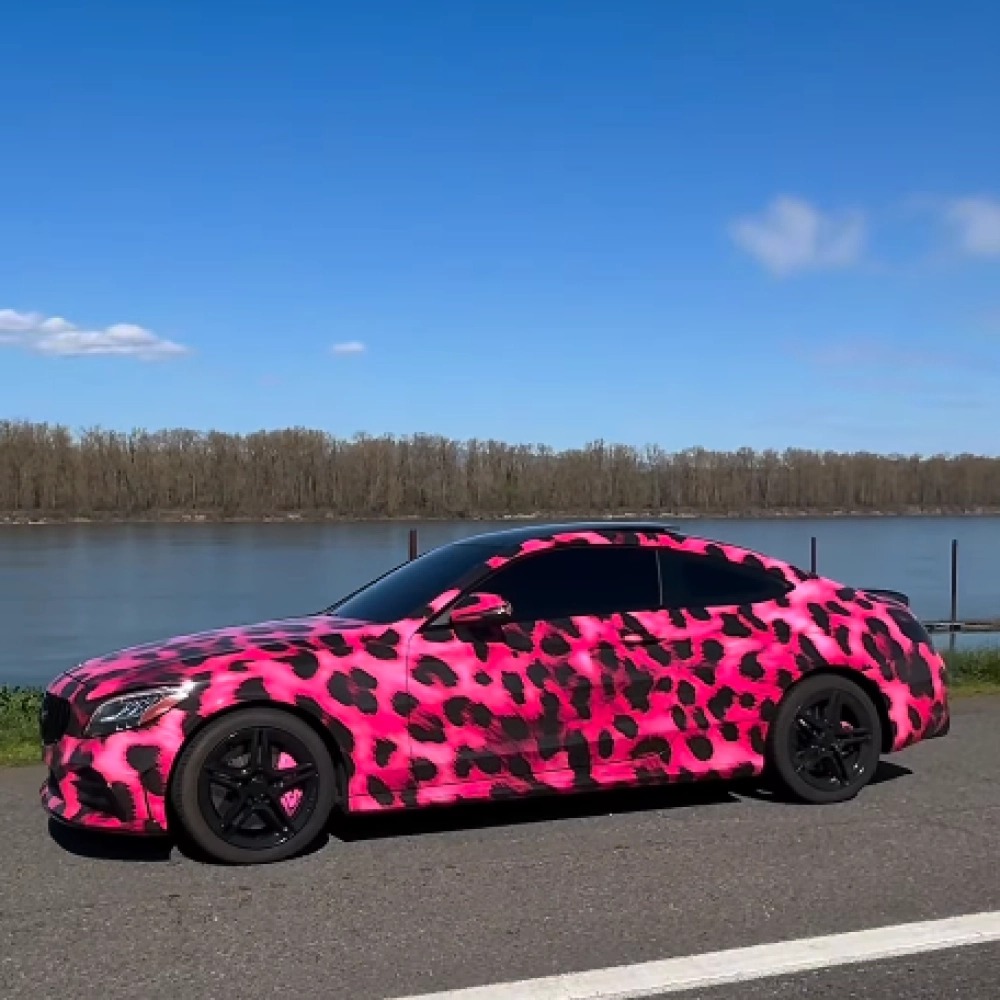
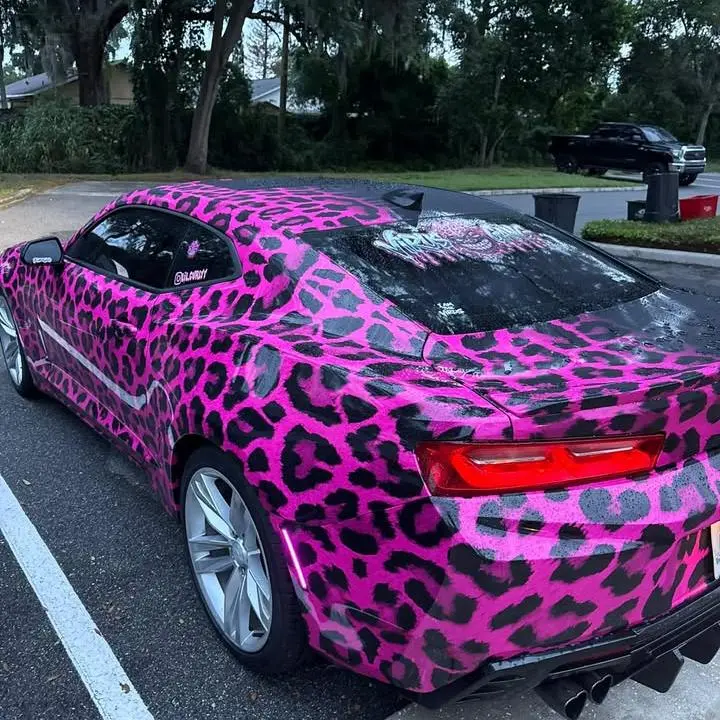
2. Pink Leopard Print Car Wrap
Pink leopard designs combine playful colors with high-contrast animal graphics.
Popular combinations include light pink with black spots, hot pink with dark purple accents, and pink-to-black gradients.
A pink gradient leopard wrap is particularly effective when the color transition follows the length of the vehicle.
Best suited for: BMW 4 Series, Kia K5, Tesla Model 3, and Mercedes-Benz CLA.
Design recommendation: Use larger spots around the rear quarter panels and avoid placing highly detailed graphics directly across complicated bumper contours.
ALUKOVINYL offers a pink-to-black gradient leopard print wrap with customizable artwork and finish options.
3. Black and White Leopard Print Wrap
A monochrome leopard design delivers a cleaner, more graphic interpretation of animal print.
Black spots against a white or light grey background can complement modern vehicle styling, particularly on cars with black wheels, tinted windows, and dark exterior trim.
Best suited for: Tesla Model Y, BMW M3, Audi A5, and Mercedes-Benz C-Class.
Design recommendation: Consider a gloss white background with matte-style black accents, subject to the available printing and finishing options.
4. Purple Leopard Print Wrap
Purple leopard patterns provide a less conventional alternative to traditional animal print colors.
Deep violet, lavender, metallic-inspired purple, and black can be combined to create different levels of contrast.
Darker purple designs often work particularly well on performance vehicles with aggressive body styling.
Best suited for: Dodge Challenger, Nissan 370Z, BMW M4, and Ford Mustang.
Design recommendation: Use dark purple as the primary background and position lighter spots along the doors or rear quarter panels.
5. Metallic-Inspired Leopard Print Wrap
A metallic-inspired leopard design combines animal graphics with the appearance of reflective or shimmering colors.
Silver, champagne gold, rose gold, and dark metallic grey can make the pattern appear more dimensional.
However, printed metallic-looking graphics do not automatically reproduce the optical properties of true metallic film. The final result depends on the print technology, substrate, and finish.
Best suited for: Porsche Panamera, Mercedes-Benz E-Class, Audi A7, and luxury sedans.
Design recommendation: Keep the pattern relatively subtle and use larger areas of uninterrupted background color.
6. Leopard Print Gradient Wrap
Gradient leopard designs combine two visual elements: a gradual color transition and animal-inspired graphics.
For example, a pink-to-black design may feature pink across the front half of the vehicle, gradually transitioning to black toward the rear.
The leopard spots can change in density or contrast as the background color shifts.
Best suited for: Sports coupes, performance sedans, custom show cars, and promotional vehicles.
Design recommendation: Confirm the gradient direction and spot positioning through a vehicle-specific digital mockup before printing.
Which Cars Look Best With Leopard Print Wraps?
Leopard print can work on many vehicles, but body proportions influence how effectively the pattern appears.
The following recommendations are styling examples rather than claims that every listed model has been wrapped with these designs.
| Vehicle | Recommended style | Best design approach |
|---|---|---|
| BMW M4 | Purple or black leopard | Full wrap with medium spots |
| Tesla Model 3 | Pink gradient leopard | Smooth front-to-rear transition |
| Jeep Wrangler | Classic brown leopard | Large spots across broad panels |
| MINI Cooper | Black and white leopard | Roof and mirror accents |
| Ford Mustang | Dark leopard print | Hood and rear quarter graphics |
| Mercedes-Benz CLA | Pink or silver leopard | Controlled, smaller pattern |
| Dodge Challenger | Purple and black leopard | Oversized spots on long panels |
| Kia K5 | Pink-to-black leopard | Full gradient design |
BMW M4: Best for Aggressive Leopard Graphics
The BMW M4 features wide body panels, strong shoulder lines, and a sporty profile.
These characteristics make it suitable for larger leopard spots, especially when the pattern is concentrated along the doors and rear quarter panels.
A black-and-purple design can complement dark wheels and carbon-fiber-style exterior accessories.
Tesla Model 3: Best for Modern Gradient Leopard Designs
The Tesla Model 3 has relatively smooth body surfaces and a streamlined shape.
This makes it a strong candidate for a continuous gradient design.
A pink-to-black leopard wrap can follow the vehicle’s length, creating a gradual transition rather than separating the design into disconnected panels.
Jeep Wrangler: Best for Classic Animal Print
The Jeep Wrangler’s upright proportions and relatively flat body sections provide a distinctive canvas for traditional leopard patterns.
Large spots can be distributed across the doors, hood, and side panels.
However, hinges, handles, exposed hardware, and removable components require careful installation planning.
MINI Cooper: Best for Partial Leopard Wraps
A MINI Cooper does not necessarily need a full-body leopard design to achieve a recognizable appearance.
A leopard print roof, mirror caps, or hood accents can create a strong contrast against the original paint color.
This approach also allows owners to experiment with animal print styling without committing to a full vehicle transformation.
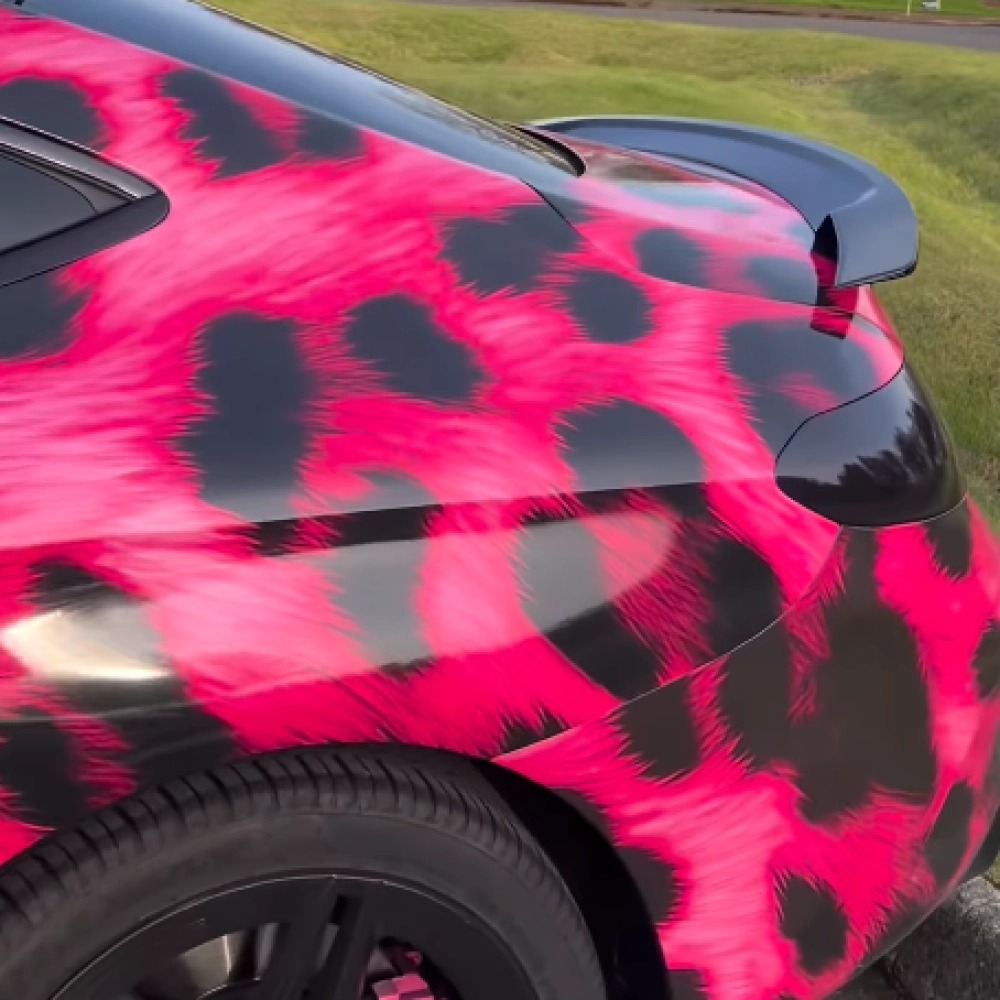
Real Customer Example: Pink-to-Black Leopard Print Kia K5
A useful real-world reference is the customer-submitted Kia K5 project featured on ALUKOVINYL’s pink-to-black leopard wrap product page.
The design combines a pink-to-black gradient with leopard-inspired graphics, illustrating how a patterned wrap can be adapted to a modern sedan.
This example highlights three practical considerations.
First, the gradient direction matters. A continuous color transition can make the wrap feel like one coordinated design rather than several separate graphics.
Second, spot placement affects visual continuity. Patterns crossing doors and adjacent panels should be planned before installation to reduce noticeable mismatches.
Third, vehicle-specific artwork is important. A design that looks balanced on a sedan may require substantial adjustments before being applied to a taller SUV or shorter coupe.
For drivers considering a similar style, reviewing real customer photographs alongside a digital mockup provides a better basis for choosing colors and pattern scale.
Full Leopard Print Wrap vs. Partial Leopard Print Wrap
One of the most important decisions is whether to cover the entire vehicle or use leopard graphics as accents.
| Feature | Full Leopard Wrap | Partial Leopard Wrap |
|---|---|---|
| Visual impact | Very high | Moderate to high |
| Material required | More | Less |
| Installation complexity | Higher | Usually lower |
| Pattern alignment | Multiple panels | Fewer panels |
| Design flexibility | Complete transformation | Easy combination with existing paint |
| Best for | Show cars and statement builds | Daily drivers and first-time buyers |
When Should You Choose a Full Wrap?
A full leopard print wrap is suitable when the goal is a complete visual transformation.
It works especially well for show cars, promotional vehicles, and highly personalized builds.
However, full coverage requires more material, more preparation, and greater attention to pattern continuity.
When Is a Partial Wrap Better?
Partial leopard graphics can be a practical option for drivers who want distinctive styling without covering the entire vehicle.
Popular applications include hood graphics, roof wraps, mirror accents, door panels, and rear quarter sections.
For example, a white BMW with black leopard graphics on the hood and roof can create a recognizable design while retaining much of its original color.
Leopard Print Wrap vs. Solid Color Vinyl vs. Custom Paint
Before selecting a leopard print design, it is useful to compare it with other automotive customization methods.
| Factor | Leopard Print Vinyl | Solid Color Vinyl | Custom Paint |
|---|---|---|---|
| Design complexity | High | Low to moderate | High |
| Custom patterns | Excellent flexibility | Limited | Excellent flexibility |
| Reversibility | Generally removable | Generally removable | Not readily reversible |
| Pattern alignment | Critical | Usually unnecessary | Depends on design |
| Installation | Specialist wrapping | Standard wrapping | Professional painting |
| Upfront cost | Varies with artwork and coverage | Often simpler to budget | Often higher for elaborate artwork |
| Repair | Reprint or replace affected sections | Replace affected sections | Paint repair or refinishing |
A leopard print wrap is often the most practical option when the driver wants detailed custom graphics without permanently repainting the vehicle.
Solid-color vinyl remains a better choice for drivers who prefer a uniform finish and simpler panel replacement.
Custom paint may be appropriate for permanent, highly specialized artwork, but it generally requires a greater commitment to the finished design.
Pros and Cons of Leopard Print Car Wraps
Advantages
1. Extensive personalization
Leopard spots can be customized by size, color, density, orientation, and placement. This provides greater creative flexibility than standard solid-color vinyl.
2. Removable styling
Automotive vinyl can generally be removed from suitable, intact paint when the correct materials and removal procedures are used.
3. Flexible coverage
Drivers can choose between full-body designs and smaller accent graphics.
4. Strong visual recognition
The contrast and distinctive shapes of leopard patterns make them highly recognizable, which can be useful for show cars and promotional vehicles.
5. Potential paint-preservation benefits
Vinyl provides a physical layer over covered surfaces and can help reduce some superficial wear. However, decorative wrap film should not be considered equivalent to dedicated paint protection film.
Disadvantages
1. Pattern matching requires additional care
Spots that cross panel edges can appear misaligned if artwork and installation are not carefully planned.
2. Excessive stretching can distort graphics
Printed leopard spots may become elongated around complex curves, bumpers, and recessed areas.
3. Replacement panels may require reprinting
A damaged section may need artwork matched to the original design, print batch, and finish.
4. Bold patterns may not appeal to every buyer
Leopard print is a highly personal styling choice and may not suit drivers seeking a subtle, factory-inspired appearance.
5. Durability depends on the complete film system
UV exposure, printing inks, laminate, installation quality, and maintenance all influence long-term appearance.
How to Choose a High-Quality Leopard Print Vinyl Wrap
A visually appealing design is only one part of a successful vehicle wrap.
The film, adhesive, printing process, and finishing system also influence installation and durability.
1. Check the Film Construction
Automotive graphics can be produced using different vinyl constructions, including cast and calendered films.
Cast vinyl is often preferred for demanding vehicle graphics because suitable products offer strong conformability and dimensional stability.
Calendered films can also be used for vehicle applications, but suitability depends on the particular film and the complexity of the surfaces being wrapped.
Do not assume that all printed films perform identically.
2. Consider the Adhesive Technology
For complex installations, repositionable adhesives and air-release channels can help installers position graphics and reduce trapped air.
However, adhesive performance varies between products.
The film must be compatible with the vehicle’s paint condition and the intended installation method.
3. Evaluate Print and Laminate Compatibility
For digitally printed leopard graphics, print quality affects spot definition, gradients, and color consistency.
A compatible protective laminate may improve resistance to environmental exposure and surface wear, depending on the system.
Before purchasing, confirm whether the quoted wrap includes a laminate and whether the components are intended to be used together.
4. Confirm the Finish
Gloss, matte, and metallic-inspired finishes can change the appearance of the same leopard artwork.
- Gloss can emphasize color saturation and contrast.
- Matte can reduce reflections and create a softer appearance.
- Metallic-style finishes can add visual complexity, depending on the materials used.
Always review physical samples where possible, since digital previews cannot reliably reproduce every surface finish.
What Do Established Wrap Manufacturers Recommend?
Technical guidance from established automotive graphics manufacturers such as 3M and Avery Dennison provides a useful framework for evaluating custom printed wraps.
Rather than selecting a product based only on its advertised appearance, professional installers should consider substrate compatibility, film conformability, application conditions, surface preparation, and post-installation care.
These considerations become particularly important with leopard print graphics because excessive stretching can visibly alter the intended pattern.
For any custom printed wrap, ask the supplier or installer to confirm the exact film construction, print protection method, recommended application procedure, and applicable warranty conditions.
Manufacturer guidance is a technical reference, not independent proof that every competing wrap product performs equally.
How Much Leopard Print Vinyl Do You Need?
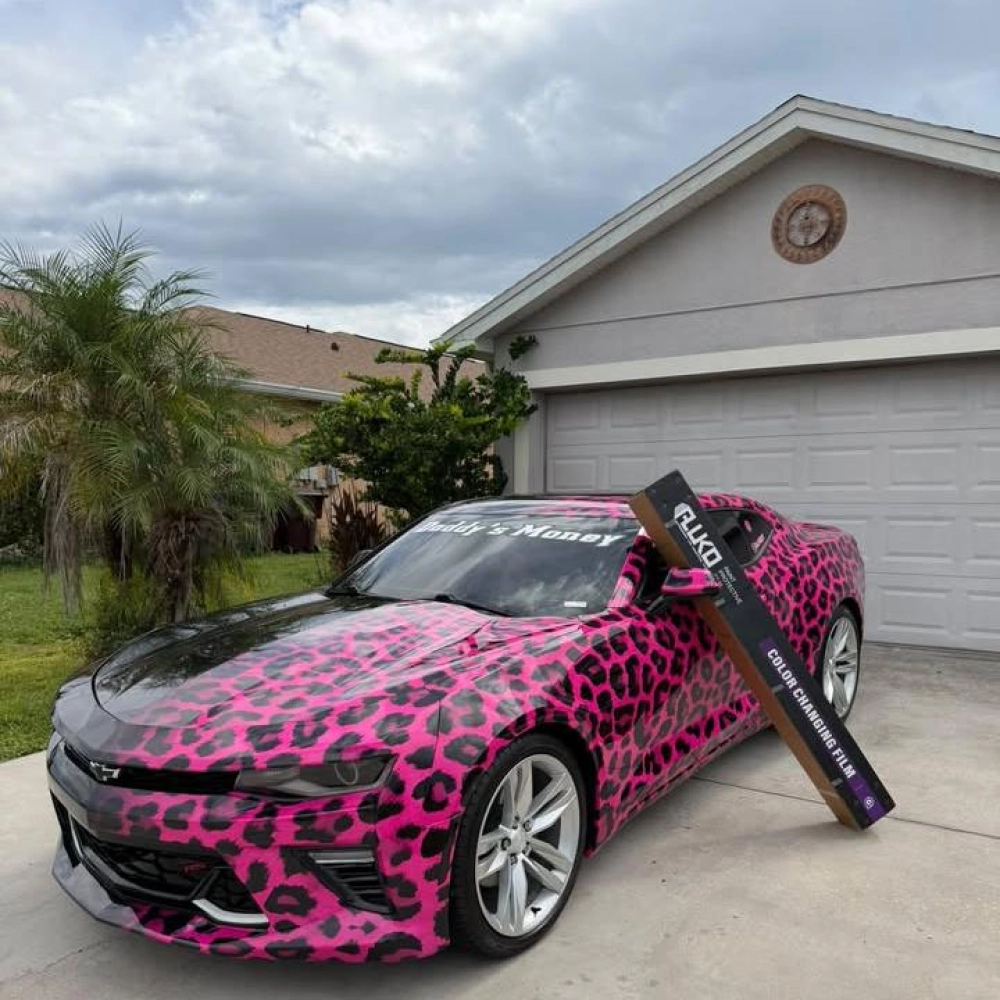
The amount of vinyl required depends on vehicle dimensions, panel complexity, desired coverage, and the amount of waste expected during installation.
For preliminary planning, ALUKOVINYL offers the following custom wrap size options.
| Vehicle category | Nominal roll length | Roll width |
|---|---|---|
| Sedan | 59 ft (18 m) | 5 ft (1.52 m) |
| SUV | 69 ft (21 m) | 5 ft (1.52 m) |
| Pickup / Truck | 79 ft (24 m) | 5 ft (1.52 m) |
These are ordering size categories, not guaranteed material requirements for every vehicle.
A large SUV with complex bumpers may require more material than a smaller vehicle with simple body panels.
Printed leopard graphics also require extra attention to pattern direction and matching.
Unlike a solid-color film, a leftover section of printed vinyl may not be suitable for another panel if the spot orientation or gradient position is incorrect.
For accurate ordering, provide the vehicle’s year, make, model, intended coverage, and design requirements.
Installation Tips for Leopard Print Vinyl Wrap
Leopard print wraps can be more challenging to install than solid-color vinyl because graphic continuity must be maintained.
Prepare the Vehicle Properly
Before installation, thoroughly clean the vehicle and remove surface contaminants.
Check for rust, peeling clear coat, loose paint, and previous repairs.
Wrapping over unstable paint can create adhesion problems and increase the risk of damage during removal.
Plan the Pattern Before Cutting
For full-body graphics, identify the major visual landmarks of the design.
These may include large leopard spots, gradient boundaries, and areas where the artwork crosses doors or quarter panels.
Confirm the orientation and panel layout before cutting the material.
Avoid Excessive Pattern Distortion
Heating and stretching can help compatible vinyl conform to curves, but excessive stretching can distort printed graphics.
A round leopard spot may become elongated when stretched around a bumper or recessed surface.
For this reason, installers should consider the shape of the artwork when planning complex areas.
Follow the Film’s Technical Requirements
Application temperatures, stretching limits, post-heating procedures, and edge-finishing requirements vary by material.
Follow the specific manufacturer’s instructions rather than applying one universal installation method to every printed film.
For full vehicle leopard wraps, professional installation is generally recommended.
How to Maintain a Leopard Print Wrap
Good maintenance helps preserve the appearance of custom printed vinyl.
Wash the vehicle regularly with suitable, non-abrasive cleaning products. Avoid aggressive solvents, harsh brushes, and abrasive polishing compounds.
When using pressure washing equipment, follow the film manufacturer’s instructions and avoid directing concentrated water pressure toward edges or seams.
Remove bird droppings, insects, and other contaminants promptly using wrap-compatible cleaning methods.
Whenever possible, reduce prolonged exposure to intense sunlight and environmental contaminants through appropriate parking and storage.
A leopard print wrap’s service life depends on the film system, print and laminate quality, climate, installation, and maintenance. It should not be assigned a universal lifespan without reference to the actual product specifications.
How to Design Your Own Leopard Print Wrap With ALUKOVINYL
A custom leopard wrap offers much more flexibility than a fixed pattern.
At ALUKOVINYL, customers can provide design references and vehicle information before approving a personalized wrap.
The process is straightforward.
Step 1: Choose Your Vehicle Size
Select the appropriate sedan, SUV, or truck size category.
Step 2: Share Your Leopard Design Idea
Provide your preferred colors, spot size, background style, and coverage requirements.
You can also submit reference artwork or request a particular gradient direction.
Step 3: Review Your Digital Mockup
Review the vehicle-specific design preview and confirm the pattern placement, colors, and overall layout.
Step 4: Approve the Design and Begin Production
Once the final artwork is approved, the custom wrap moves into production and shipping preparation.
ALUKOVINYL’s custom ordering process includes artwork confirmation before production.
Explore the custom car wraps collection for additional personalized graphics and vehicle wrap designs.
Frequently Asked Questions About Leopard Print Wraps
1. Can I wrap my entire car in leopard print?
Yes. A leopard print vinyl wrap can be designed for full-vehicle coverage, provided the material and artwork are suitable for the vehicle. Professional installation is recommended for complex printed designs.
2. Is leopard print vinyl wrap removable?
Generally, yes. Automotive vinyl can be removed from compatible, intact painted surfaces using appropriate procedures. Paint condition, adhesive age, and removal technique affect the risk of damage.
3. Can I customize the colors of a leopard print wrap?
Yes. Custom printed leopard wraps can use traditional brown and black, pink gradients, purple, white, grey, and many other color combinations.
4. Is a matte or gloss leopard wrap better?
Gloss is often suitable for bold, saturated colors, while matte can create a softer, less reflective appearance. The better choice depends on the design and the driver’s preferred finish.
5. How much does a leopard print car wrap cost?
The total cost depends on the vehicle size, printed vinyl quantity, design complexity, material specifications, and installation labor. Partial wraps generally require less material and labor than full-body wraps.
6. Does leopard print wrap protect car paint?
Decorative vinyl can provide a physical barrier against some minor surface exposure, but it does not offer the same protection as dedicated TPU paint protection film. It should not be relied upon to prevent significant stone-chip damage.
7. Can I install leopard print vinyl myself?
Experienced DIY installers may be able to apply smaller graphics or simple panels. Full-body printed designs are more challenging because the artwork must align across panels and avoid distortion.
8. Which vehicles look best with leopard print?
BMW coupes, Tesla sedans, Jeep Wranglers, MINI Coopers, Ford Mustangs, and other vehicles can work well with leopard graphics. The most important factor is adapting the pattern to the vehicle’s proportions.
9. Can I combine leopard print with another wrap color?
Yes. Leopard accents can be paired with black, white, pink, purple, or metallic-style backgrounds. Combining animal graphics with solid-color sections can create a more controlled appearance.
10. How long does a leopard print wrap last?
Durability varies by film construction, printing system, protective laminate, installation quality, climate, and maintenance. Confirm the expected service life and warranty conditions for the specific product before ordering.
Final Verdict: Is a Leopard Print Wrap Worth It?
A leopard print wrap is worth considering for drivers who want a highly personalized exterior rather than another conventional paint-inspired color.
Its greatest advantage is creative flexibility. Pattern scale, color combinations, gradients, finishes, and placement can all be adjusted to suit the vehicle.
However, a successful leopard wrap requires more planning than a standard solid-color installation. Pattern alignment, material selection, and graphic distortion should be considered before production.
For first-time buyers, partial leopard graphics can be a practical starting point. For show cars and statement builds, a vehicle-specific full wrap offers the greatest creative freedom.
Ultimately, the best leopard print wrap is not necessarily the boldest design. It is the one that complements the vehicle’s shape, maintains visual consistency, and matches the owner’s intended style.
Create Your Custom Leopard Print Wrap at ALUKOVINYL
Ready to give your vehicle a distinctive animal-inspired look?
At ALUKOVINYL, you can explore custom leopard print graphics, personalize your colors and pattern placement, and review a digital mockup before production.
Whether you prefer classic brown leopard spots, a pink-to-black gradient, or a completely original animal print design, our custom wrap options help bring your concept to life.