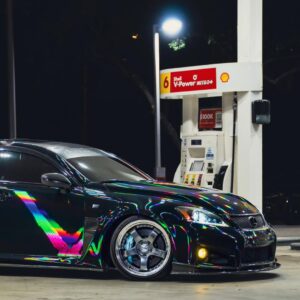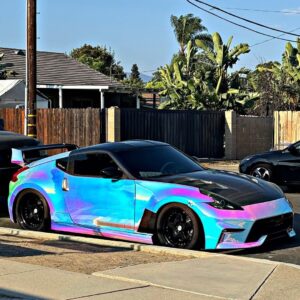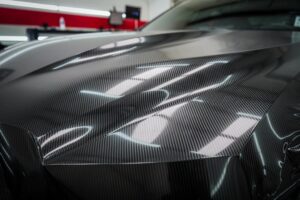

A PPF wrap is a protective automotive film applied over painted surfaces to help reduce damage from stone chips, scratches, road debris, and environmental contamination. Modern TPU car wraps are available in clear gloss, matte, and colored finishes, allowing drivers to preserve factory paint, transform its appearance, or combine styling with protection.
But not every PPF wrap offers the same performance, appearance, or value.
A transparent gloss film on a Porsche 911 serves a different purpose from matte PPF on a Mercedes-AMG or colored TPU film on a BMW M4. Understanding these differences helps vehicle owners avoid unnecessary costs and choose protection suited to their driving conditions.
This guide examines the technical characteristics of TPU PPF, compares gloss and matte finishes, reviews published manufacturer specifications, and explains where PPF provides genuine value—and where conventional vinyl may be more practical.
Editorial disclosure: ALUKOVINYL manufactures and sells automotive films. Product-specific ALUKOVINYL specifications are manufacturer-reported. Competitor specifications are attributed to their respective manufacturers and should not be interpreted as independent comparative test results.
What Is a PPF Wrap?
A PPF wrap (paint protection film wrap) is a transparent or colored protective film installed over automotive paint. Most premium modern PPF products use thermoplastic polyurethane (TPU), a flexible material capable of conforming to curved vehicle surfaces while providing a sacrificial protective layer.
Unlike a conventional decorative wrap, PPF is primarily engineered to absorb everyday surface wear before it reaches the original paint.
A typical TPU PPF system includes:
- A protective surface coating that may provide self-healing and stain resistance.
- A flexible polyurethane layer for conformability and impact protection.
- A pressure-sensitive adhesive for attachment to painted surfaces.
- A removable release liner used during installation.
Not every manufacturer uses identical construction.
For example, 3M’s Scotchgard Paint Protection Film Pro Series 200 is available in gloss and matte finishes and features self-healing technology, a hydrophobic surface, and an optimized adhesive designed to improve installation.
According to 3M, this product is intended to protect painted surfaces from stone chips, scratches, insects, road tar, stains, and outdoor weathering.
Source: 3M Scotchgard PPF Pro Series 200
These characteristics provide a useful industry benchmark, although they do not independently establish the performance of every TPU product.
Gloss TPU Wrap vs Matte TPU Wrap vs Clear PPF Wrap
One common source of confusion is that these terms describe overlapping characteristics.
Clear describes transparency. Gloss and matte describe surface appearance. TPU describes the principal film material.
Consequently, a product can be both clear and glossy, or transparent and matte.
| Feature | Gloss Clear TPU PPF | Matte Clear TPU PPF | Colored TPU PPF |
|---|---|---|---|
| Main appearance | High-shine finish | Low-reflection finish | New vehicle color |
| Factory color visible | Yes | Yes, with altered sheen | Usually concealed |
| Paint protection | Yes | Yes | Yes |
| Self-healing | Product-dependent | Product-dependent | Product-dependent |
| Best application | Factory gloss preservation | Stealth styling | Color transformation |
| Maintenance | Gloss-safe products | Matte-safe products | Finish-specific care |
| Typical buyer | Paint preservation | Appearance refinement | Styling and protection |
The right option depends on whether the customer wants to preserve the factory finish or create a different appearance.
1. Gloss TPU Wrap: Best for Preserving Factory Paint
Gloss TPU PPF is designed for drivers who like their original paint and want to retain its depth, reflections, and metallic character.
It is especially suitable for black, red, blue, and metallic factory finishes where optical clarity matters.
ALUKOVINYL’s 7.5mil gloss clear TPU PPF is listed with the following manufacturer-reported specifications:
| Specification | ALUKO 7.5mil Gloss Clear PPF |
|---|---|
| Material | TPU |
| Nominal thickness | 7.5mil ± 0.3mil |
| Approximate thickness | 190.5 microns |
| Glossiness | 94 (manufacturer specification) |
| Elongation at break | 370.23% |
| Application | Wet installation |
| Surface properties | Self-healing, hydrophobic |
These figures come from the ALUKOVINYL product listing and are not presented as independent laboratory verification.
Recommended vehicle: Porsche 911
The Porsche 911 provides a useful example because its low nose, curved front fenders, and rear quarter panels combine complex installation geometry with exposed painted surfaces.
For a Porsche owner who wants to preserve the original finish, gloss clear PPF is a more logical choice than an opaque color-changing wrap.
Recommended coverage: Front bumper, hood, front fenders, mirror caps, rocker panels, and optionally full-body coverage.

2. Matte TPU Wrap: Best for a Subtle Stealth Appearance
Matte TPU PPF changes the way light reflects from a vehicle’s paint.
Rather than producing sharp mirror-like reflections, a matte finish diffuses light, giving the bodywork a softer and more understated appearance.
A clear matte film can change the appearance of glossy factory paint without replacing its underlying color.
However, matte PPF requires different maintenance from gloss PPF.
Polishing compounds, abrasive cleaners, and gloss-enhancing waxes may create uneven shine or permanently alter the matte surface.
Recommended vehicle: Mercedes-AMG GT 63
The Mercedes-AMG GT 63’s broad hood, pronounced shoulder lines, and large body panels make it a useful example for comparing gloss and matte finishes.
A matte clear PPF can give an originally glossy dark-gray AMG a more restrained appearance while retaining visible body contours.
The trade-off is maintenance sensitivity. Glossy patches caused by improper cleaning or abrasion can be difficult to correct without replacing the affected film.

3. Colored TPU Wrap: Best for Styling and Protection
Colored TPU PPF combines an opaque or semi-opaque color-changing layer with a protective film construction.
This makes it attractive to drivers who want a new exterior color without relying exclusively on conventional vinyl.
A colored PPF may be available in gloss, satin, matte, metallic, or specialty finishes.
However, colored TPU PPF is not automatically superior to clear PPF. Additional optical layers, pigments, and coatings can affect stretching behavior, appearance consistency, and color matching.
Recommended vehicle: BMW M4
The BMW M4 is a useful example for colored PPF because its large hood, muscular rear quarters, and distinctive front bumper create several challenging installation areas.
A gloss metallic blue or deep purple TPU finish can substantially change its appearance while adding a protective film layer.
Recommended coverage: Full-body installation with consistent panel orientation and careful planning around bumper openings, mirrors, and curved rear panels.

For more color-changing options, explore ALUKOVINYL’s color ppf collection.
How Much Protection Does a TPU PPF Wrap Actually Provide?
PPF works by placing a sacrificial polymer layer between the environment and the painted surface.
That layer can reduce the likelihood of minor road damage reaching the factory clear coat.
However, PPF does not make a vehicle scratch-proof or impact-proof.
A high-energy stone impact can penetrate the film. Sharp objects can cut through the protective layer, and sufficiently severe impacts can damage both film and paint.
Film Thickness: What Do 7.5mil, 8.5mil, and 10mil Mean?
The unit mil means one-thousandth of an inch—not one millimeter.
| Film thickness | Approximate metric thickness |
|---|---|
| 7.5mil | 190.5 μm |
| 8.5mil | 215.9 μm |
| 10mil | 254 μm |
A 10mil film has approximately 33% greater nominal thickness than a 7.5mil film.
That does not prove it offers 33% more stone-chip protection.
Actual impact resistance also depends on polymer formulation, coating behavior, adhesive properties, and the testing conditions.
For example, a thicker film with poor adhesion or unsuitable stretching behavior may perform less effectively in a particular installation than a thinner, well-engineered alternative.
The useful buying question is therefore not simply “Which film is thickest?”
It is:
Which PPF construction has the appropriate mechanical properties, optical finish, and installation characteristics for this vehicle?
Does PPF Wrap Really Self-Heal?
Self-healing is a legitimate technology used in modern premium PPF, but the term is frequently misunderstood.
Certain polyurethane top coats can recover from light surface deformation when exposed to suitable heat.
3M describes heat-assisted recovery of minor scratches and marks in its Pro Series 200 PPF.
However, self-healing should not be interpreted as unlimited damage repair.
What self-healing may improve:
- Fine washing swirls
- Minor surface marks
- Light superficial abrasions
What it generally cannot repair:
- Deep cuts
- Punctures
- Torn film
- Severe stone impacts
- Damage penetrating the protective layer
A customer should also distinguish between a product advertised as self-healing and one supported by a reproducible test protocol.
Without comparable testing conditions, claims such as “100% self-healing” are not meaningful evidence that a film can recover from every type of scratch.
PPF Wrap vs Vinyl Wrap: Which Offers Better Value?
Both products can be applied to vehicle paint, but they are designed around different priorities.
Traditional vinyl wrap is usually the more practical choice for printed graphics, temporary branding, complex custom artwork, and cost-conscious color changes.
TPU PPF is more appropriate when paint protection is a major objective.
| Consideration | TPU PPF Wrap | Conventional Vinyl Wrap |
|---|---|---|
| Primary function | Paint protection | Styling and color change |
| Material | Usually TPU | Commonly PVC-based |
| Stone-chip protection | Designed for this purpose | More limited |
| Self-healing | Available in selected products | Not typical |
| Custom printing | More specialized | Widely available |
| Installation cost | Often higher | Often lower |
| Original paint visibility | Clear variants | Usually opaque |
| Best value | Protection-focused projects | Styling-focused projects |
A practical compromise is to prioritize PPF on high-impact areas rather than wrapping the entire vehicle.
For example, a highway-driven sedan may benefit more from protecting the front bumper, hood, and mirror caps than from covering every exterior panel.
This is particularly relevant when the customer has a limited budget.
Comparing PPF Brands: 3M, TeckWrap, Tinybot, INOZETEK and ALUKO
The PPF market includes established protection-focused manufacturers and newer styling-oriented brands.
A meaningful comparison should distinguish between published product specifications, warranty terms, material prices, and independent evidence.
| Brand | Relevant products | Published positioning | Price transparency |
|---|---|---|---|
| 3M | Scotchgard Pro Series 200 | Gloss/matte PPF, self-healing, hydrophobic coating | Dealer/distributor quotation |
| TeckWrap | Clear X75M, M75, Color PPF | Clear, matte and colored TPU options | Public online prices |
| Tinybot | Gloss, matte, colored and specialty PPF | Wide selection of visual finishes | Varies by listing |
| INOZETEK | Automotive styling films | Strong emphasis on appearance and color finishes | Product-specific quotation |
| ALUKO | Gloss clear and colored TPU PPF | Factory-direct clear and colored film options | Product-page pricing |
What Do Published Prices Show?
As of the listings reviewed in October 2026:
- TeckWrap Clear X75M Shade PPF: $719 for a listed 5ft × 49ft roll.
- TeckWrap Clear M75 Matte PPF: From $99 for a listed 5ft × 3.3ft selection.
- TeckWrap Gloss True Black Color PPF: From $239 for a listed 5ft × 9.8ft selection.
- ALUKO 7.5mil Gloss Clear PPF: Listed at £431.29 per piece in the accessed storefront view; the price may vary by selected size, currency, and promotion.
- 3M Pro Series 200: Public product information and dealer channels are available, but a directly comparable retail roll price was not established.
These prices are not directly comparable without normalizing roll dimensions, taxes, shipping, currency, and film specifications.
A $239 short-length purchase should not be compared with a $719 full roll as though both contain the same material quantity.
For example, the $719 TeckWrap 49ft roll works out to approximately $14.67 per linear foot, before considering taxes or any other costs.
The more reliable comparison uses equal widths and lengths, equivalent finish types, verified technical specifications, and comparable warranty conditions.
Industry sources:
No overall brand-performance ranking is assigned here because comparable independent testing across all five brands was not established.
PPF Wrap Advantages and Disadvantages
Advantages
1. Physical paint protection
TPU PPF is designed to reduce direct exposure of automotive paint to everyday abrasion, small debris, and environmental contamination.
2. Multiple appearance options
Clear gloss, clear matte, and colored finishes allow customers to select protection without necessarily sacrificing styling preferences.
3. Minor scratch recovery
Selected self-healing top coats can reduce the visibility of superficial marks.
4. Potentially easier cleaning
Hydrophobic surfaces can encourage water beading and simplify routine maintenance, although this does not eliminate the need for washing.
5. Targeted coverage
Customers can protect high-impact areas without purchasing a full-body installation.
Disadvantages
1. Higher initial cost
Quality TPU film and professional installation often cost more than conventional decorative vinyl.
2. Installation complexity
Wet installation, contamination control, edge finishing, and stretching require experience.
3. Imperfect protection
Deep scratches, sharp impacts, and accidents can still damage the paint beneath the film.
4. Maintenance restrictions
Matte and specialty finishes require appropriate cleaning products.
5. Removal risks
Poorly repaired, deteriorated, or previously damaged paint may be vulnerable during removal. Paint-safe removal cannot be guaranteed on every surface.
Installation: Why the Installer Matters as Much as the Film
A technically capable film can still produce disappointing results if it is installed incorrectly.
Professional TPU PPF installation usually involves:
Step 1: Paint inspection
Identify scratches, chips, repainting, clear-coat defects, and areas of weak adhesion.
Step 2: Surface decontamination
Remove road tar, bonded particles, grease, wax, and other contaminants.
Step 3: Pattern selection
Choose between pre-cut patterns and bulk installation based on the panel shape and required edge coverage.
Step 4: Wet application
Use a film-compatible slip and tack solution, following the manufacturer’s instructions.
Step 5: Controlled stretching
Avoid unnecessary tension around bumpers, mirrors, and recessed areas.
Step 6: Edge finishing and inspection
Check for contamination, lifted edges, trapped moisture, adhesive marks, and excessive stretching.
3M reports that its Pattern Marketplace supports nearly 4,500 quality-tested paint-protection and window-film patterns, illustrating how digital pattern systems have become an important part of professional installation.
However, pre-cut patterns do not eliminate the need for careful surface preparation and installer judgment.
How Much PPF Wrap Do You Need?
Material planning is another factor that affects cost.
Consider a standard 5ft-wide roll:
| Roll length | Approximate coverage area |
|---|---|
| 33ft × 5ft | 165 sq ft |
| 49ft × 5ft | 245 sq ft |
| 59ft × 5ft | 295 sq ft |
| 69ft × 5ft | 345 sq ft |
These figures represent raw rectangular material area, not usable installed coverage.
Actual requirements depend on vehicle size, panel layout, cutting waste, seam placement, and installer technique.
A compact sedan may require substantially less material than a full-size SUV, especially when the roof is excluded.
Practical recommendation: Measure the individual panels and prepare a cutting layout before purchasing. Do not rely exclusively on the vehicle’s overall length.
What Does Independent Testing Actually Prove?
One of the biggest problems with online PPF comparisons is the assumption that published marketing claims represent independent evidence.
ASTM D6486-23 addresses short-term vehicle-service exposure testing for automotive coatings, including scratching, impact, stone chipping, insect contamination, bird droppings, tree sap, and environmental fallout.
It also emphasizes the importance of experimental design when comparing field exposure with laboratory performance.
Source: ASTM D6486 — Vehicle Service Exposure
Although this standard concerns automotive coatings rather than serving as a universal PPF certification, it provides a useful framework for evaluating real-world exposure.
For a credible PPF comparison, installers and buyers should request:
- Technical data sheets identifying test methods
- Thickness measurements and tolerances
- Adhesion and elongation results
- UV/weathering test conditions
- Stain-resistance results
- Self-healing test procedures
- Warranty exclusions
- Installation and removal instructions
A ten-year warranty is not the same as a guarantee against every scratch or stone impact.
For example, 3M’s published Pro Series 200 warranty identifies coverage for yellowing, bubbling, and cracking under applicable conditions, while excluding certain forms of physical damage and misuse.
The lesson is simple: compare what is actually tested and warranted—not just what appears in a product headline.
Which PPF Wrap Should You Buy?
The best choice depends on your priorities.
Choose gloss clear TPU PPF if: You like the original paint, want to maintain factory reflections, and prioritize transparent protection.
Choose matte clear TPU PPF if: You want a low-reflection finish and are prepared to use matte-safe cleaning methods.
Choose colored TPU PPF if: You want a different exterior color while retaining a protective film construction.
Choose conventional vinyl if: Your priority is custom graphics, broad color selection, or a lower-cost styling project.
Choose partial PPF coverage if: You want practical protection but cannot justify the cost of a full-body installation.
For many daily drivers, prioritizing the front bumper, hood, front fenders, and mirrors is a sensible starting point.
Frequently Asked Questions About PPF Wrap
Is PPF wrap better than vinyl wrap?
PPF is generally more appropriate for protecting painted surfaces against everyday road hazards. Vinyl is usually better suited to affordable color changes, printed graphics, and decorative customization. The best option depends on the project’s main objective.
What is the difference between TPU car wrap and PPF wrap?
In automotive marketing, TPU car wrap often refers to TPU-based protective film, including clear and colored PPF. PPF wrap is a broader description of the protective application. Product construction should always be checked rather than relying on terminology alone.
Can clear PPF change a glossy car to matte?
Yes. A clear matte PPF can diffuse reflections and give glossy factory paint a matte or satin appearance while allowing the underlying color to remain visible.
Does gloss TPU PPF make a car shinier?
A high-quality gloss film may enhance the perceived depth and reflections of well-prepared paint. However, the final appearance depends on the original surface, optical clarity, installation, and coating quality.
Is 7.5mil PPF thick enough?
A 7.5mil construction can be suitable for normal daily-driving protection. Customers facing higher-impact conditions may consider thicker products, but thickness alone does not establish protective performance.
Can PPF wrap damage original paint?
Removal from sound, properly cured factory paint is generally lower-risk when performed correctly. Repainted panels, failing clear coat, poor installation, and improper removal can increase the risk of paint damage.
Can you pressure-wash a PPF-wrapped car?
Usually, after the manufacturer’s recommended curing period. Keep excessive pressure and concentrated spray away from exposed film edges, and follow the specific product’s maintenance instructions.
Should I install PPF myself?
Small, simple panels may be manageable for experienced DIY users. Full bumpers, compound curves, matte finishes, and expensive colored TPU products are generally better handled by trained installers.
Final Verdict: The Best PPF Wrap Depends on Your Car
There is no universally best PPF wrap.
A Porsche 911 owner trying to preserve factory paint has different requirements from a Mercedes-AMG owner seeking a matte appearance or a BMW M4 owner planning a complete color transformation.
Gloss clear PPF is often the most straightforward option for paint preservation. Matte PPF offers an alternative appearance with additional maintenance considerations. Colored TPU PPF combines customization with protection, usually at a higher cost than traditional vinyl.
The most informed purchase is based on material specifications, installation quality, intended use, verified evidence, and total project cost—not simply brand recognition or advertised film thickness.
Explore TPU PPF Options at ALUKOVINYL
ALUKOVINYL offers clear and colored TPU protection films for daily drivers, performance vehicles, and professional wrap projects.
Explore our ppf film collection for different protection and finish options, or view the tpu car wrap product for transparent gloss protection.
Protect the original paint. Choose the finish that suits your vehicle. Invest in the coverage you actually need.