Carbon fiber has long been associated with motorsport, lightweight performance parts, and high-end automotive engineering. But replacing a hood, roof, spoiler, or body panel with genuine carbon fiber can be expensive and impractical when the goal is mainly visual.
That is where carbon PPF offers a different approach.
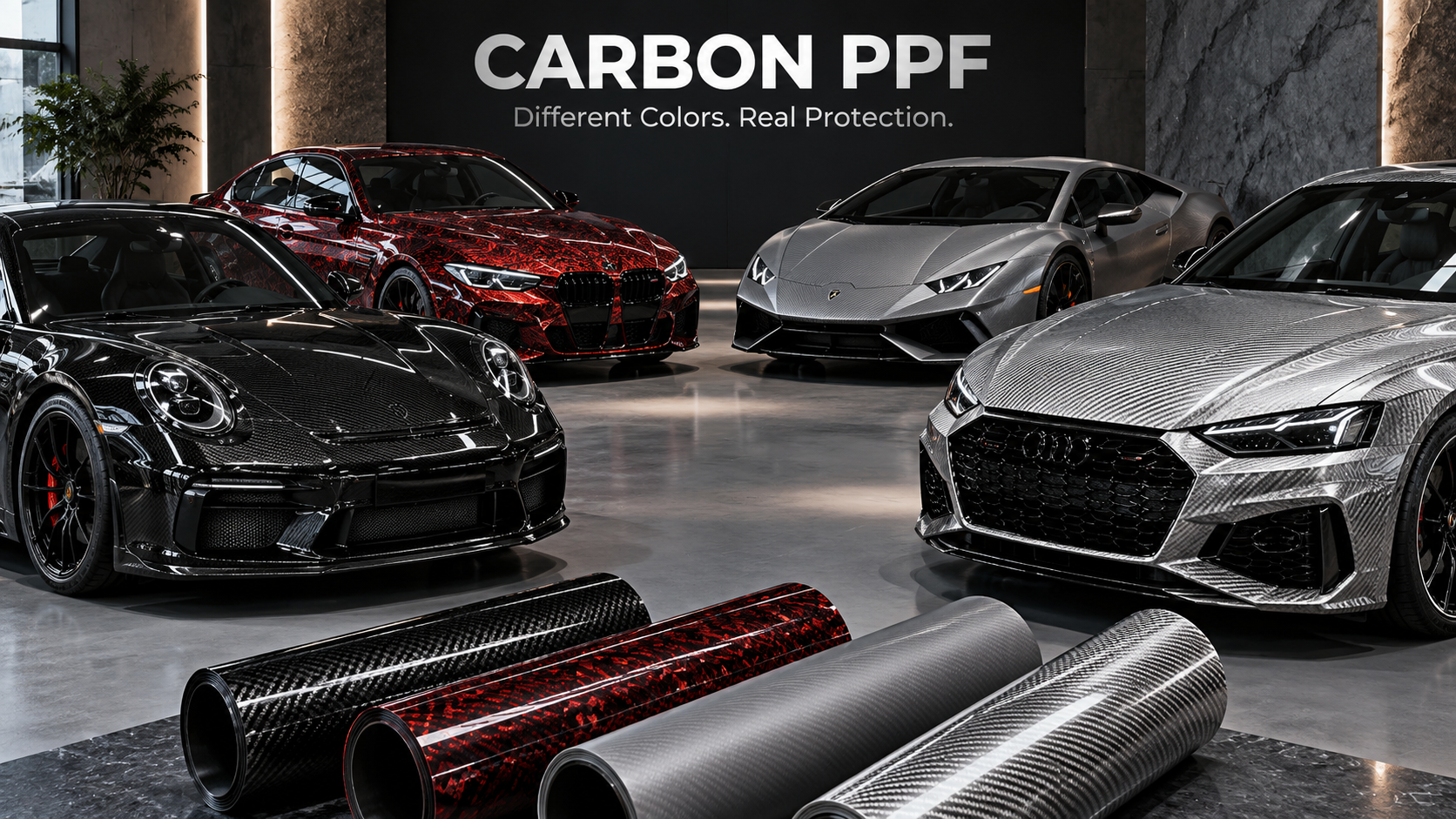
Carbon PPF combines a carbon-inspired surface appearance with the protective function of paint protection film. Depending on the product, buyers can now choose traditional black carbon, transparent carbon, matte carbon, silver carbon, forged red carbon, metallic aluminum-style carbon, and other variations rather than being limited to one familiar black weave.
However, carbon PPF should not be confused with genuine structural carbon fiber. Nor should every TPU carbon film automatically be assumed to provide identical protection simply because “TPU” or “PPF” appears in the product name.
This guide examines what carbon PPF actually is, the different colors available, how it compares with carbon vinyl and real carbon fiber, its advantages and disadvantages, and what technical information buyers should consider before purchasing.
Disclosure: ALUKOVINYL manufactures and sells automotive films, including the carbon PPF products discussed in this article. Product-specific descriptions therefore represent manufacturer information unless an independent source is specifically identified. References to third-party manufacturers such as 3M are included to explain broader PPF technology and industry practices, not to imply that their test results automatically apply to ALUKOVINYL products.
Featured Snippet: What Is Carbon PPF?
Carbon PPF is a paint protection film designed to create a carbon-fiber-inspired appearance while adding a protective polymer layer over automotive paint. Most modern premium PPF systems use polyurethane/TPU constructions, while carbon effects can range from traditional woven black patterns to transparent, matte, silver, metallic, and forged-carbon styles.
The important difference from ordinary carbon vinyl is purpose.
A carbon vinyl wrap is primarily a styling material. Carbon PPF is intended to combine styling with greater physical paint protection.
In simple terms:
Carbon vinyl = primarily appearance
Carbon PPF = appearance + paint protection
Real carbon fiber = structural/composite material
Those three products may look similar from a distance, but they should not be treated as interchangeable materials.
How Does Carbon PPF Work?
Modern PPF is generally a multi-layer film rather than a single sheet of decorative plastic.
A typical construction may include:
- A protective topcoat
- A TPU or polyurethane body layer
- Carbon-fiber visual/texture elements
- Pressure-sensitive adhesive
- Release liner
The exact architecture varies by manufacturer.
The TPU body provides flexibility and physical protection, while the upper layers influence properties such as gloss, stain resistance, surface feel, and self-healing behavior.
This general approach is well established within the PPF industry. For example, major automotive materials manufacturer 3M describes its polyurethane paint protection films as being engineered to help protect vehicle surfaces from rock chips, scratches, stains and environmental exposure.
That does not mean every carbon PPF performs identically to a 3M product. Different manufacturers can use different TPU formulations, adhesives, coatings, thicknesses and manufacturing processes.
For buyers, “TPU” should therefore be treated as the beginning of a technical comparison—not the end of one.
Carbon PPF Colors: More Than Traditional Black Carbon
One of the most interesting developments in this category is the expansion beyond conventional black woven carbon.
ALUKOVINYL’s current carbon PPF collection includes several distinct visual directions, including glossy, matte, transparent, silver, forged and metallic-style constructions.
Here are some of the most useful options and where they make sense.
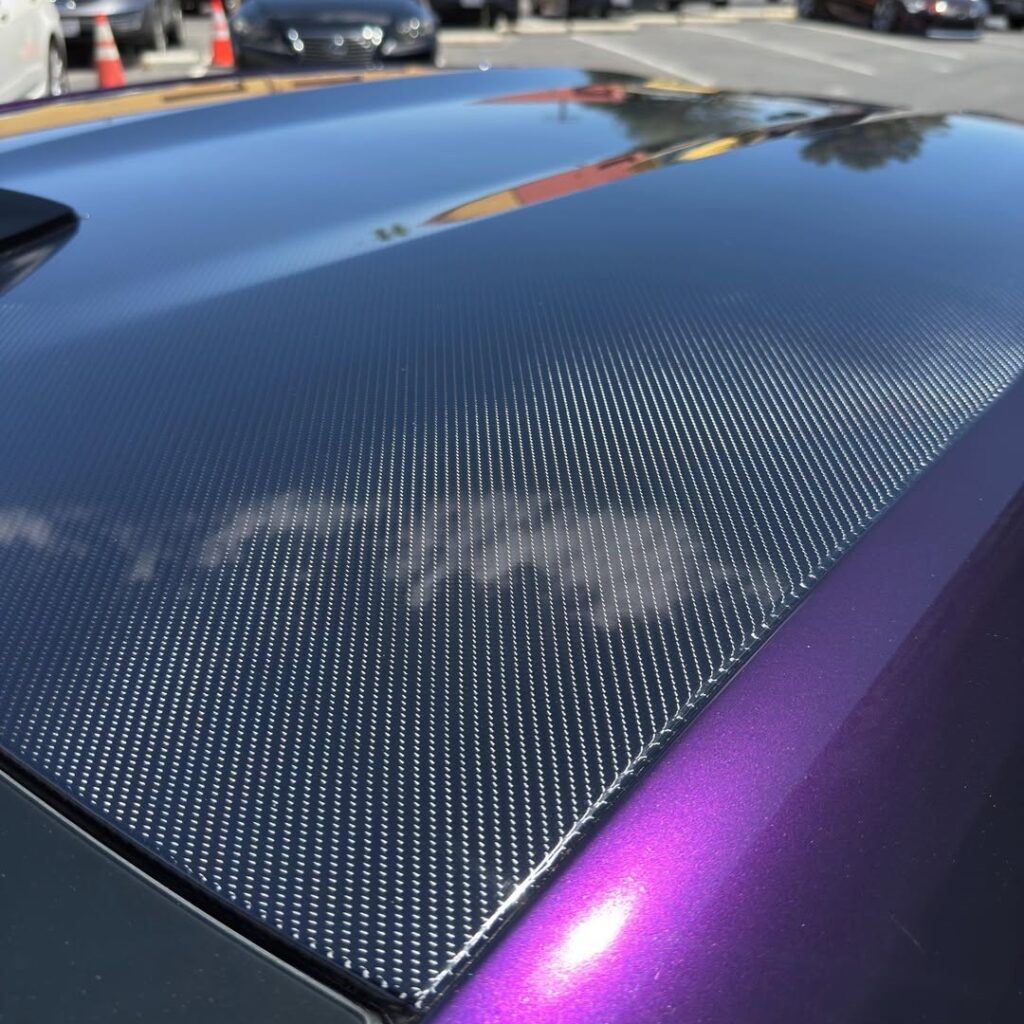
1. Gloss Black Carbon PPF
Black remains the classic carbon-fiber appearance.
A glossy woven carbon effect works particularly well on performance-oriented vehicles because the dark weave creates contrast while reflections emphasize the pattern.
Good applications include:
- Hood
- Roof
- Mirror caps
- Spoiler
- Trunk
- Front splitter
- Full vehicle for an aggressive appearance
Best vehicle examples: BMW M3/M4, Porsche 911, Chevrolet Corvette, Nissan GT-R and Mercedes-AMG models.
Black carbon is usually the safest option for customers who want the visual association with traditional carbon-fiber automotive components.
2. Red Forged Carbon PPF
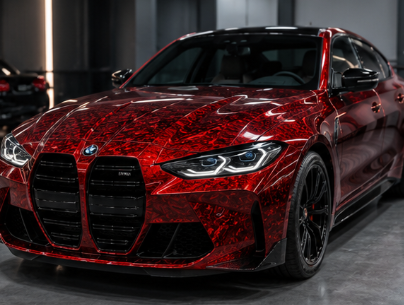
Forged carbon has a very different appearance from traditional woven carbon.
Instead of regular diagonal fibers, forged carbon uses an irregular fragmented visual pattern. Red pigment makes this effect considerably more dramatic.
Red forged carbon PPF is therefore best treated as a styling statement rather than an attempt to imitate conventional OEM carbon fiber.
It works especially well on:
- Black vehicles
- Dark gray vehicles
- Performance coupes
- Track-inspired builds
- Accent panels
A black BMW M4 with a red forged-carbon hood, for example, creates significantly stronger contrast than conventional black-on-black carbon.
3. Silver Forged Carbon PPF
Silver forged carbon offers a more technical and futuristic appearance.
Instead of the aggressive darkness of black carbon or visual intensity of red, silver reflects considerably more ambient light.
This can work especially well with:
- Black paint
- White paint
- Nardo-style gray
- Silver vehicles
- Modern EV designs
It can also visually emphasize complex panel shapes because highlights move across the irregular forged pattern.
4. Matte Carbon PPF
Gloss is not always the best way to show carbon.
Matte carbon reduces surface reflections and places greater visual emphasis on texture.
The result tends to look more understated and motorsport-inspired than glossy carbon.
Matte carbon works particularly well on vehicles with:
- Satin black accents
- Matte wheels
- Dark trim
- Aggressive aerodynamic packages
One practical consideration is maintenance. Matte and textured surfaces need appropriate cleaning methods because polishing them like conventional gloss paint can alter their appearance.
5. Transparent Carbon PPF
Transparent carbon PPF takes a fundamentally different approach.
Instead of completely replacing the factory color, it allows some of the underlying paint to remain visible beneath a carbon-inspired effect.
This can be particularly interesting when the original paint itself is valuable to the design.
Imagine:
Red paint + transparent carbon = red carbon appearance
Blue paint + transparent carbon = blue-toned carbon appearance
White paint + transparent carbon = light technical carbon appearance
This makes transparent carbon especially useful for owners who like their factory paint but want to add texture and protection.
Because the substrate influences the final appearance, installers should test a sample on the actual vehicle before committing to a full panel.
6. Matte Silver Carbon PPF
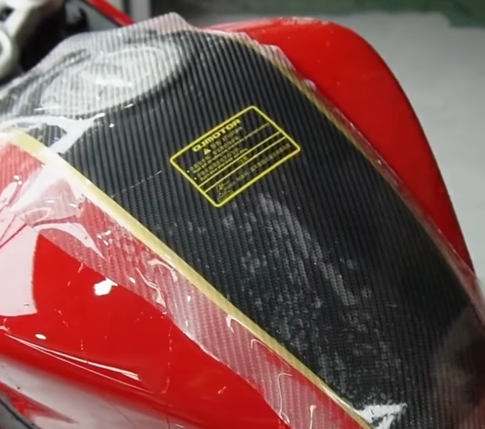
Matte silver combines two relatively unusual visual characteristics: a light carbon appearance and reduced reflectivity.
Instead of looking like conventional glossy carbon, the finish can resemble a technical composite or lightweight motorsport material.
This can complement futuristic vehicles particularly well.
Examples include:
- Tesla Model 3 Performance
- Tesla Model S Plaid
- Porsche Taycan
- Audi e-tron GT
- BMW i4
7. Liquid Metallic Aluminum Carbon PPF
Metallic aluminum-style carbon moves even further away from conventional black carbon.
The objective is not necessarily to imitate a real carbon panel perfectly. Instead, it combines carbon-inspired patterning with a metallic visual character.
This makes it more suitable for customers who prioritize customization over OEM realism.
That distinction matters:
The most realistic carbon look and the most visually dramatic carbon look are not necessarily the same product.
Which Carbon PPF Color Should You Choose?
The choice should depend on both the vehicle color and the desired visual result.
| Carbon PPF Type | Visual Character | Works Especially Well With | Best Use |
|---|---|---|---|
| Gloss Black Carbon | Classic/performance | Almost any color | Hood, roof, full car |
| Matte Black Carbon | Stealth/motorsport | Black, gray, white | Hood, roof, aero parts |
| Red Forged Carbon | Aggressive | Black, dark gray | Hood, accents |
| Silver Forged Carbon | Futuristic | Black, white, gray | Full/partial wrap |
| Transparent Carbon | Factory-color dependent | Bright OEM colors | Hood, roof, full panels |
| Matte Transparent Carbon | Subtle/textured | Premium factory colors | Protection + texture |
| Matte Silver Carbon | Technical | Dark colors | Full/partial wrap |
| Metallic Aluminum Carbon | Modern/industrial | Black, gray | Show builds |
There is no objectively “best” color.
The correct choice depends on whether you want realism, contrast, subtlety or visual impact.
Carbon PPF vs. Carbon Fiber Vinyl Wrap
These products are often confused because both can create a carbon-fiber appearance.
Their priorities are different.
| Feature | Carbon PPF | Carbon Vinyl Wrap |
|---|---|---|
| Primary goal | Protection + styling | Styling |
| Common base material | TPU/polyurethane | PVC/PET depending on product |
| Carbon appearance | Yes | Yes |
| Physical paint protection | Higher | More limited |
| Stone-chip protection | Designed for this function | Not its primary purpose |
| Cost | Usually higher | Usually lower |
| Styling choices | Growing | Extremely broad |
| Printed/custom graphics | Limited | Excellent |
| Installation | More specialized | Established wrap workflow |
If the objective is mainly inexpensive visual customization, a conventional car wrap may be the more logical choice.
If physical paint protection is a priority, a tpu wrap or dedicated PPF product deserves consideration.
Carbon PPF vs. Real Carbon Fiber
This comparison requires an important clarification.
Carbon PPF does not turn a steel, aluminum or plastic body panel into carbon fiber.
Real carbon fiber is a composite engineering material made using carbon reinforcement and resin systems. Depending on its construction, it can be used to reduce component weight while achieving specific mechanical properties.
Carbon PPF is a surface film.
It does not:
- Reduce vehicle weight in a meaningful way
- Increase chassis rigidity
- Replace structural carbon components
- Provide the mechanical properties of genuine carbon composites
Its advantages are instead appearance, reversibility and surface protection.
If someone wants the performance benefit of a genuine carbon hood, PPF is not a substitute.
If they want the appearance of carbon without replacing an expensive body panel, carbon PPF becomes much more relevant.
Does Carbon PPF Really Protect Paint?
PPF as a product category is specifically engineered around paint protection.
Major manufacturers such as 3M describe modern automotive PPF as protection against hazards including stone chips, scratches, stains and environmental contamination. Premium PPF products may also incorporate self-healing surface technology.
But there is an important E-E-A-T distinction:
Evidence demonstrating that a particular 3M film performs to a particular specification is not automatically evidence that another manufacturer’s carbon PPF performs identically.
When comparing products, request product-specific technical information whenever possible.
Useful parameters include:
- Total film thickness
- TPU layer thickness
- Tensile strength
- Elongation
- Adhesive strength
- UV/weathering test method
- Stain resistance
- Yellowing resistance
- Shrinkage
- Impact/chip testing
- Topcoat chemistry
- Self-healing test conditions
- Warranty terms
Thickness alone is not enough.
A thicker film can still perform poorly if its adhesive, TPU chemistry or topcoat is inferior. Conversely, an intelligently engineered film does not need to win a simple “which film is thickest?” comparison to perform effectively.
What Does Independent Industry Evidence Tell Us?
Independent perspective is particularly important when discussing a product sold by the publisher of the article.
3M’s documentation provides useful evidence about PPF technology as a category, including polyurethane film construction and protection against common automotive hazards.
Other color-PPF suppliers, including TeckWrap and Tinybot, demonstrate how rapidly the market has expanded beyond transparent PPF into colored and specialty finishes.
These competing products are useful references because they show that color and appearance are increasingly being integrated into protective-film systems.
However, manufacturer specifications should still be interpreted carefully.
A technical data sheet tells you what a manufacturer reports under defined conditions. It does not automatically predict how every installation will perform on every vehicle.
Climate, installation technique, panel geometry, maintenance, storage and road exposure can all affect real-world results.
That is why we recommend comparing measurable specifications rather than relying on phrases such as:
“premium TPU”
“ultimate protection”
“best carbon PPF”
or
“lifetime protection.”
Without a defined test method, these phrases provide limited technical information.
Pros and Cons of Carbon PPF
Advantages
1. Protection and styling in one material
The main benefit is straightforward: carbon PPF provides a carbon-inspired appearance while maintaining the protective purpose of PPF.
2. More color choices than traditional carbon
Black is no longer the only option. Red forged, silver forged, transparent, matte silver and metallic carbon effects significantly expand customization possibilities.
3. Useful for partial installations
You do not necessarily need to cover the entire vehicle.
Carbon PPF can work especially well on high-impact or visually important areas such as the hood, roof, mirrors and aerodynamic components.
4. Less commitment than replacing body panels
A genuine carbon hood or roof can require a major financial and physical modification. Film provides a reversible styling alternative.
5. TPU-based PPF can provide meaningful surface protection
A properly engineered PPF system is designed to protect painted surfaces from common road hazards.
Disadvantages
1. It is not genuine carbon fiber
Carbon PPF provides a visual effect, not the structural properties or weight reduction of real carbon composites.
2. It usually costs more than carbon vinyl
If appearance is the only objective, carbon vinyl can be more economical.
3. Pattern alignment matters
Carbon weave is directional.
Poor panel orientation can result in adjacent panels showing inconsistent weave directions, which immediately reduces the quality of an installation.
4. Complex panels require installer skill
Bumpers, mirrors, deep recesses and compound curves can require substantial stretching and positioning.
With patterned films, excessive distortion may become more visually obvious than with a plain solid color.
5. Not every product has equivalent independent testing
Consumers should not assume that all films labeled TPU PPF have identical UV stability, self-healing ability, stain resistance or impact performance.
6. Texture and finish can complicate repair matching
Replacing one damaged panel months later may create a visible difference if the replacement material comes from another production batch or if the existing film has weathered.
Installation Insight: Carbon Pattern Direction Matters
One of the most overlooked technical differences between solid-color PPF and carbon PPF is visual directionality.
A solid black film can look nearly identical after being rotated 180 degrees.
A woven carbon pattern cannot.
Before cutting material, an installer should determine the weave direction for the entire vehicle.
For example:
- Left and right fenders should mirror intentionally.
- Hood weave should be centered consistently.
- Door-to-quarter-panel transitions should be planned.
- Replacement panels should follow the original orientation.
Forged carbon is generally less geometrically repetitive than traditional woven carbon, but orientation can still influence reflections and the overall visual balance.
For this reason, installer experience with patterned films can be just as important as the film specification itself.
Best Cars for Carbon PPF
Carbon PPF can technically be used on many vehicles, but its visual language naturally suits performance-oriented designs.
BMW M3 / M4
Gloss black carbon works well with BMW’s aggressive body lines, while red forged carbon can create a stronger show-car appearance.
Porsche 911
A carbon hood or roof can visually reinforce the 911’s motorsport identity without requiring replacement body panels.
Chevrolet Corvette C8
The C8’s angular body surfaces provide numerous opportunities for carbon accents around the hood, roof and aerodynamic elements.
Nissan GT-R
Traditional black carbon works naturally with the GT-R’s performance-focused design.
Tesla Model 3 Performance
Silver, matte silver and transparent carbon can complement the minimalist EV design without necessarily creating an overly traditional motorsport appearance.
Lamborghini and McLaren-style Supercars
These vehicles already use visual cues associated with composite materials, making carbon-pattern PPF particularly compatible with their styling.
How to Maintain Carbon PPF
Maintenance should follow the specific film manufacturer’s instructions, but several general principles are useful.
Wash contamination rather than allowing it to remain on the film for extended periods.
Avoid aggressive solvents unless the manufacturer confirms compatibility.
Do not aggressively polish matte carbon surfaces because polishing may change the finish.
When pressure washing, avoid directing extremely high-pressure water directly into film edges.
Remove bird droppings, insects, tree sap and similar contaminants reasonably quickly.
For textured carbon finishes, use clean microfiber materials to avoid trapping dirt within the surface pattern.
Maintenance cannot eliminate environmental aging, but correct cleaning can help preserve appearance.
Frequently Asked Questions About Carbon PPF
What is carbon PPF?
Carbon PPF is paint protection film with a carbon-fiber-inspired appearance. It is intended to combine automotive surface protection with carbon-style customization.
Is carbon PPF real carbon fiber?
No. Carbon PPF is a polymer film applied to a vehicle surface. Genuine carbon fiber is a composite material with completely different structural properties.
Is carbon PPF better than carbon vinyl?
It depends on the objective. Carbon PPF makes more sense when paint protection is important. Carbon vinyl can be more economical when the main objective is appearance.
What colors does carbon PPF come in?
Available options can include gloss black, matte black, transparent, matte transparent, red forged carbon, silver forged carbon, matte silver and metallic aluminum-style carbon. Availability varies by manufacturer.
Can carbon PPF self-heal?
Some TPU PPF products use self-healing topcoats designed to reduce minor surface scratches under appropriate conditions. This should be verified for the specific product rather than assumed for every carbon PPF.
Does carbon PPF stop rock chips?
PPF is designed to reduce damage from common road debris and stone impacts, but no film makes paint completely impact-proof. Protection depends on film construction, impact energy, installation and coverage.
Can carbon PPF cover an entire car?
Yes, depending on the product and installer capability. However, carbon is visually strong, so many owners choose strategic panels rather than a complete vehicle.
Is transparent carbon PPF actually transparent?
It is better described as a translucent or transparent-effect carbon film. The underlying paint can influence the final visual result, so sampling on the actual vehicle is recommended.
Which carbon PPF looks most realistic?
Traditional black woven carbon generally resembles familiar automotive carbon components most closely. Forged and colored carbon options prioritize customization rather than strict OEM realism.
Is carbon PPF worth it?
Carbon PPF makes the most sense when a buyer wants both a carbon-inspired appearance and PPF-level surface protection. If protection is unnecessary and budget is the main concern, carbon vinyl may be a more efficient solution.
Final Verdict: Who Should Choose Carbon PPF?
Carbon PPF occupies an interesting position between decorative wrapping and conventional paint protection.
Its strongest advantage is not that it perfectly replaces genuine carbon fiber—it does not.
Its advantage is that it allows vehicle owners to combine carbon-inspired styling with a protective film layer without replacing factory body panels.
Traditional gloss black carbon remains the most recognizable choice, while matte carbon creates a quieter motorsport look. Red and silver forged carbon emphasize customization, and transparent carbon allows the factory paint to become part of the final visual effect.
The right choice therefore depends on the objective.
Choose traditional woven carbon when realism matters.
Choose forged carbon when visual impact matters.
Choose transparent carbon when preserving the influence of the factory color matters.
And choose conventional vinyl instead when low-cost styling is more important than PPF-level protection.
For buyers comparing materials, ALUKOVINYL offers traditional car wrap solutions as well as protective tpu wrap options.
Customers specifically looking for TPU-based color and protection combinations can explore TPU carbon PPF, while the dedicated carbon PPF product page provides a closer look at the carbon-fiber finish.
The important buying principle is simple:
Do not choose carbon PPF solely because a product description calls it “premium.” Compare its construction, finish, technical data, installation requirements, warranty and evidence—and then choose the carbon style that actually suits the vehicle.