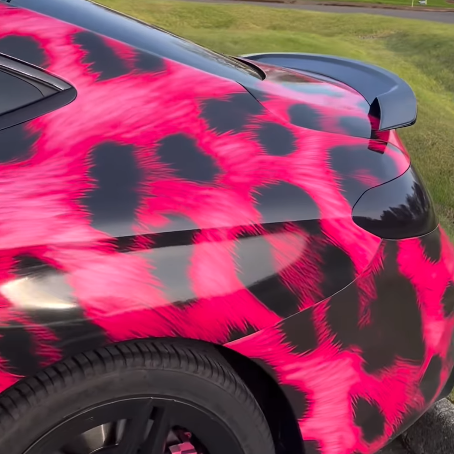
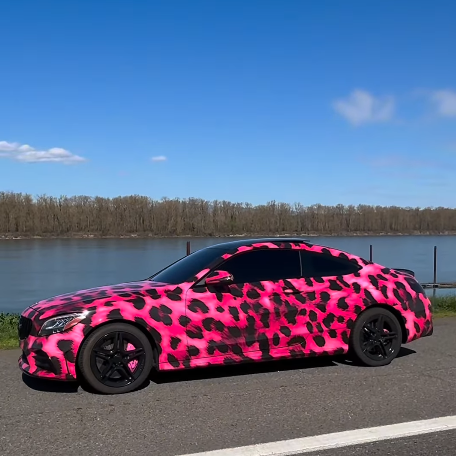
A leopard print car wrap turns an ordinary vehicle into something unmistakably personal. But today’s leopard wraps no longer have to mean traditional tan, brown, and black animal print. Pink leopard spots, black-on-black stealth patterns, purple gradients, oversized graphics, and custom two-tone combinations can completely change how the pattern feels on a vehicle.
The real challenge is not deciding whether leopard print looks bold—it does. The challenge is choosing the right colors, spot scale, finish, placement, and vehicle-specific layout so that the finished wrap looks intentional rather than visually overcrowded.
This guide explains the best leopard print car wrap colors and design ideas, which vehicles work particularly well with the pattern, the advantages and disadvantages of printed leopard wraps, and what to consider before ordering a custom design.
Featured Snippet: What Is a Leopard Print Car Wrap?
A leopard print car wrap is a printed automotive vinyl wrap featuring leopard-inspired spots or rosette patterns. Unlike paint, a custom printed wrap can combine leopard graphics with virtually any background color, gradient, logo, stripe, or personalized artwork.
Popular combinations include:
- Classic tan + black leopard
- White + black leopard
- Pink + black leopard
- Purple + black leopard
- Red + black leopard
- Grey + black leopard
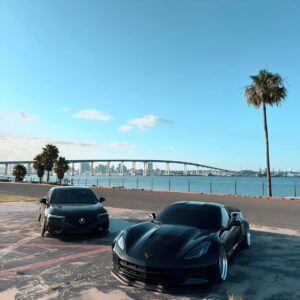
- Black-on-black stealth leopard
- Gradient + leopard print
A leopard wrap can cover the entire vehicle or be used selectively on the hood, roof, doors, quarter panels, mirrors, or other accent areas.
For drivers who want something more individual than a standard factory color, a custom leopard print car wrap provides considerably more design freedom because the pattern, color, scale, and positioning can all be customized.
Why Leopard Print Works So Well as a Car Wrap
Leopard print is unusually well suited to vehicle wrapping because it combines organic shapes with strong visual contrast.
A car is not a flat canvas. Its body consists of doors, fenders, bumpers, curves, recesses, panel gaps, mirrors, handles, and aerodynamic surfaces. Highly geometric patterns can sometimes expose alignment differences between those panels.
Leopard patterns are more forgiving.
Because leopard spots naturally vary in shape, orientation, and spacing, slight changes caused by body curvature generally feel like part of the design rather than an obvious interruption.
This is an important distinction between designing a pattern for a computer screen and designing one for a vehicle.
Avery Dennison’s professional wrap-training material makes a similar broader point about printed graphics: a digital layout is a two-dimensional representation being transferred onto a three-dimensional vehicle. The installed result therefore does not necessarily reproduce a flat mockup with perfect geometric accuracy.
That makes vehicle-specific design planning particularly important for custom printed wraps.
Best Leopard Print Car Wrap Colors
Color changes the personality of leopard print more dramatically than many people expect.
Instead of asking only, “Which leopard color looks best?”, it is more useful to ask:
What character do you want the vehicle to communicate?
Here are some of the strongest combinations.
1. Classic Tan, Brown & Black Leopard
This is the most recognizable interpretation of leopard print.
Typical palette:
Tan / Beige + Brown + Black
Best for:
Luxury SUVs, coupes, lifestyle builds, fashion-inspired cars and retro-themed vehicles.
Why it works:
Warm colors preserve the visual connection with natural leopard fur, so the design remains immediately recognizable even from a distance.
Design Tip:
Avoid making every spot identical. Natural-looking variations in size and spacing create a more convincing pattern.
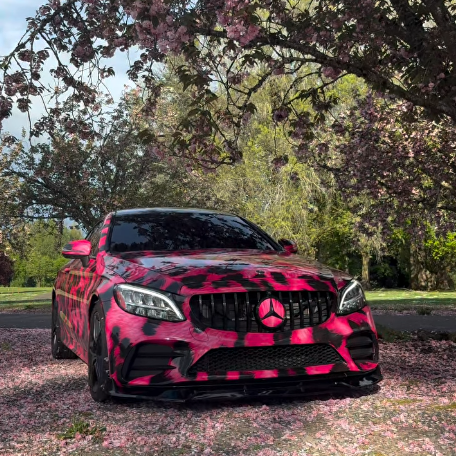
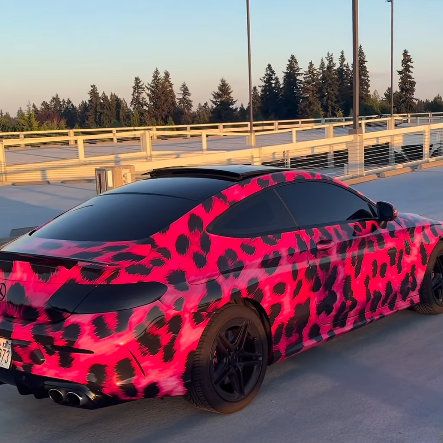
2. Pink Leopard Print Car Wrap
Pink completely changes the personality of leopard print.
Rather than trying to imitate an animal pattern realistically, a pink leopard print car wrap becomes a fashion statement.
Strong combinations include:
Hot Pink + Black
Baby Pink + White
Pink + Grey
Pink-to-Black Gradient + Leopard Spots
The last option is particularly interesting because the leopard graphics can gradually disappear into the darker portion of the vehicle.
ALUKOVINYL has already produced a customer design using a pink-to-black gradient combined with leopard graphics on a Kia K5, demonstrating how animal print can be integrated into a larger custom composition rather than simply repeated across every panel.
3. White & Black Leopard Print
For a cleaner and more modern interpretation, remove the traditional brown completely.
White + black creates extremely clear contrast while retaining the recognizable leopard pattern.
Works particularly well on:
- Tesla Model 3
- Tesla Model Y
- BMW 3 Series
- Porsche 718
- Toyota Supra
A useful variation is an off-white or pearl-grey background rather than pure white. This reduces the visual harshness while maintaining strong contrast.
4. Purple Leopard Print
Purple works especially well when the goal is a darker, more luxurious animal-print design.
Consider:
Lavender + Black — softer and more playful
Deep Purple + Black — aggressive and mysterious
Purple + Pink — highly expressive
Purple Gradient + Black Leopard — particularly effective on coupes
One advantage of purple is its range. A light lavender leopard design and a nearly-black violet design can share the same underlying pattern while creating completely different vehicles.
5. Red & Black Leopard Print
Red and black make the pattern considerably more aggressive.
This combination works particularly well on muscle cars and performance vehicles such as:
Ford Mustang
Dodge Challenger
Dodge Charger
Chevrolet Camaro
Chevrolet Corvette
Instead of covering the entire vehicle with spots, another approach is to concentrate the leopard pattern around the rear quarter panels and gradually transition into solid red toward the front.
That creates movement without overwhelming the body shape.
6. Black-on-Black Stealth Leopard
One of the most sophisticated leopard concepts does not rely heavily on color at all.
Matte Black Background + Gloss Black Leopard Spots
From a distance, the vehicle appears black.
Under sunlight or street lighting, however, the leopard pattern becomes visible as light reflects differently from the two surfaces.
This approach works especially well on luxury and performance vehicles where an extremely colorful animal print might compete too strongly with the original body design.
The Most Important Design Decision: Spot Size
Color receives most of the attention, but pattern scale can matter just as much.
Small leopard spots create a busier, textile-like appearance.
Large spots create stronger shapes that can be recognized from farther away.
Small Pattern
Best for:
- Mirrors
- Roofs
- Interior trim
- Small cars
- Accent panels
Medium Pattern
The safest choice for most full vehicle wraps.
It provides enough detail without turning the body into visual noise.
Oversized Leopard Pattern
Best for:
- SUVs
- Wide-body cars
- Pickup trucks
- Show cars
- Highly customized builds
Large patterns also give designers more opportunity to position individual spots around important body lines.
ALUKOVINYL Design Perspective
For a full custom wrap, we generally prefer to think of leopard spots as graphic elements rather than wallpaper.
Instead of simply repeating the same pattern from bumper to bumper, spot placement can follow the vehicle’s shape.
For example, the pattern can become larger over the rear quarter panel, become more sparse toward the hood, or blend into a gradient along the doors.
That makes the design feel created for the vehicle, rather than applied to it.
Leopard Print + Gradient: One of the Most Flexible Custom Ideas
Gradient backgrounds solve one of the biggest design challenges with animal-print wraps: visual overload.
Instead of maintaining the same contrast across the entire vehicle, the designer can gradually reduce it.
For example:
Pink → Black Gradient + Black Leopard
Front:
Bright pink with clearly visible spots
Middle:
Dark pink/purple transition
Rear:
Almost-black finish where the spots subtly disappear
The eye naturally moves along the vehicle instead of encountering an equally busy pattern everywhere.
This is especially effective on long-body cars such as the Kia K5, Dodge Charger, Porsche Panamera, BMW 5 Series, and many SUVs.
Full Leopard Wrap vs Partial Leopard Wrap
You do not necessarily need to wrap the entire vehicle.
Avery Dennison installer Blake Madsen notes that vehicle wraps can also be applied selectively to areas such as roofs, hoods, mirrors, and other accents.
For leopard designs, this creates several useful possibilities.
| Design | Visual Impact | Complexity | Best For |
|---|---|---|---|
| Full Leopard Wrap | Very High | High | Show builds / complete transformations |
| Leopard Hood | Medium | Low | Sports cars |
| Leopard Roof | Medium | Low | Sedans / hatchbacks |
| Leopard Rear Section | High | Medium | Performance cars |
| Leopard Side Graphics | High | Medium | Coupes / SUVs |
| Leopard Mirrors | Subtle | Low | First-time customizers |
| Gradient + Leopard | Very High | High | Fully customized builds |
A partial wrap can also make a strong pattern easier to live with over time.
Which Cars Look Best With Leopard Print?
Technically, leopard graphics can be designed for almost any vehicle. But certain body shapes provide particularly effective canvases.
BMW M3 / M4
Wide fenders and large side surfaces provide plenty of room for medium-to-large leopard patterns.
Recommended: Pink/black, purple/black or grey/black.
Porsche 911
The 911’s uninterrupted curves favor flowing patterns rather than rigid graphics.
Recommended: Classic leopard or black-on-black.
Dodge Challenger / Charger
Large panels allow oversized patterns without making individual spots feel cramped.
Recommended: Red/black, orange/black or purple/black.
Tesla Model 3 / Model Y
The minimalist body makes a strong printed wrap particularly noticeable.
Recommended: White/black, grey/black or pastel leopard.
Jeep Wrangler
Leopard print can complement the Wrangler’s more adventurous visual identity.
Recommended: Tan/black, olive/black or sand/black.
Kia K5
The long profile gives designers enough space to combine gradients and leopard graphics effectively.
A real ALUKOVINYL customer project used a pink-to-black gradient leopard design on a Kia K5, illustrating this approach particularly well.
Designing Leopard Print for a Real Vehicle
This is where professional custom wrap design differs from simply downloading an animal-print image.
1. Design Around Important Body Features
Do not allow the most visually important leopard spots to fall directly across:
- Door handles
- Panel gaps
- Fuel doors
- Parking sensors
- Sharp bumper transitions
These elements can interrupt the graphic.
2. Consider the Vehicle in 3D
A digital mockup is only a preview.
Professional wrap-training material from Avery Dennison specifically notes that a two-dimensional printed layout is being adapted to a three-dimensional vehicle, meaning the installed graphic may not align exactly like the flat artwork.
That is why final positioning should account for panel boundaries and installer adjustment.
3. Use High-Quality Artwork
Custom printed graphics expose low-resolution artwork quickly because a small computer image may eventually be enlarged across several feet of vehicle bodywork.
Vector artwork is ideal for scalable patterns.
When raster artwork is necessary, high-resolution source files should be used.
General professional print guidelines from Avery recommend 300 dpi at final print size for artwork and favor CMYK workflows when predictable printed color is important.
Vehicle-wrap production specifications can differ from label and commercial-print workflows, so your wrap printer should ultimately determine the correct file setup.
4. Request a Mockup Before Production
A vehicle-specific mockup allows you to evaluate:
- Pattern size
- Color balance
- Spot density
- Gradient direction
- Graphic placement
- Overall visual weight
At ALUKOVINYL, custom production begins only after the customer approves the final design.
This matters especially with leopard patterns because a design that looks balanced on a rectangular image can feel dramatically different once mapped onto doors, fenders, bumpers, and windows.
Pros and Cons of Leopard Print Car Wraps
Pros
Extremely Customizable
Colors, pattern size, gradients, spot density, orientation and placement can all be changed.
More Distinctive Than Most Solid Colors
Traditional blacks, whites, greys and reds remain major mainstream wrap colors. A printed leopard design intentionally moves in the opposite direction: individuality rather than neutrality.
Works With Partial Wraps
You can use leopard graphics on only the hood, roof, doors or rear section.
Removable
One major advantage of automotive wrap film is the ability to change the vehicle’s appearance without committing to a permanent custom paint design.
Vehicle-Specific Design
Custom printing allows graphics to be adapted to the proportions and character of a specific model.
Cons
Pattern Alignment Requires More Planning
Printed graphics require careful positioning between panels.
Installation Is Less Forgiving
Misalignment that might be invisible on solid vinyl can become obvious when a printed pattern needs to continue across two panels.
Repairs May Be More Complicated
If one damaged section needs replacement, reproducing the correct pattern position and color can require matching the original production artwork.
Strong Designs Are Not for Everyone
Leopard print intentionally attracts attention. Buyers looking for an OEM-like appearance may prefer solid gloss, satin, metallic or matte colors.
Digital Color Is Not Exact Physical Color
Phone and computer screens reproduce color differently from printed vinyl. Always treat digital renderings as visual references rather than perfect physical color samples.
Leopard Print vs Other Custom Car Wrap Designs
| Style | Visual Character | Customization | Design Complexity |
|---|---|---|---|
| Leopard Print | Wild / Fashion-forward | Very High | Medium–High |
| Camo | Rugged / Tactical | High | Medium |
| Anime / Itasha | Artistic / Character-driven | Extremely High | Very High |
| Racing Graphics | Performance-oriented | High | High |
| Gradient | Modern / Fluid | Very High | Medium–High |
| Marble | Luxury / Artistic | High | Medium |
| Geometric | Futuristic / Structured | High | High |
| Solid Color | Clean / Minimal | Moderate | Low |
There is no universally superior style.
The better question is whether the design matches the vehicle, owner, intended visual impact, and willingness to maintain a highly customized finish.
Leopard Wrap vs Paint
For complex leopard graphics, vinyl has one particularly important advantage over custom paint: design reversibility.
A professionally installed vehicle wrap can later be removed and replaced with another style.
According to Avery Dennison installer guidance, this ability to change a vehicle’s appearance without committing permanently to one design is one of the major reasons wraps have become an important form of vehicle customization.
Paint may still be preferable when a permanent finish, restoration-level result, or highly specialized painted artwork is the goal.
For owners who enjoy changing their vehicle’s appearance, however, printed vinyl provides much more flexibility.
How to Care for a Leopard Print Vinyl Wrap
Printed wraps should be treated as automotive graphics rather than factory paint.
Basic care can make a significant difference.
Hand wash whenever possible.
3M recommends hand washing wrapped vehicles and advises using touchless washing when automatic washing is unavoidable because brushes may scratch or dull the film or lift graphic edges.
Remove contaminants quickly.
Fuel, bird droppings, tree sap and similar contaminants should not remain on the film longer than necessary.
Reduce unnecessary UV and heat exposure.
Whenever practical, park indoors, under a cover or in shade. 3M similarly recommends protected parking to help wrapped film maintain its appearance.
Avoid aggressive pressure washing around edges.
Edges, seams and corners deserve particular care because excessive pressure can contribute to lifting.
The service life of any printed wrap depends on the specific film system, printing and lamination method, installation quality, climate, vehicle storage, exposure orientation and maintenance. Avoid assuming that every custom printed wrap will have the same lifespan.
How ALUKOVINYL Custom Leopard Wraps Work
Creating a custom leopard wrap should be a collaborative process rather than simply selecting a generic pattern.
ALUKOVINYL uses a four-step custom workflow:
Step 1 — Choose Your Vehicle Size
Current standard custom-wrap options include:
Sedan — 59 ft
SUV — 69 ft
Pickup — 79 ft
Vehicle geometry varies, so size selection should still be checked against the specific model and intended coverage.
Step 2 — Confirm Your Design
Provide your vehicle information and describe the design you want.
Examples:
“Pink-to-black gradient with medium black leopard spots.”
“Matte grey base with oversized dark leopard pattern.”
“Classic tan leopard but with fewer spots toward the hood.”
Step 3 — Review Your Vehicle Mockup
A vehicle-specific preview is prepared so the design can be reviewed before production.
Changes can be requested during this stage.
Step 4 — Approve & Produce
Production begins after the final design has been approved.
Explore the ALUKOVINYL Leopard Print Custom Car Wrap to create your own combination of color, pattern and vehicle-specific graphics.
FAQ About Leopard Print Car Wraps
Can I customize the colors of a leopard print car wrap?
Yes. Leopard print does not need to use natural tan and black colors. Pink, purple, white, red, grey, green, gradients and other combinations can be incorporated into a custom printed design.
Can you make pink leopard print car wraps?
Yes. Pink and black is one of the most visually distinctive combinations, and it can also be combined with white, grey or gradient backgrounds.
Can leopard print be combined with a gradient?
Yes. Gradient + leopard is particularly effective because the visibility of the pattern can change progressively across the vehicle.
Can I wrap only part of my car in leopard print?
Yes. Popular partial-wrap areas include the hood, roof, mirrors, doors, rear quarter panels and trunk.
What size leopard pattern should I choose?
Medium-scale patterns are generally the most versatile for complete vehicles. Smaller spots create a busier look, while oversized patterns are particularly effective on SUVs, pickups, wide-body vehicles and show builds.
Will leopard print line up perfectly between every body panel?
A professional design can be planned for continuity, but a vehicle is a three-dimensional object with panel gaps, curved surfaces and separate components. Some installation adjustment is normal. Important graphic elements should therefore be positioned with real vehicle geometry in mind.
Is a leopard print wrap permanent?
No. Automotive vinyl wraps are designed as removable surface films, although correct installation and removal techniques remain important.
Does a car wrap protect the original paint?
A wrap creates a physical layer over the covered paint and can reduce direct exposure to minor environmental contact, but vinyl wrap should not be confused with dedicated paint protection film. It is primarily a restyling product.
How should I wash a leopard print wrap?
Hand washing is generally preferable. Avoid aggressive brushes, harsh chemicals and unnecessary high-pressure spraying around seams and edges.
Can I submit my own leopard design?
Custom artwork can be used when it is suitable for large-format production. High-resolution or vector artwork is preferable, and a vehicle mockup should be reviewed before printing.
Final Thoughts: Make the Pattern Fit the Car
The best leopard print car wrap is not necessarily the loudest one.
Successful designs balance three things:
color + pattern scale + vehicle shape.
A Porsche 911 may benefit from flowing medium-sized leopard spots that complement its curved body. A Dodge Challenger can carry a much larger pattern. A Tesla may look striking with a minimalist monochrome interpretation, while a Kia K5 can provide enough horizontal space for a pink-to-black leopard gradient.
That is the advantage of custom printing: you are not limited to choosing a pattern from a fixed catalog.
You can determine where the leopard pattern begins, how large the spots become, which colors dominate, how the graphics interact with the body lines, and how dramatic the final vehicle should be.
If you want a traditional animal-inspired look, start with tan, brown and black.
If you want something fashion-driven, explore pink, lavender or white.
If you prefer a darker premium appearance, consider black-on-black or deep purple.
And if none of those combinations feels personal enough, build your own.