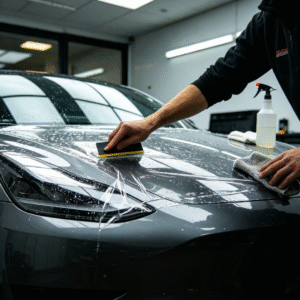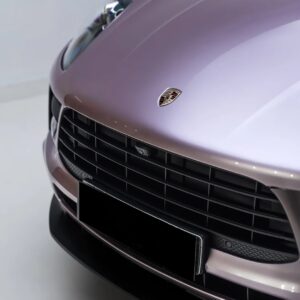
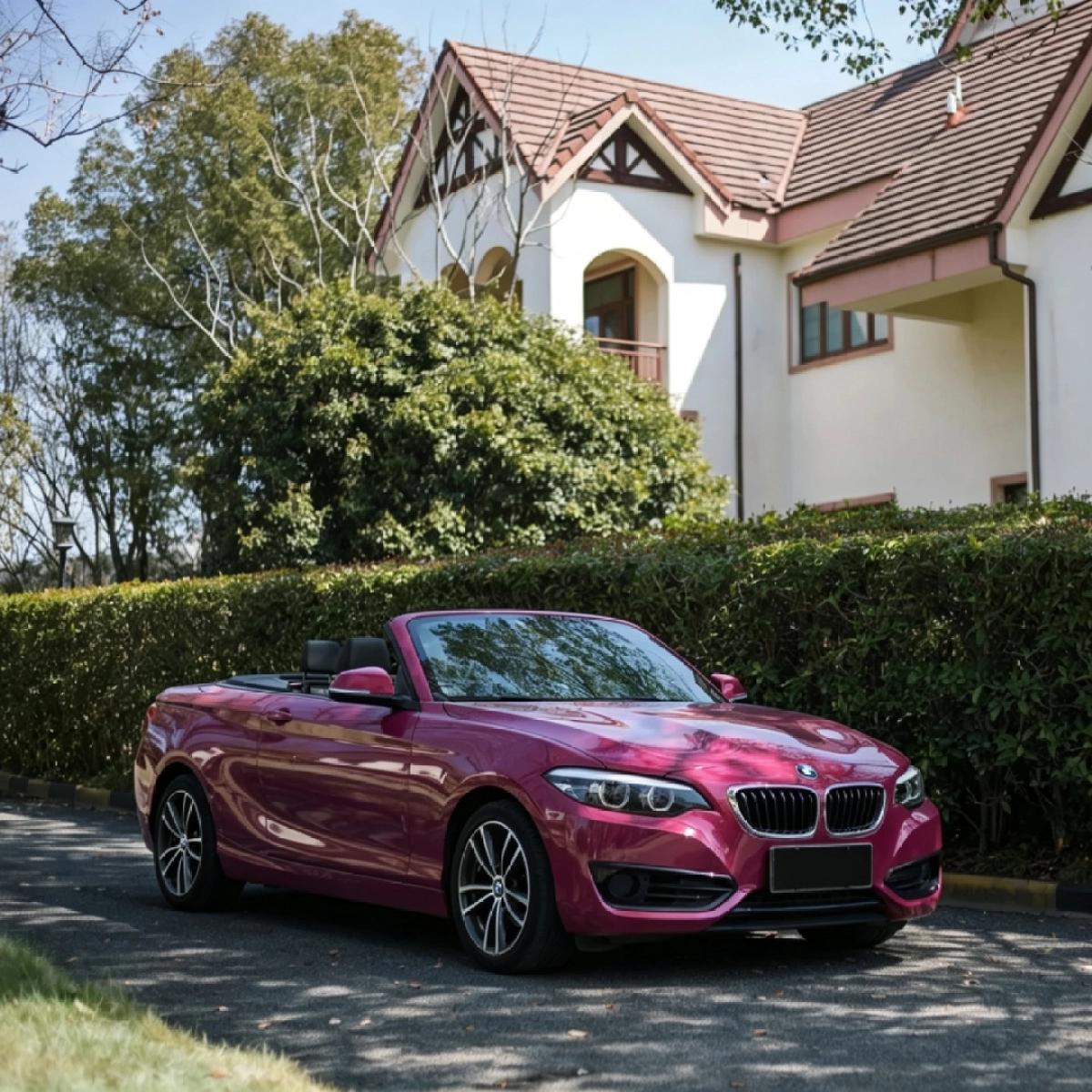
Ruby Star is one of those automotive colors that rarely disappears into traffic. Sitting somewhere between vivid red, magenta and deep pink depending on the light, it can dramatically change the personality of a sports car, sedan or SUV.
Ruby Star PPF takes that appearance and combines it with a TPU-based paint protection film, allowing owners to change the vehicle’s color while adding a physical protective layer over the original paint.
That sounds straightforward, but choosing color PPF requires more consideration than choosing a color from a photograph.
Material construction, gloss, installation quality, impact protection, UV stability, self-healing behavior, expected service life and cost all affect whether color PPF makes sense for a particular vehicle.
ALUKOVINYL manufactures and sells Ruby Star PPF, so this guide has an unavoidable commercial connection to the product. For that reason, manufacturer-reported specifications are identified as such rather than presented as independently verified performance.
This guide examines what Ruby Star PPF is, how it compares with vinyl and clear PPF, its advantages and disadvantages, technical specifications, installation considerations and the types of vehicles on which this distinctive color works particularly well.
Featured Snippet: What Is Ruby Star PPF?
Ruby Star PPF is a colored thermoplastic polyurethane (TPU) paint protection film that combines a glossy red-magenta color transformation with a protective layer over automotive paint. Unlike conventional vinyl, its primary material platform is PPF, so it is designed to provide both styling and protection against common road and surface damage.
ALUKOVINYL’s TPU Glossy Ruby Star Colored PPF is manufacturer-rated for 5–7 years of expected durability and lists a gloss value of 94, 93A hardness, 370.23% elongation at break and 22.32 MPa tensile strength.
These figures should be understood as ALUKOVINYL’s published specifications rather than results independently verified for this article.
Why Is Ruby Star Such a Distinctive Automotive Color?
Ruby Star sits outside the conventional definition of red.
In bright sunlight, the finish can appear vivid and energetic, with noticeable pink or magenta character. Under shade or softer lighting, the color can appear deeper and closer to saturated ruby red.
This variability makes Ruby Star particularly effective on vehicles with strong body lines.
Instead of simply covering the car with one visually flat color, the changing reflections across doors, fenders, bumpers and quarter panels can emphasize the vehicle’s geometry.
This is one reason the color tends to work particularly well with:
- Black wheels
- Gloss-black trim
- Carbon-fiber components
- Dark panoramic roofs
- Black aerodynamic packages
- Yellow or black brake calipers
Ruby Star is therefore not necessarily a universal color.
Someone looking for an understated OEM-style transformation may prefer gray, black, white or a muted metallic finish.
For someone who wants the vehicle to become visually distinctive, however, Ruby Star occupies an interesting space between red, pink and magenta.
How Does Ruby Star PPF Work?
Ruby Star PPF should not be confused with ordinary colored vinyl.
The fundamental material is TPU — thermoplastic polyurethane — rather than the PVC commonly associated with conventional vehicle color-change films.
A modern PPF system typically combines several functional components:
Top coat → TPU film → adhesive → release liner
The top coat influences properties such as gloss, stain resistance, hydrophobicity and self-healing behavior.
The TPU layer provides flexibility and physical protection.
The adhesive bonds the film to the painted surface.
The exact chemistry differs between manufacturers, which is why two products described simply as “TPU PPF” should not automatically be assumed to perform identically.
That distinction is important when comparing manufacturers.
3M, for example, describes its Series 150 PPF as protecting paint against stone chips, scratches, bugs, road tar, staining and harsh outdoor weathering, including UV exposure. It also incorporates heat-activated self-healing for minor scratches.
That establishes what a modern premium PPF system can be engineered to do.
It does not, however, independently validate every performance claim made for Ruby Star PPF.
Ruby Star PPF Technical Specifications
ALUKOVINYL currently publishes the following specifications for its Ruby Star PPF:
| Specification | ALUKOVINYL Published Value |
|---|---|
| Base material | Covestro |
| Adhesive | American Ashland (Bostik) |
| Finish | TPU Gloss |
| Standard roll | 5 ft × 49.5 ft |
| Expected durability | 5–7 years |
| Hardness | 93A |
| Glossiness | 94 |
| UV resistance | 98.5% |
| Tensile strength | 22.32 MPa |
| Elongation at break | 370.23% |
| Tearing strength | 68.52 KN/m |
| 24-hour peel strength | 1932 gf/inch |
| Application | Wet & Dry |
| Claimed features | Hydrophobic, scratch- and stain-resistant |
Important E-E-A-T disclosure
These are manufacturer-reported specifications.
They should not be interpreted as an independent laboratory comparison demonstrating that Ruby Star PPF performs better than 3M, Tinybot, TeckWrap or another PPF manufacturer.
This distinction matters.
A useful PPF comparison should ideally consider standardized measurements for:
- Film thickness
- Tensile strength
- Elongation
- Peel adhesion
- Weathering
- UV exposure
- Yellowing
- Stain resistance
- Gravel-chip resistance
- Hydrophobicity
- Shrinkage
- Self-healing behavior
- Long-term color stability
Until comparable third-party testing is available across brands, technical specification tables are best used as a screening tool rather than absolute proof of real-world superiority.
How Does Ruby Star PPF Compare With Modern Premium PPF?
One useful industry benchmark is 3M Paint Protection Film Series 150.
3M’s published technical documentation lists Series 150 at approximately 190 μm overall thickness and describes self-healing, stain resistance, hydrophobic properties, conformability and a 10-year consumer warranty subject to warranty terms.
This comparison should not be interpreted as saying Ruby Star PPF equals 3M Series 150.
The products are also designed for different purposes.
3M Series 150 is primarily positioned as a virtually invisible clear protective film.
Ruby Star PPF is simultaneously a color-change product and protective film.
That difference matters because adding color introduces another performance consideration:
color stability.
For a clear PPF, consumers primarily evaluate transparency, yellowing, gloss and protection.
For a color PPF, consumers also need to consider:
- Pigment stability
- Color consistency
- Panel matching
- Replacement-panel matching
- UV-related color change
- Lot-to-lot variation
Color PPF therefore solves an additional styling problem but also introduces additional variables.
Ruby Star PPF vs. Vinyl Wrap
This is probably the most useful comparison for someone who simply wants a Ruby Star-colored vehicle.
A traditional car wrap is primarily designed for appearance.
Ruby Star PPF attempts to combine appearance with physical paint protection.
| Feature | Ruby Star PPF | Ruby Star Vinyl |
|---|---|---|
| Primary material | TPU | Usually PVC/PET-supported vinyl system |
| Main objective | Protection + color change | Color change |
| Stone-chip protection | Higher protective intent | Limited |
| Self-healing | Available depending on PPF construction | Generally not equivalent to TPU PPF |
| Material thickness | Generally greater | Generally thinner |
| Installation | More specialized | Widely understood by wrap installers |
| Color transformation | Yes | Yes |
| Graphics/printing | Limited | Excellent |
| Upfront cost | Higher | Lower |
| Best use | Protection + long-term styling | Styling and lower-cost color change |
Neither material is universally better.
If your objective is primarily to change the vehicle’s appearance and you expect to switch colors frequently, vinyl can make more financial sense.
If your priority is maintaining the original paint while simultaneously converting the vehicle to Ruby Star, color PPF becomes more compelling.
Ruby Star PPF vs. Clear P
Clear PPF represents another important alternative.
Suppose you already own a Porsche, BMW, Tesla or Mercedes in a factory color you genuinely like.
In that situation, installing clear PPF may be more logical than covering the original color.
Clear PPF preserves the factory appearance while adding protection.
Ruby Star PPF solves a different problem:
“I want PPF protection, but I also want my car to become Ruby Star.”
That makes the decision relatively straightforward.
Choose clear PPF when you want to preserve the factory appearance.
Choose Ruby Star PPF when you want to change the color while adding a protective film.
What Does Ruby Star PPF Look Like on Different Cars?
Ruby Star does not look identical on every vehicle.
Body shape, black trim, wheel design, glass area and lighting can significantly change the overall effect.
Ruby Star PPF on a Porsche Taycan
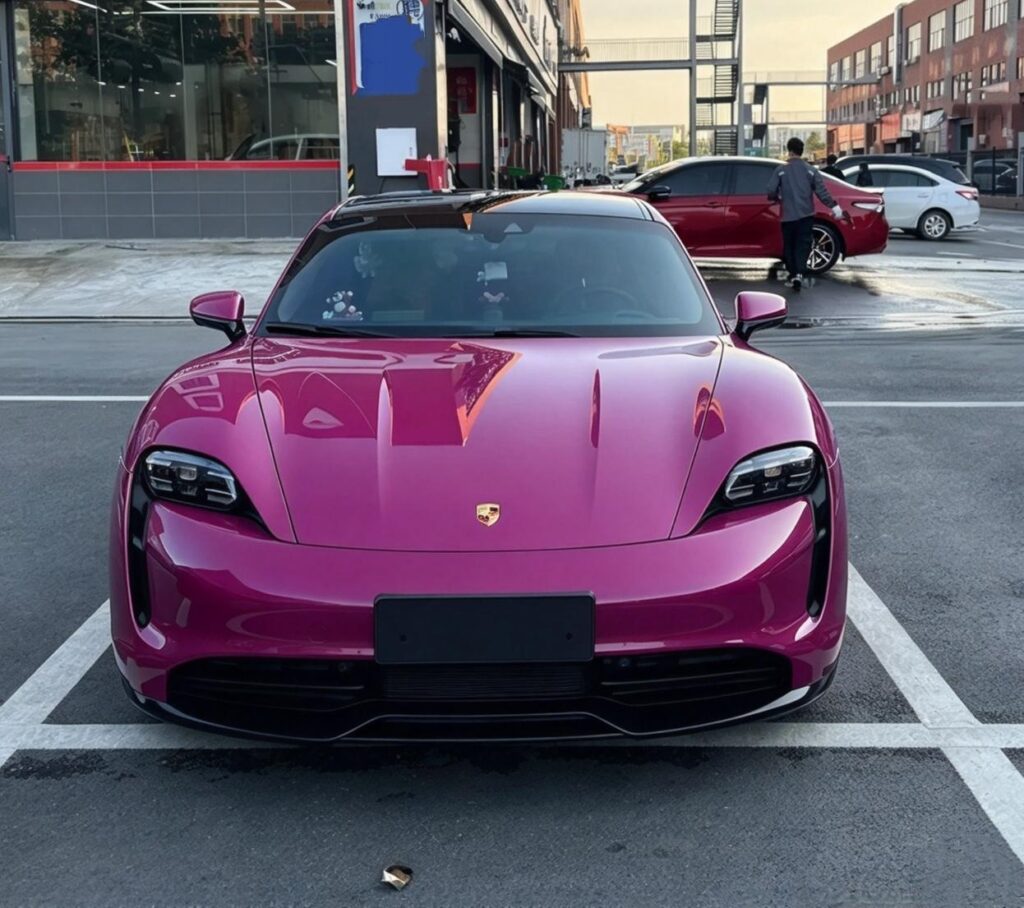
Ruby Star PPF on Porsche Taycan
A Porsche Taycan is one of the most natural candidates for this type of color.
Its rounded fenders create large highlight transitions, allowing a glossy Ruby Star surface to shift visually between bright magenta-red highlights and deeper ruby shadows.
Black wheels and exposed carbon-fiber details can create a strong contrast without introducing another competing color.
Ruby Star PPF on a BMW M4
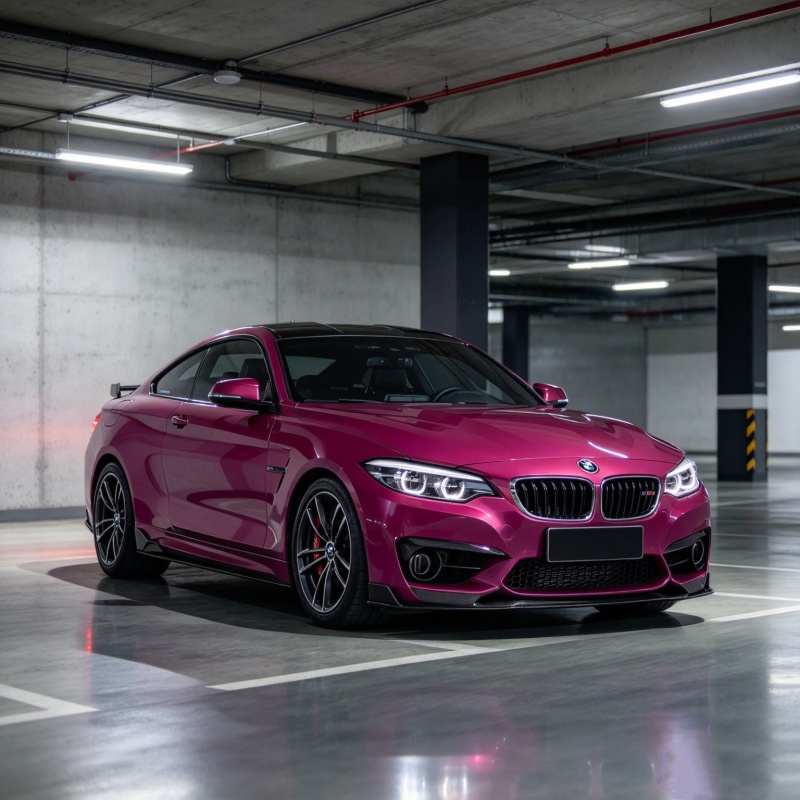
BMW M4 wrapped in glossy Ruby Star color PPF
The M4 has considerably more angular surfaces than the 911.
Ruby Star can emphasize the hood contours, front fenders, shoulder lines and aggressive rear quarter panels.
A black roof, dark grille and black wheels create an especially strong contrast.
Ruby Star PPF on a Tesla Model 3
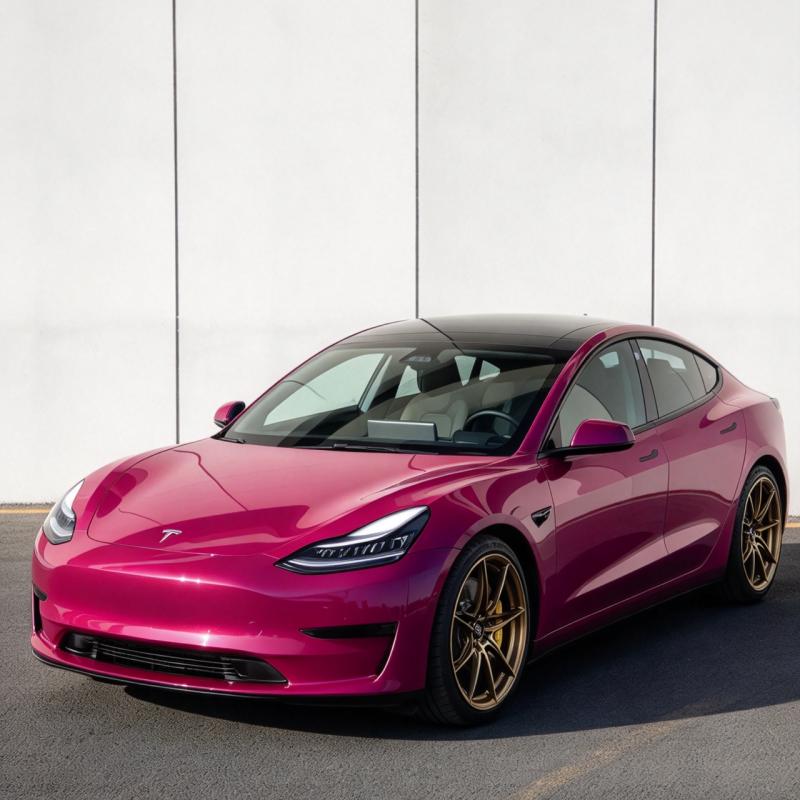
Tesla Model 3 with TPU Ruby Star PPF
Tesla’s relatively minimalist body design creates a different result.
Large, smooth panels allow Ruby Star to become the dominant visual element rather than competing with complicated styling details.
For owners wanting to distinguish a Model 3 from the common white, gray and black examples on the road, a vivid color can dramatically change its character.
Ruby Star PPF on a Lamborghini Huracán
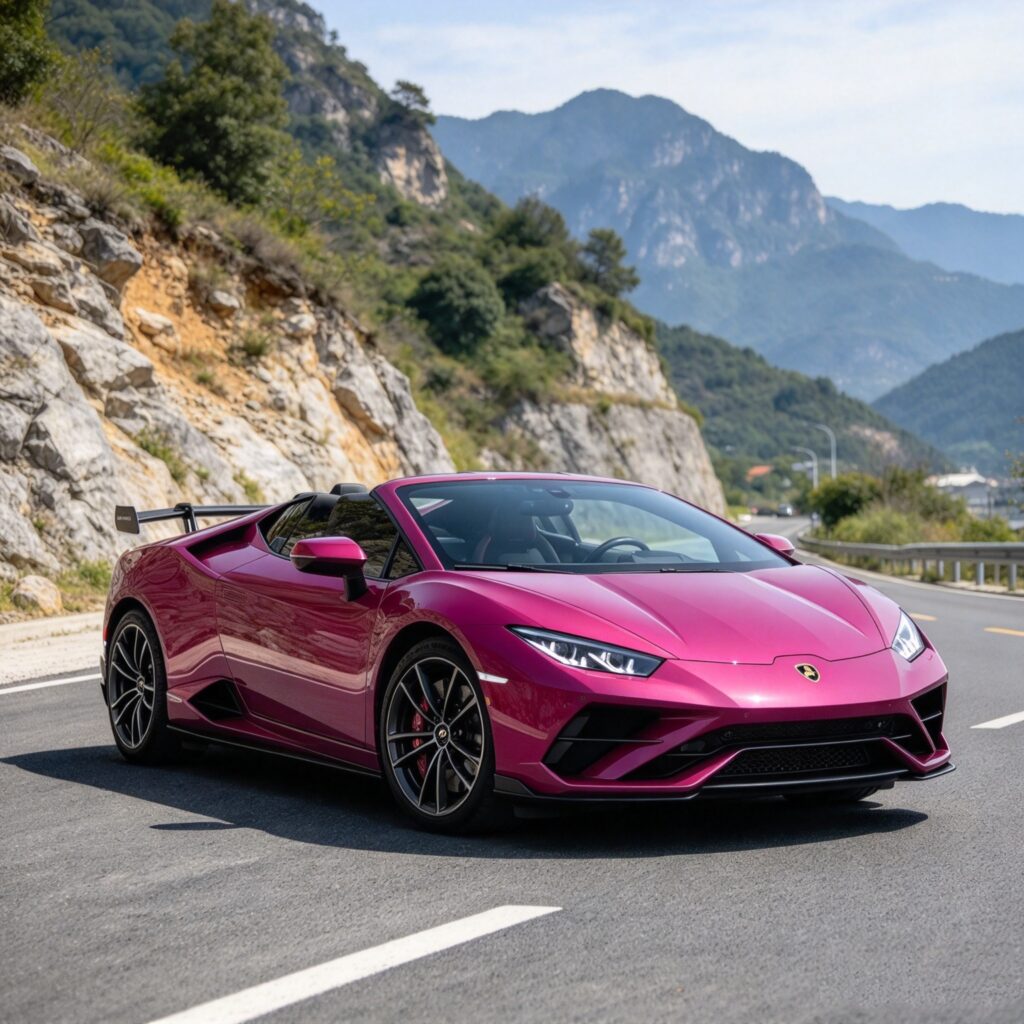
Lamborghini Huracán protected with glossy Ruby Star PPF
Ruby Star becomes much more dramatic on a supercar.
Sharp body lines create high-contrast reflections across the color, while black aerodynamic components help frame the vivid finish.
The trade-off is installation complexity.
Deep bumper openings, sharp contours and aerodynamic components require considerably more installer skill than large flat panels.
Pros and Cons of Ruby Star PPF
A trustworthy buying guide should explain where the product makes sense — and where it does not.
Advantages
1. Color change and protection in one film
The most obvious advantage is eliminating the need to choose between a color transformation and a protective film.
2. Distinctive high-gloss appearance
Ruby Star offers substantially more visual impact than conventional clear PPF.
3. TPU construction
The TPU platform is designed around protection and conformability rather than color change alone.
4. Self-healing functionality
The manufacturer describes the film as thermally self-healing, intended to help minor surface scratches recover under suitable heat.
5. Hydrophobic surface
A hydrophobic top coat can make water and some contamination easier to remove during routine washing.
6. Protects the factory color underneath
Owners can obtain a radically different exterior appearance without permanently repainting the original finish.
Disadvantages
1. More expensive than conventional vinyl
Color PPF combines protection and color, so its material and installation costs are generally higher than style-focused vinyl.
If protection is not important to you, paying for PPF may provide limited additional value.
2. Requires an experienced PPF installer
A highly skilled vinyl installer is not automatically a highly skilled PPF installer.
PPF involves different material behavior, solution control, stretch management and edge finishing.
3. Difficult repairs can create color-matching issues
If one panel needs replacement several years later, a newly installed piece may not perfectly match film that has already experienced years of sunlight and environmental exposure.
This is a potential limitation of virtually any colored exterior film.
4. Bold color limits universal appeal
Ruby Star is intentionally conspicuous.
Someone considering resale or preferring an understated OEM appearance may find a neutral color more practical.
5. Manufacturer specifications are not independent validation
The 5–7 year durability, 98.5% UV resistance and other figures discussed above are ALUKOVINYL-published specifications.
Until those exact claims are supported by accessible independent testing, buyers should not treat them as equivalent to third-party certification.
This is one of the most important limitations to disclose.
What Do Other Color PPF Brands Tell Us?
The broader market helps put Ruby Star PPF into context.
Tinybot currently lists multiple PPF systems at 7.5 mil, with published measurements for self-healing temperature, hydrophobic contact angle, elongation and peel adhesion. Its current PPF comparison page also lists a 10-year limited warranty across its core lineup.
This illustrates how the PPF market is moving toward publishing more measurable specifications rather than relying solely on descriptions such as “premium” or “high protection.”
3M takes an even more technical approach with detailed product bulletins covering thickness, application, self-healing and warranty conditions.
For consumers, this leads to an important buying rule:
Do not compare color PPF by color alone.
Ask the seller or installer about:
- Base polymer
- Total thickness
- Top-coat technology
- Adhesive
- Elongation
- Weathering testing
- UV testing methodology
- Stain resistance
- Warranty
- Installation requirements
The prettiest sample book does not necessarily identify the best film for your application.
Installation Matters as Much as the Film
Even premium material can perform poorly if installation is inadequate.
Ruby Star PPF should be installed over a properly prepared surface.
Before installation, contaminants such as wax, grease, road tar and embedded particles should be removed.
Paint condition should also be inspected.
PPF does not repair:
- Peeling clear coat
- Deep scratches
- Rust
- Poor repaint work
- Uncured paint
- Existing body damage
Installation technique becomes particularly important around bumpers, mirrors, air intakes and compound curves.
Excessive stretching can reduce film thickness and may affect appearance.
For a color PPF installation, edge quality is also highly visible because exposed factory paint can create obvious contrasting lines.
For this reason, consumers should evaluate an installer’s PPF portfolio, rather than asking only whether the shop has experience wrapping cars.
How Long Can Ruby Star PPF Last?
ALUKOVINYL currently states an expected durability of 5–7 years for Ruby Star PPF.
That number should be treated as a manufacturer expectation, not a guarantee that every installation will look identical after seven years.
Actual service life can be affected by:
- Climate
- UV exposure
- Outdoor parking
- Mileage
- Road conditions
- Washing technique
- Chemical exposure
- Installation quality
- Maintenance
- Vehicle storage
A garage-kept weekend car in a mild climate and an outdoor daily driver in Arizona do not experience the same environment.
This is why universal statements such as “PPF lasts exactly seven years” should be avoided.
Is Ruby Star PPF Worth It?
The answer depends on what problem you are trying to solve.
Ruby Star PPF makes the strongest case when you want:
Ruby Star color + paint protection + glossy finish + TPU construction in one installation.
It makes less economic sense when you simply want a temporary Ruby Star color and do not care about additional protection.
In that situation, conventional vinyl may be the more appropriate product.
Similarly, if you already love the vehicle’s factory paint, clear PPF may accomplish your actual goal more efficiently.
This is why the question should not be:
“Is color PPF better than vinyl?”
A better question is:
“Which material solves my particular styling and protection requirements with the fewest unnecessary compromises?”
Frequently Asked Questions About Ruby Star PPF
What color is Ruby Star PPF?
Ruby Star is a vivid red-magenta color that can appear more red, pink or ruby depending on lighting conditions, body shape and reflections.
Is Ruby Star PPF the same as Ruby Star vinyl?
No. They can produce similar color transformations, but Ruby Star PPF uses a TPU protective-film platform, whereas conventional color-change wrap is primarily designed for styling.
Does Ruby Star PPF protect against rock chips?
Paint protection film is designed to provide a physical barrier between road debris and automotive paint. However, no PPF can guarantee protection against every impact. Protection depends on film construction, impact severity and installation.
Can Ruby Star PPF self-heal scratches?
ALUKOVINYL lists thermal self-healing among the product’s features. Self-healing generally applies to minor surface marks rather than deep cuts, tears or punctures.
How long does Ruby Star PPF last?
ALUKOVINYL lists expected durability at approximately 5–7 years. Actual service life varies according to climate, installation, vehicle use and maintenance.
Is Ruby Star PPF better than clear PPF?
They solve different problems. Clear PPF preserves the factory color, while Ruby Star PPF changes the vehicle’s appearance while providing a protective film layer.
Is Ruby Star PPF better than vinyl wrap?
Ruby Star PPF is more appropriate when paint protection is important. Vinyl is generally more appropriate when affordable styling, graphics or frequent color changes are the priority.
Can Ruby Star PPF be installed on a daily driver?
Yes, provided the underlying paint is suitable and the film is installed correctly. Daily drivers are also where protective-film functionality can be particularly relevant because of repeated road exposure.
Final Perspective: Protection First, Color Second
Ruby Star PPF represents an interesting evolution in vehicle customization.
Traditional car wrap focuses primarily on appearance.
Clear tpu wrap focuses primarily on preserving paint.
Modern color ppf attempts to combine both goals.
Ruby Star pushes that concept further by using one of the most visually distinctive colors in the category.
But buyers should look beyond the color.
The important questions are whether the film’s construction, installation requirements, published specifications, expected durability and price align with how the vehicle will actually be used.
ALUKOVINYL publishes detailed specifications for its Ruby Star product, including its TPU base, gloss, tensile strength, elongation and expected durability. Those numbers provide useful information for comparison, but they remain manufacturer-provided data unless independently verified.
That distinction does not make the specifications meaningless.
It simply makes the buying decision more transparent.
For a customer who wants only an inexpensive color transformation, conventional vinyl may still be the more sensible solution.
For someone who loves the original paint, clear PPF may be preferable.
But for an owner who specifically wants a vivid Ruby Star transformation and a TPU protective layer in the same installation, color PPF provides a compelling third option.
Explore ALUKOVINYL car wrap:
https://www.alukovinyl.com/
Compare tpu wrap:
https://www.alukovinyl.com/Paint-Protection-Film/
Browse additional color ppf:
https://www.alukovinyl.com/ALUKO-TPU-Car-Wrap/
View the exact ruby star ppf:
https://www.alukovinyl.com/TPU-Glossy-Ruby-Star-Colored-PPF-Paint-Protection-Film