Satin black PPF is a colored thermoplastic polyurethane (TPU) paint protection film that gives vehicles a smooth, low-sheen black finish while helping protect their original paint from stone chips, light scratches, and road debris. Unlike satin black vinyl wrap, it is engineered primarily as a protective film, although its performance depends on film construction, installation quality, and maintenance.
But is satin black paint protection film actually worth the additional investment? And does it work equally well on a Tesla, BMW, Mercedes-Benz, or Porsche?
The answers depend on more than appearance.
This guide examines satin black PPF through published manufacturer specifications, automotive installation considerations, real customer-submitted vehicle examples, and comparisons with competing products.
Editorial disclosure: ALUKOVINYL manufactures and sells automotive wrapping films, including the satin black PPF discussed here. Product-specific performance figures are identified as manufacturer-reported specifications. Competitor information comes from publicly available manufacturer materials. This article is not an independent laboratory evaluation.
What Is Satin Black PPF, and How Does It Work?
Satin black PPF is a colored paint protection film designed to create a black finish with controlled, subdued reflections rather than a highly reflective gloss or an extremely flat matte appearance.
Its appearance comes from a combination of black pigmentation and surface-coating technology.
Most modern automotive PPF products use a flexible polyurethane-based construction, although individual formulations vary.
A typical colored TPU PPF system includes:
- Protective top coat: Helps resist surface contamination and minor abrasion.
- Colored TPU layer: Provides flexibility, impact resistance, and the desired appearance.
- Adhesive layer: Bonds the material to properly prepared automotive paint.
- Release liner: Protects the adhesive before application.
The important distinction is that satin black PPF is not simply black vinyl with a different name.
Conventional automotive vinyl is primarily engineered for appearance changes. TPU PPF is designed to provide a physical protective barrier.
For example, 3M’s Scotchgard Paint Protection Film Pro Series 200 is marketed for protection against stone chips, scratches, stains, and environmental exposure, with self-healing technology for minor surface marks.
Source: 3M Scotchgard PPF Pro Series 200.
However, these 3M characteristics should not be interpreted as independently verified performance results for every satin black PPF brand.
Satin Black PPF on Real Cars: What Changes Between Models?
Satin black PPF can produce noticeably different visual results depending on the vehicle’s proportions, body lines, factory trim, and lighting conditions.
A useful way to evaluate the finish is to examine actual vehicle applications rather than relying only on isolated material swatches.
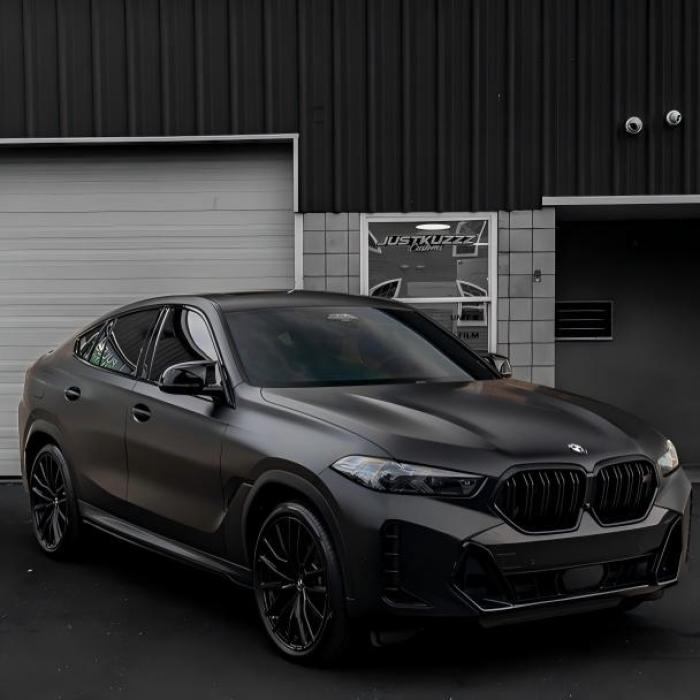
1. BMW X6: Satin Black on a Sculpted SUV

The BMW X6 is a particularly interesting application because of its sloping roofline, pronounced shoulders, and large body panels.
A satin black finish reduces intense reflections across the doors while preserving softer highlights along the vehicle’s sculpted surfaces.
This can make the SUV appear visually more cohesive without completely hiding its body lines.
ALUKOVINYL’s product page includes a customer-submitted BMW X6 satin black installation review dated August 24, 2026.
That review provides an identifiable application example, but it should not be interpreted as independent proof of long-term scratch resistance or film durability.
Installation consideration: The X6’s front bumper contours, rear-quarter transitions, and mirror housings require careful tension management and edge finishing.
2. Tesla Model S: Satin Black on Smooth Bodywork

The Tesla Model S has smoother, more continuous body surfaces than many traditional sports sedans.
On this type of bodywork, satin black can create a clean, understated appearance.
The finish is particularly effective when combined with dark window trim, black wheels, and minimal chrome detailing.
ALUKOVINYL’s product page includes customer-submitted Tesla Model S satin black PPF examples dated August 13, 2026, along with a separate 2026 Model S Plaid submission.
These examples support the film’s use on actual Tesla vehicles, although they do not establish its long-term performance.
Installation consideration: Large uninterrupted doors and hood panels make contamination, film alignment, and subtle surface defects more visible.
3. Mercedes-AMG GT: Satin Black on a Performance Sedan

The Mercedes-AMG GT 4-Door Coupe offers a different design challenge.
Its long hood, wide rear shoulders, and complex bumper geometry can emphasize the contrast between soft satin reflections and aggressive styling lines.
Satin black may be particularly suitable for owners who want a more restrained appearance than gloss black while preserving a recognizable performance-car silhouette.
However, this is a vehicle-fit analysis, not a documented ALUKOVINYL installation case.
Installation consideration: Large bumper openings, compound curves, and tightly integrated exterior trim can increase labor time and material waste.
4. Porsche 911: Satin Black on Curved Body Panels

The Porsche 911 presents another useful application scenario because of its rounded front fenders, curved hood, and compact body proportions.
On these surfaces, satin black creates soft directional highlights rather than sharp reflections.
This can make the car appear more sculptural, particularly under indirect daylight.
However, the same curved panels can make uneven film tension and finish variation easier to notice.
Installation consideration: Front fenders, bumper openings, and curved rear-quarter sections require careful panel planning.
Which Vehicles Benefit Most?
| Vehicle | Visual advantage | Main installation concern |
|---|---|---|
| BMW X6 | Emphasizes SUV body contours | Large curved panels |
| Tesla Model S | Smooth, understated appearance | Contamination on flat surfaces |
| Mercedes-AMG GT | Softens aggressive reflections | Complex bumper geometry |
| Porsche 911 | Highlights rounded body shapes | Compound curves and tension |
These are appearance and installation assessments, not comparative laboratory performance results.
Satin Black PPF Technical Specifications: What Do the Numbers Mean?
One of the biggest weaknesses in automotive film marketing is the tendency to use impressive numbers without explaining their relevance.
ALUKOVINYL publishes several technical values for its TPU Satin Black Colored PPF.
The following are manufacturer-reported figures for product SKU TPUT5011.
| Property | Published value | Practical relevance |
|---|---|---|
| Base material | Covestro | Identifies a reported material supplier |
| Adhesive | Ashland (Bostik) | Identifies a reported adhesive supplier |
| Tensile strength | 22.32 MPa | Resistance to tensile loading |
| Elongation at break | 370.23% | Stretch capacity under test conditions |
| Tear strength | 68.52 kN/m | Resistance to tear propagation |
| Coating fracture elongation | 112% | Stretch tolerance of the coating |
| UV resistance | 98.5% | Requires test method and wavelength details |
| Expected durability | 5–7 years | Manufacturer estimate, not guaranteed field life |
Source: ALUKOVINYL TPU Satin Black Colored PPF.
These values are useful starting points, but they require interpretation.
Why Elongation Does Not Equal Installation Freedom
A reported elongation at break of 370.23% does not mean installers should stretch the film anywhere near that amount during installation.
Breaking elongation describes a material’s behavior under specified testing conditions.
Real installations involve additional variables, including:
- Surface curvature
- Coating strain
- Adhesive stress
- Temperature
- Film orientation
- Long-term edge retention
The published coating fracture elongation of 112% also suggests why examining only the TPU base material can be misleading.
Professional takeaway: A film’s maximum laboratory elongation is not its recommended installation stretch limit.
Why UV Resistance Needs Context
A statement such as “98.5% UV resistance” sounds impressive, but a technically meaningful evaluation should identify the measurement method, wavelength range, and test conditions.
Without those details, the number cannot reliably establish how the film will look after several years of outdoor exposure.
Likewise, identifying a reputable raw-material supplier does not independently verify the finished film’s performance.
Satin Black PPF vs. Satin Black Vinyl Wrap
Both products can produce a similar low-sheen black appearance, but their primary functions differ.
| Feature | Satin Black PPF | Satin Black Vinyl |
|---|---|---|
| Primary purpose | Paint protection and color change | Appearance transformation |
| Material | Typically TPU | Typically PVC or other wrap film |
| Stone-chip protection | Designed for protective performance | Limited |
| Self-healing | Product-dependent | Not standard |
| Material cost | Generally higher | Generally lower |
| Installation | Specialized PPF techniques | Conventional wrap techniques |
| Styling options | More limited | Broad |
| Best use | Protection-focused color change | Budget-conscious customization |
For a customer who mainly wants a different appearance, a conventional vinyl wrap may be the more economical option.
For an owner concerned about road debris and surface protection, satin black PPF deserves consideration.
Neither material should be described as universally superior.
Satin Black PPF vs. Clear Matte PPF
Another common mistake is treating colored satin black PPF and transparent matte PPF as interchangeable.
They are not.
Colored satin black PPF changes the visible vehicle color to black.
Clear matte PPF generally changes the surface appearance while allowing the underlying paint color to remain visible.
For example, clear matte PPF over a factory blue vehicle can create a muted blue finish. Satin black color PPF would instead conceal the original blue appearance.
Clear matte PPF may therefore be preferable when an owner likes the factory color but wants reduced reflections.
Colored satin black PPF is more appropriate when the objective is a full black transformation.
Both are part of the broader PPF film category.
Brand Comparison: ALUKOVINYL, 3M and TeckWrap
Comparing brands requires more care than comparing marketing descriptions.
Not every brand offers a directly equivalent colored satin black product, and not every manufacturer publishes prices for identical roll sizes.
| Brand / product | Product type | Publicly reported features | Price information |
|---|---|---|---|
| ALUKOVINYL Satin Black TPU PPF | Colored satin black TPU PPF | Hydrophobic, scratch-resistant, manufacturer-reported self-healing | Varies by selected roll size |
| 3M Scotchgard Pro Series 200 Matte | Transparent matte PPF | Self-healing, hydrophobic, 10-year limited consumer warranty | Dealer/distributor quotation |
| TeckWrap Satin Velour Black CPX301M | Colored satin black PPF | Satin finish, multiple roll lengths | From $239 for 5 ft × 9.8 ft |
Prices and product listings checked October 2026. TeckWrap’s starting price is for a short cut length, not a full vehicle roll. Prices exclude installation and may change.
3M’s Pro Series 200 Matte is included as a protective-film benchmark, not as a direct black color-change equivalent.
TeckWrap’s Satin Velour Black is a more direct appearance-category comparison.
Official references:
What About Tinybot and INOZETEK?
Tinybot and INOZETEK are also relevant automotive film suppliers, but a fair price comparison requires an identified product SKU, matching film width and length, comparable specifications, and a publicly verifiable price.
Without those details, ranking one brand as cheaper, more durable, or technically superior would be speculative.
Buying insight: Request technical data sheets and written warranty terms before comparing products based on headline specifications alone.
Pros and Cons of Satin Black PPF
Advantages
1. Color change and protection together
Satin black PPF can transform the appearance of a vehicle while adding a physical protective layer.
2. Reduced harsh reflections
The satin finish produces softer highlights than high-gloss black, which can complement sculpted bodywork.
3. Potential self-healing performance
Products with an appropriate top coat can recover from some minor surface scratches under suitable conditions.
4. Suitable for premium vehicle customization
Satin black is particularly attractive on luxury sedans, sports cars, and performance SUVs.
5. Hydrophobic surface options
Hydrophobic coatings can help water bead and make routine cleaning easier, although they do not eliminate water spots.
Disadvantages
1. Higher initial cost
Satin black TPU PPF generally costs more than conventional color-change vinyl.
2. More demanding installation
Complex bumpers, recesses, and sharp body contours require careful handling.
3. Surface contamination remains visible
Black finishes can reveal dust, dried water deposits, fingerprints, and uneven cleaning marks.
4. Repairs can be expensive
A damaged panel may require replacement film, and color or sheen differences between material batches can complicate matching.
5. Not completely scratch-proof
Self-healing coatings cannot reliably repair deep cuts, tears, or severe impact damage.
6. Warranty and durability are not identical
A manufacturer’s expected service-life estimate does not automatically establish warranty coverage. Coverage must be checked against the written policy for the exact product.
What Does Satin Black PPF Installation Really Require?
Satin black PPF should not be treated as a simple peel-and-stick project.
The installation process generally includes paint inspection, decontamination, panel planning, application, edge finishing, and post-installation inspection.
Surface Preparation
Before applying the film, the installer should remove contaminants that could interfere with adhesion.
Paint defects should be documented beforehand because PPF does not repair existing scratches or damaged clear coat.
Stretch and Tension Management
Complex automotive surfaces often require controlled material manipulation.
Excessive tension can contribute to lifting, visual distortion, and coating stress.
This is particularly important around bumper corners, mirror housings, and deep recesses.
Application Method
ALUKOVINYL’s Satin Black product listing identifies wet application in its specifications.
Installers should follow the instructions for the selected film and adhesive system rather than assuming that all PPF products support identical wet or dry installation methods.
Post-Installation Inspection
Inspect the vehicle for trapped contamination, edge lifting, wrinkles, moisture pockets, and uneven surface appearance.
A technically successful installation should be evaluated not only immediately after application but also after the film has had time to settle.
How Much Satin Black PPF Does a Car Need?
Material planning is one of the most overlooked cost factors.
ALUKOVINYL offers several roll lengths, including 49 ft, 59 ft, 69 ft, and 79 ft, with a nominal width of approximately 5 ft.
The following estimates are illustrative planning ranges, not verified cutting layouts.
| Vehicle category | Illustrative material range |
|---|---|
| Compact sedan | 49–59 ft |
| Midsize sedan | 59–69 ft |
| Sports coupe | 49–69 ft |
| Midsize SUV | 69–79 ft |
| Large SUV | 79 ft or more |
Actual requirements depend on panel dimensions, installation orientation, wrapping edges, waste allowance, and whether the roof is included.
For example, a Tesla Model S and BMW X6 should not automatically be assigned the same roll length simply because both can receive satin black PPF.
A professional installer should measure the vehicle and prepare a panel layout before ordering.
How to Maintain Satin Black PPF
Satin finishes require appropriate cleaning methods because polishing or abrasive treatment may create unwanted changes in surface sheen.
Recommended practices include:
- Wash using a pH-neutral automotive shampoo.
- Use clean microfiber wash mitts and towels.
- Remove bird droppings and insect residue promptly.
- Avoid abrasive compounds and conventional gloss-enhancing polishes unless approved by the film manufacturer.
- Keep pressure-washer nozzles away from vulnerable film edges.
- Inspect edges periodically for lifting or contamination.
Hydrophobic properties may make washing easier, but they do not make a vehicle maintenance-free.
For self-healing films, follow the manufacturer’s heat and temperature instructions. Excessive heat can damage coatings or affect adhesion.
How to Evaluate PPF Performance Without Relying on Marketing Claims
A stronger technical assessment should distinguish four evidence categories.
Manufacturer specifications: Useful for understanding claimed material properties, but not necessarily independently verified.
Independent laboratory testing: Potentially stronger evidence when methods, samples, and results are disclosed.
Real vehicle installations: Demonstrate appearance and installation feasibility, but do not automatically prove durability.
Long-term field observations: Can reveal discoloration, edge lifting, staining, and maintenance problems that short demonstrations may miss.
ASTM standards provide useful frameworks for evaluating polymer and automotive surface performance.
For example, ASTM D6486 addresses automotive coating exposure under vehicle-service conditions, including scratching, stone chipping, and environmental contamination.
However, it is not a universal certification of finished PPF quality.
A meaningful product comparison should ideally include consistent sample preparation, standardized test methods, environmental conditions, and repeated measurements.
Evidence limitation: The publicly available ALUKOVINYL product specifications and customer-submitted photographs do not establish an independent, controlled head-to-head performance comparison against 3M, TeckWrap, Tinybot, or INOZETEK.
Who Should Choose Satin Black PPF?
Satin black PPF is most appropriate for customers who want both a black color transformation and a protective film.
It is especially relevant for:
- Owners of premium vehicles seeking a restrained appearance.
- Drivers who want color change and road-debris protection.
- Tesla and BMW owners considering full-body black styling.
- Enthusiasts who prefer soft satin reflections over high gloss.
- Customers willing to invest in professional installation and maintenance.
However, satin black PPF may not be the best option for everyone.
Customers primarily seeking inexpensive customization may prefer vinyl.
Those who want to retain their original paint color may prefer clear PPF.
Drivers who want a different color but similar protection should compare alternative color PPF finishes before purchasing.
Frequently Asked Questions About Satin Black PPF
Is satin black PPF better than matte black vinyl?
Satin black PPF is generally more appropriate when paint protection is a major priority. Matte black vinyl is often more cost-effective when the main objective is changing appearance.
Does satin black PPF scratch easily?
It can still develop scratches. A self-healing top coat may recover from minor surface marks, but deep scratches and cuts are not automatically repairable.
Does satin black PPF protect against rock chips?
PPF is designed to help protect paint from common road debris and stone impacts. Protection depends on film construction, impact severity, and installation quality.
Can satin black PPF be polished?
Conventional abrasive polishing is generally unsuitable for satin finishes because it may create uneven gloss. Always follow the film manufacturer’s maintenance instructions.
Is satin black PPF suitable for Tesla vehicles?
Yes, provided the paint is suitable for installation and the correct application procedures are followed. ALUKOVINYL’s product page includes customer-submitted Tesla Model S installations.
Is satin black PPF the same as clear matte PPF?
No. Satin black PPF changes the visible color to black, while clear matte PPF modifies the appearance of the underlying paint without replacing its color.
How long does satin black PPF last?
Service life varies by product, climate, installation, and maintenance. ALUKOVINYL publishes an expected durability range of 5–7 years for its Satin Black TPU PPF, but this is a manufacturer estimate rather than independently verified real-world performance.
Can satin black PPF be removed?
PPF can generally be professionally removed from suitable painted surfaces, but removal risk depends on paint condition, repaint history, adhesive aging, and installation quality. Damage-free removal should never be guaranteed for every vehicle.
Final Verdict: Is Satin Black PPF Worth Buying?
Satin black PPF is worth considering when the objective is to combine a distinctive black finish with the protective function of modern TPU film.
Its biggest advantage is not simply that it looks more premium than vinyl. It is that the material is engineered around a different performance objective: protecting automotive paint while changing its appearance.
However, higher material costs, installation complexity, repair considerations, and maintenance requirements mean that it is not automatically the best choice for every driver.
The strongest purchasing decision comes from comparing the film’s actual specifications, installation requirements, warranty conditions, and intended vehicle use—not simply choosing the product with the most impressive marketing claims.
For customers interested in a satin black transformation, explore ALUKOVINYL’s satin black PPF and review available sizes, product specifications, and real customer-submitted vehicle examples before ordering.
The right paint protection film should match the vehicle, the owner’s expectations, and the level of protection required—not just the desired color.