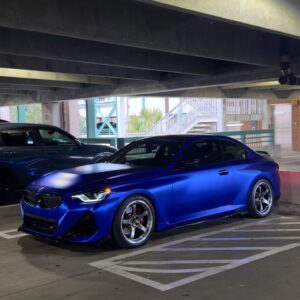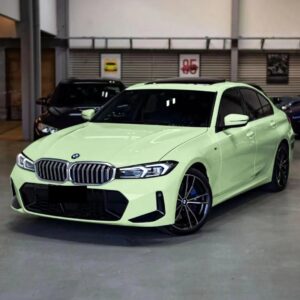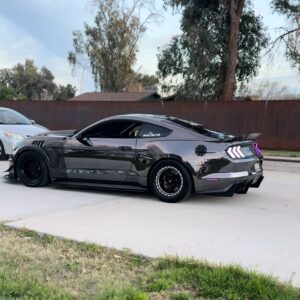
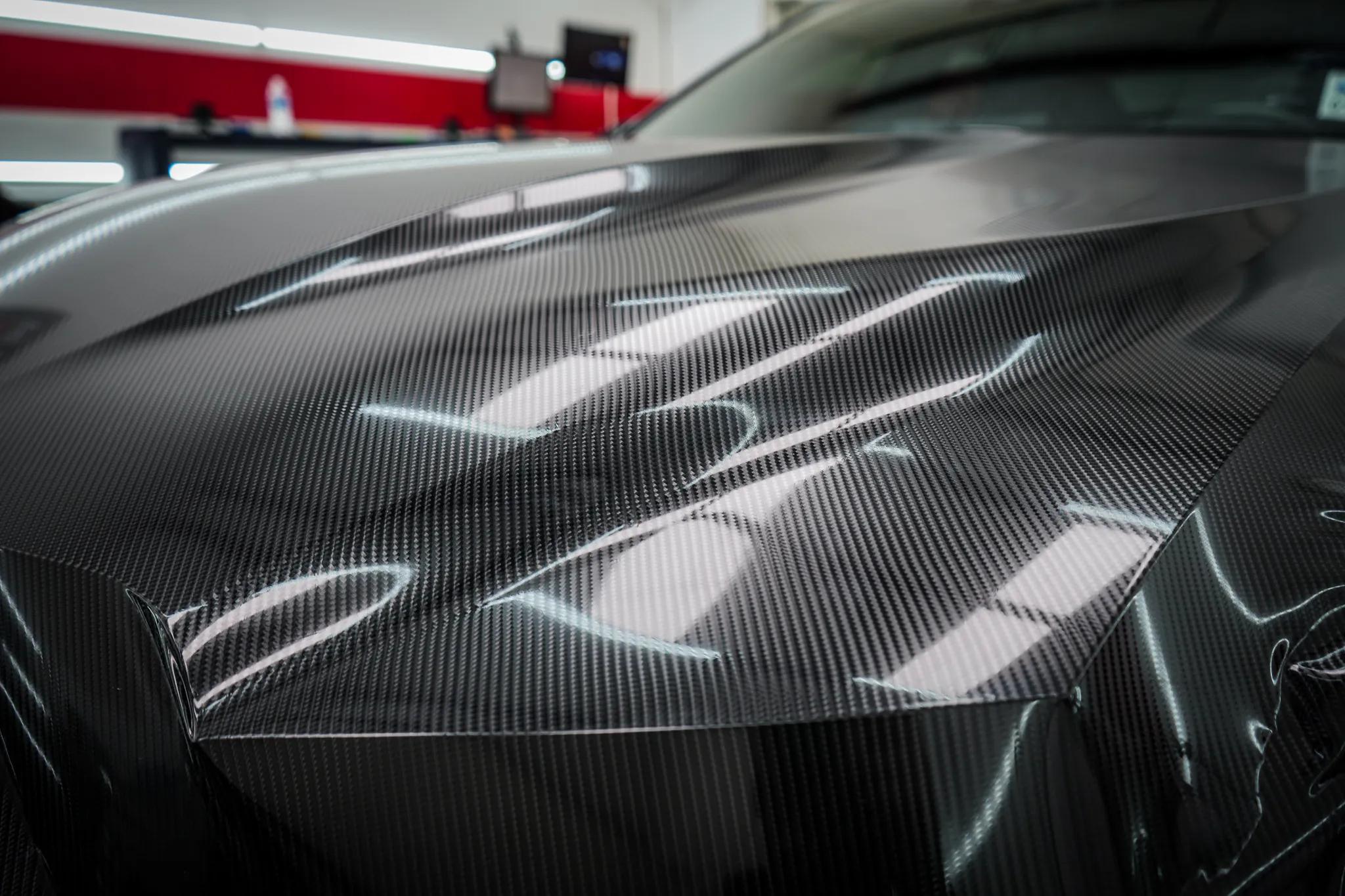
Carbon fiber has been associated with performance cars for decades, but covering a vehicle in genuine carbon-fiber body panels is expensive and impractical for most owners. Carbon-pattern vinyl offers the appearance at a much lower price, but its primary purpose is styling rather than impact protection.
That leaves a third option: carbon fiber PPF.
Modern carbon PPF combines a carbon-fiber-inspired visual pattern with the thicker TPU construction associated with paint protection film. More importantly, buyers are no longer limited to conventional black carbon. Depending on the manufacturer, the category now includes gloss carbon, forged carbon and colored carbon-inspired finishes.
So, what is the best carbon fiber PPF in 2026?
Featured Snippet: What Is the Best Carbon Fiber PPF?
The best carbon fiber PPF is a TPU-based film that combines a realistic and consistent carbon pattern with measurable paint-protection performance, a quality topcoat, stable adhesive, good conformability and appropriate warranty support. There is no single best carbon PPF for every car: gloss woven carbon suits OEM+ builds, forged carbon creates a more aggressive appearance, while colored carbon PPF works best when visual customization is the priority.
Don’t choose carbon PPF from photos alone. Compare TPU construction, thickness, topcoat, self-healing behavior, stain resistance, UV/weathering data, adhesive quality, pattern distortion under stretch and technical documentation.
That last factor—pattern distortion—is especially important for carbon PPF and is often overlooked.
What Is Carbon Fiber PPF?
Carbon fiber PPF is a paint protection film engineered to reproduce the visual texture or weave of carbon fiber while creating a protective barrier over automotive paint.
It is important to distinguish it from actual carbon fiber.
Real automotive carbon fiber is a composite material typically made from carbon reinforcement and a polymer resin. It can be used structurally or cosmetically depending on the component.
Carbon fiber PPF does not turn a steel or aluminum hood into a carbon-fiber component, nor does it provide the weight reduction associated with replacing a body panel with genuine carbon fiber.
Instead, it provides two different benefits:
carbon-inspired appearance + surface protection.
That makes it particularly relevant to owners who like the appearance of carbon fiber but do not want to replace expensive body panels.
It also differs from conventional carbon-pattern car wrap, which is generally chosen primarily for cosmetic customization.
Carbon Fiber PPF vs Carbon Fiber Vinyl Wrap
This is one of the most important distinctions for buyers.
Both products can produce a carbon-inspired appearance, but they are engineered around different priorities.
| Feature | Carbon Fiber PPF | Carbon Vinyl Wrap |
|---|---|---|
| Primary purpose | Protection + styling | Styling |
| Typical base material | TPU | Usually PVC |
| Carbon appearance | Woven/forged/colored patterns | Very broad pattern selection |
| Rock-chip protection | Higher | Limited |
| Self-healing | Available on appropriate TPU PPF | Usually not comparable to PPF |
| Material thickness | Generally thicker | Generally thinner |
| Installation | More specialized | Familiar to wrap installers |
| Price | Higher | Lower |
| Graphics/customization | Limited | Excellent |
| Best use | Premium styling + protection | Affordable cosmetic transformation |
3M’s current Paint Protection Film Series 100 provides a useful benchmark for understanding modern PPF construction. 3M lists its film at 7.5 mil and describes protection against stone chips, scratches, bug damage, road tar, stains and harsh outdoor weathering including UV radiation. The company also states that minor scratches can disappear through heat-activated self-healing.
That does not mean every carbon PPF automatically delivers identical performance to 3M.
Instead, it demonstrates why PPF and cosmetic vinyl should not be evaluated as the same product category.
Carbon Fiber PPF vs Real Carbon Fiber
Another common misunderstanding is that carbon PPF is an alternative to real carbon fiber in a structural sense.
It isn’t.
Consider a performance-car hood.
Replacing the original hood with a genuine carbon-fiber hood may reduce weight while changing the appearance of the vehicle. Applying carbon PPF to the existing hood does not materially transform the underlying component.
Carbon PPF is therefore more accurately described as a surface treatment.
Real carbon fiber makes more sense when:
- Weight reduction matters.
- Structural properties matter.
- Authentic composite construction is important.
- The budget supports replacement panels.
Carbon PPF makes more sense when:
- You want the carbon appearance.
- You want to keep the factory panel.
- Paint protection matters.
- Reversibility matters.
- Replacing body panels would be unnecessarily expensive.
For many street cars, the second scenario is more practical.
What Actually Makes the Best Carbon Fiber PPF?
Search results for the best carbon fiber PPF often focus almost entirely on appearance.
That is not enough.
A carbon-pattern film introduces an additional technical problem that conventional solid-color PPF does not have:
The pattern itself must survive installation convincingly.
This gives us six practical criteria for evaluating carbon PPF.
1. TPU Construction
Modern premium PPF commonly uses thermoplastic polyurethane.
TPU offers a useful combination of elasticity, toughness and conformability, allowing a protective film to follow automotive bodywork while maintaining its protective function.
However:
TPU is a material category, not a quality guarantee.
Two products described as “TPU PPF” can still differ significantly in topcoat chemistry, adhesive, optical quality, weathering resistance and mechanical properties.
Look for measurable specifications instead of relying only on phrases such as:
- Premium TPU
- Military grade
- Ultimate protection
- Nano technology
- Super self-healing
Without supporting data, these are marketing terms rather than meaningful comparison criteria.
2. Carbon Pattern Realism
Carbon PPF has to perform visually as well as mechanically.
Cheap carbon patterns can look obviously printed, overly repetitive or unnaturally glossy.
A convincing woven carbon appearance should create a sense of depth when light moves across the surface.
Look at the film from:
- Directly above
- 45 degrees
- Side lighting
- Direct sunlight
- Indoor LED lighting
- Several feet away
A product that looks convincing in a tightly cropped studio photograph may look completely different across an entire hood.
Installer tip
Ask for a physical swatch before ordering a full roll whenever possible.
Digital images are affected by camera exposure, editing, monitor calibration and lighting.
Carbon texture is particularly difficult to evaluate accurately from a screen.
3. Pattern Distortion Under Stretch
This is one of the most important professional considerations in this entire guide.
A solid black PPF can stretch around a curved bumper without producing an obvious geometric pattern change.
Carbon PPF cannot hide stretching as easily.
Imagine a regular woven pattern:
//// //// //// ////
Stretch one section substantially more than another and the visual spacing can change.
The result can be:
- wider weave
- narrower weave
- curved pattern lines
- inconsistent reflections
- mismatched neighboring panels
Therefore, maximum elongation is not automatically the same as maximum usable stretch for carbon PPF.
A film may physically stretch much farther than it can stretch while still looking like convincing carbon fiber.
That is an important distinction for installers.
4. Topcoat and Self-Healing Performance
A premium carbon PPF should not be evaluated only by the TPU underneath.
The topcoat strongly affects everyday ownership.
Depending on the film, it can influence:
- scratch resistance
- stain resistance
- gloss
- hydrophobicity
- chemical resistance
- self-healing behavior
- ease of cleaning
Tinybot, for example, currently publishes technical data for its colored TPU PPF rather than relying exclusively on marketing descriptions. Its listed testing includes ≥90% gloss at 60°, a 103° hydrophobic contact angle, heat-based self-healing at 70°C and anti-yellowing testing of ΔE ≤2 after 1,000 hours of Q-UV exposure.
These figures are manufacturer-published rather than independent certification of every colored PPF on the market, but they illustrate the type of measurable information buyers should look for.
5. Adhesive and Installation Behavior
A technically impressive PPF can still produce a poor result if its adhesive system is difficult to control.
3M specifically highlights repositionability, reduced lift lines and minimized adhesive marks in its current Series 100 PPF information.
For carbon PPF, adhesive behavior becomes particularly important because installers may need to reposition material to maintain consistent pattern alignment.
Poor installation can produce:
- stretch marks
- adhesive distortion
- trapped contamination
- lifting edges
- uneven weave
- inconsistent panel direction
This is why professional installation should be considered part of the product decision—not an afterthought.
6. Published Technical Data
The phrase “best PPF” should require evidence.
At minimum, serious buyers should look for some combination of:
- Film thickness
- TPU source/type
- Tensile strength
- Elongation at break
- Adhesion
- Topcoat information
- Stain resistance
- UV/weathering testing
- Self-healing conditions
- Hydrophobicity
- Warranty terms
- Installation instructions
If one manufacturer publishes measurable specifications while another only says “premium quality,” the first gives the buyer more information to evaluate.
But even published manufacturer specifications should be described accurately:
Manufacturer-reported specifications are useful evidence, but they are not the same as independent laboratory verification.
That distinction is important for any credible comparison.
Types of Carbon Fiber PPF: Which One Is Best?
One of the biggest changes in carbon-style PPF is that buyers are no longer limited to conventional black.
ALUKOVINYL’s carbon PPF collection, for example, includes different carbon-inspired appearances for owners who want something beyond the traditional black weave.
This creates several distinct styling directions.
Gloss Black Carbon PPF — Best All-Round Choice
This is the most recognizable carbon look.
Gloss black carbon works especially well on:
- Hoods
- Roofs
- Mirror caps
- Spoilers
- Splitters
- Performance SUVs
- Full sports-car builds
It tends to work particularly well when the goal is an OEM+ appearance.
Best for: Porsche 911, BMW M3/M4, Toyota Supra, Nissan GT-R, Corvette and performance-oriented Tesla builds.
Forged Carbon PPF — Best for Aggressive Builds
Forged carbon uses a fragmented appearance rather than the traditional uniform weave.
The aesthetic is associated with high-end performance components and creates a more visually aggressive surface.
Because the pattern is irregular, forged carbon can also behave differently visually under stretching than a perfectly aligned woven pattern.
Best for: Lamborghini-inspired builds, McLaren-style projects, widebody cars and modified supercars.
Colored Carbon PPF — Best for Custom Builds
This is where carbon PPF becomes more interesting than simply copying genuine black carbon.
Instead of asking:
“Does this look exactly like real carbon fiber?”
the design objective becomes:
“Can carbon texture become part of the vehicle’s color design?”
Colored carbon PPF may use:
This works particularly well when the owner wants the carbon pattern to remain visible rather than disappear into a predominantly black finish.

Gloss vs Matte Carbon Fiber PPF
Finish matters almost as much as color.
Gloss Carbon
Gloss tends to create stronger visual depth because reflections emphasize the weave.
Advantages
- Stronger visual depth
- Easier to notice the carbon pattern
- High-end appearance
- Works well with gloss paint
Disadvantages
- Surface marks can be more visible
- Strong reflections can occasionally overwhelm the pattern
Matte/Satin Carbon
Matte and satin reduce reflections and create a more technical appearance.
Advantages
- More understated
- Motorsport-inspired appearance
- Pairs well with matte body colors
Disadvantages
- Carbon depth may appear weaker
- Surface care can require more attention
- Polishing is generally not appropriate for matte finishes
There is no universally superior finish.
The correct choice depends on the vehicle.
Best Carbon Fiber PPF by Vehicle Type
Rather than ranking films purely by brand, it can be more useful to match the finish to the car.
BMW M3 / M4
A gloss woven carbon hood or roof complements the factory carbon components commonly associated with M cars.
For an aggressive modified build, colored carbon can create stronger contrast.
Porsche 911
Carbon should usually be used selectively unless the build is intentionally extreme.
Hood accents, roof sections, mirrors or aero pieces can produce a more cohesive OEM+ result than covering every surface.
Toyota GR Supra
The Supra’s curved bodywork makes carbon visually interesting but also makes stretch management particularly important.
Large pattern distortion across the hood or bumpers can be noticeable.
Nissan GT-R
Traditional black carbon works naturally with the GT-R’s performance identity, while forged carbon can suit heavily modified builds.
Tesla Model 3 / Model Y
Colored carbon provides an opportunity to create a much more distinctive appearance than the relatively limited factory color palette.
Lamborghini / McLaren
Forged carbon is particularly appropriate because real forged-composite components already have strong associations with modern exotic cars.
Carbon Fiber PPF vs Regular Color PPF
Should you choose carbon or conventional color PPF?
| Criterion | Carbon Fiber PPF | Regular Color PPF |
|---|---|---|
| Paint protection | Strong when properly engineered | Strong when properly engineered |
| Surface appearance | Textured/patterned | Solid/metallic/pearlescent/etc. |
| Pattern alignment | Important | Usually irrelevant |
| Stretch visibility | Higher | Lower |
| Styling | Performance-focused | Extremely broad |
| Installation difficulty | Higher on complex panels | Generally easier visually |
| Best application | Sports/performance builds | Whole-car color changes |
For most luxury sedans where the goal is simply to change the color, regular color PPF is usually the more natural choice.
For performance vehicles where carbon itself is part of the design language, carbon PPF can be much more compelling.
How Does ALUKO Compare With Other Carbon PPF Options?
A credible “best carbon fiber PPF” guide should not simply declare the publisher’s own product the winner.
ALUKOVINYL sells carbon PPF, so there is an obvious commercial relationship that readers should know about.
Instead, it is more useful to compare what different manufacturers currently emphasize.
ALUKO
The main advantage is selection, particularly for customers interested in multiple carbon colors and effects rather than only conventional black carbon.
ALUKO’s best carbon fiber PPF option should therefore be considered alongside competing films based on the desired appearance, specifications, price and installation requirements—not simply because it appears on this website.
TeckWrap
TeckWrap currently maintains a dedicated Carbon Fiber PPF collection and describes its carbon PPF as using Lubrizol TPU, combining a woven carbon appearance with self-healing protective functionality.
Tinybot
Tinybot is particularly useful as a comparison point because it publishes technical test values for its colored TPU PPF, including gloss, contact angle, self-healing temperature and accelerated UV testing.
3M
3M is more useful here as an industry PPF technology benchmark than as a direct colored-carbon competitor.
Its Series 100 product documentation provides transparent specifications including 7.5-mil construction, self-healing behavior, adhesive characteristics and a 10-year consumer warranty.
This is an important distinction: 3M’s specifications should not be interpreted as proof that ALUKO, TeckWrap, Tinybot or another carbon PPF performs identically.
Each product needs to be evaluated on its own documentation.
Pros and Cons of Carbon Fiber PPF
Advantages
Paint protection plus styling. Carbon PPF combines a carbon-inspired appearance with a thicker protective-film format.
Multiple carbon styles. Buyers can now move beyond traditional black into forged and colored carbon effects.
Reversible appearance change. Unlike replacing painted body panels, film allows the original panel to remain underneath, assuming suitable paint condition and proper installation/removal.
Self-healing potential. Appropriate TPU PPF topcoats can recover from certain minor surface scratches with heat.
Excellent performance-car aesthetic. Carbon texture naturally complements sports cars and modified vehicles.
Disadvantages
More expensive than carbon vinyl. Buyers primarily interested in appearance may find vinyl more cost-effective.
Pattern distortion matters. Excessive stretching can visibly change a woven carbon pattern.
Installation is demanding. Pattern alignment introduces another variable that solid-color PPF does not have.
Not real carbon fiber. It provides neither the structural characteristics nor weight reduction of genuine composite panels.
Appearance varies significantly between products. A convincing pattern in one film can look artificial in another.
Independent data can be limited. Many specialty colored/carbon PPF products rely primarily on manufacturer-published specifications rather than independent long-term comparative testing.
That final limitation is worth considering when comparing less-established specialty films with PPF products from manufacturers that have extensive technical documentation.
How to Install Carbon PPF Without Ruining the Pattern
Carbon PPF requires a slightly different mindset from solid-color film.
First, establish the pattern direction before cutting material.
For adjacent panels, keep orientation consistent unless the design intentionally calls for contrast.
Second, avoid unnecessary stretch.
Instead of forcing one large section into a deep compound curve, consider how the material can be positioned to distribute tension more evenly.
Third, inspect the pattern—not only the film.
An installation can technically have no bubbles or lifting and still look poor because the carbon weave is distorted.
Finally, evaluate the vehicle from several feet away.
Installers naturally work close to the panel. Carbon alignment problems can actually become more obvious from a distance.
How to Maintain Carbon Fiber PPF
Good maintenance is relatively straightforward.
Use a pH-appropriate automotive shampoo, soft microfiber wash media and safe drying techniques.
Avoid repeatedly directing a pressure washer closely at film edges.
Remove contaminants such as bird droppings, bug residue and tree sap promptly rather than allowing them to remain on the topcoat.
Before applying ceramic coatings, waxes or other surface products, confirm compatibility with the PPF manufacturer.
For matte or satin carbon PPF, avoid abrasive polishing products designed to create gloss.
Most importantly, follow the manufacturer’s care instructions for the specific film rather than assuming every TPU PPF should be maintained identically.
FAQ: Best Carbon Fiber PPF
What is the best carbon fiber PPF?
The best carbon fiber PPF combines TPU construction, convincing carbon appearance, a quality topcoat, reliable adhesive, appropriate self-healing behavior, weathering/stain resistance and enough conformability to install without excessive pattern distortion. The best finish depends on the vehicle and design objective.
Is carbon fiber PPF better than carbon vinyl?
For paint protection, carbon PPF generally has the advantage because PPF is engineered around surface protection. Carbon vinyl is typically cheaper and offers greater styling flexibility, making it better when appearance and budget are the main priorities.
Is carbon PPF real carbon fiber?
No. Carbon PPF visually reproduces carbon-fiber patterns but does not provide the structural strength or weight reduction of genuine carbon-fiber components.
Can carbon PPF self-heal?
Some TPU carbon PPF products use self-healing topcoats capable of reducing certain light surface scratches when exposed to appropriate heat. Deep cuts, punctures and severe impacts cannot simply heal themselves.
Does carbon PPF protect against rock chips?
PPF is designed to provide more physical protection than ordinary cosmetic vinyl, but actual stone-chip performance depends on film construction, thickness, TPU formulation, impact severity and installation.
Does carbon PPF look realistic?
High-quality products can produce convincing woven or forged-carbon effects, particularly under natural light. However, appearance varies significantly between products. A physical sample is preferable to evaluating the film solely from online photos.
Can carbon PPF be used on an entire vehicle?
Yes, but a full carbon-pattern vehicle creates a much stronger visual statement than using the film selectively. Hood, roof, trunk, mirror and aero-piece applications often create a more OEM-inspired appearance.
What color carbon fiber PPF should I choose?
Black woven carbon is the safest choice for OEM+ styling. Forged carbon suits aggressive exotic or modified builds. Blue, red, purple and other colored carbon PPFs work best when customization rather than realism is the main objective.
Final Verdict: How Should You Choose the Best Carbon Fiber PPF?
The best carbon fiber PPF is not simply the product with the darkest weave, highest gloss or boldest marketing claims.
Start with four questions:
Does the carbon pattern look convincing?
Does the film provide measurable PPF performance?
Can it conform to the vehicle without destroying the pattern?
Does the manufacturer provide enough technical information to justify the price?
For owners seeking the closest appearance to conventional automotive carbon fiber, gloss black woven carbon remains the safest all-round choice.
For exotic and aggressively modified builds, forged carbon PPF can produce a more distinctive appearance.
For enthusiasts who want carbon texture without being limited to black, colored carbon PPF opens up considerably more design possibilities.
The final decision should balance appearance against TPU construction, topcoat technology, adhesive behavior, weathering data, installation requirements, warranty and price.
ALUKOVINYL manufactures and sells the films discussed on this site, so our own product information should be understood as manufacturer information rather than independent third-party testing. We recommend comparing specifications, requesting physical samples where possible and discussing installation requirements with an experienced PPF installer before purchasing a full roll.
If you want to explore beyond conventional black carbon, browse ALUKOVINYL’s different carbon PPF colors and finishes and compare them with standard color PPF before deciding which approach works best for your vehicle.
The best carbon fiber PPF is ultimately the one that protects the paint, maintains a convincing pattern after installation, and matches the visual purpose of the build—not simply the film carrying the biggest “best” claim.