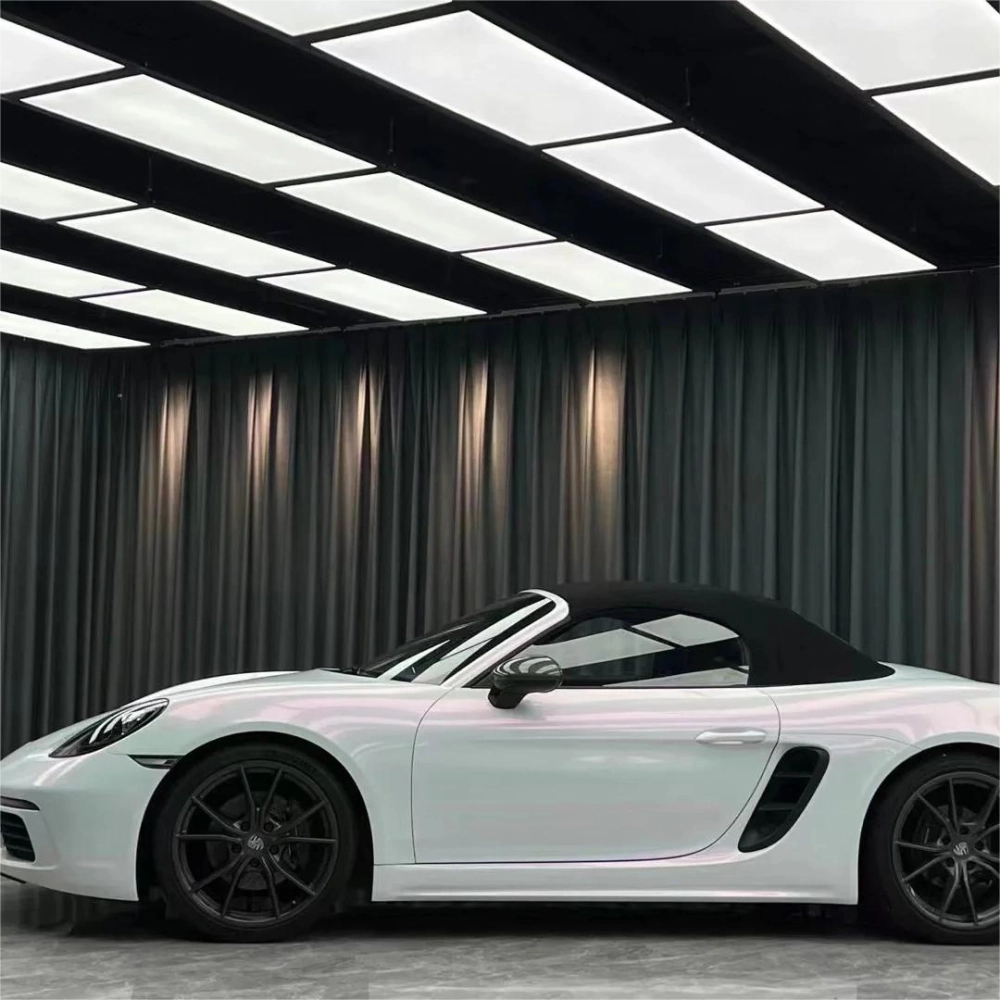

A white car can look timeless. A pink car can look impossible to ignore. But what if you want something between the two?
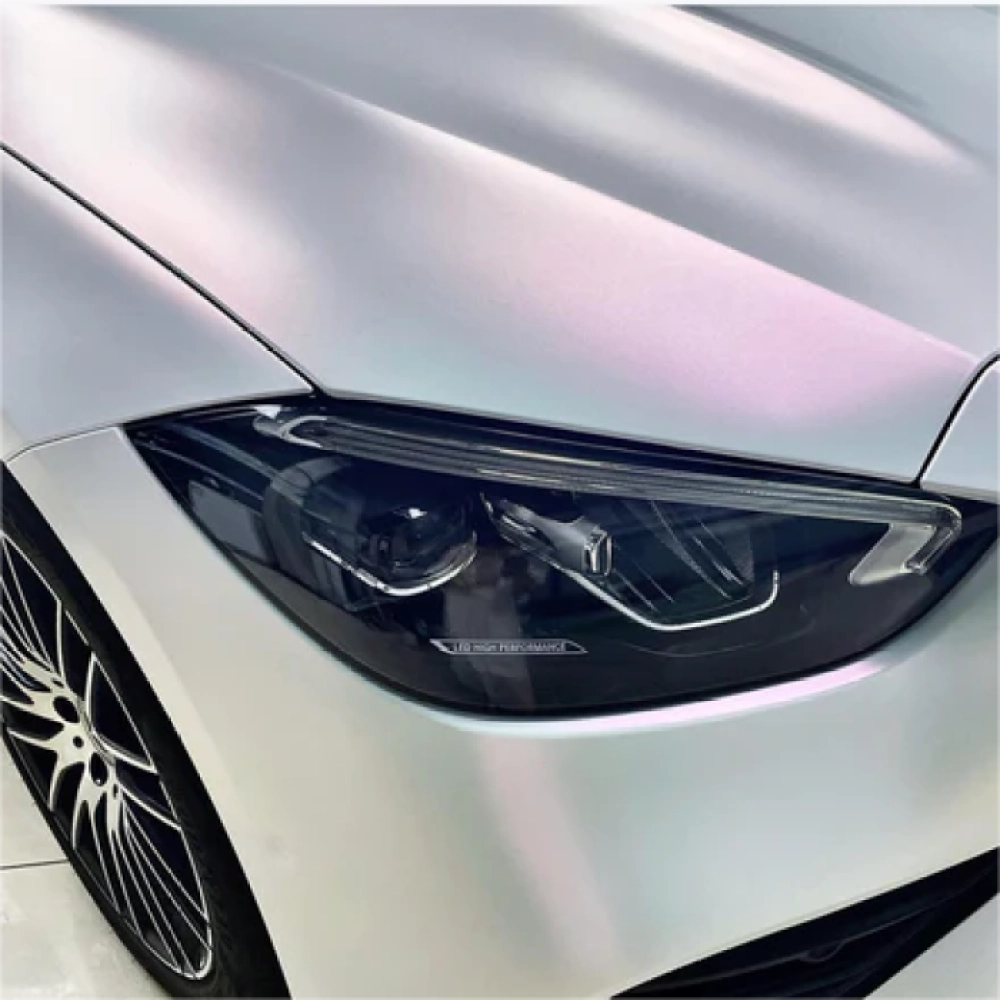
A white pink iridescent car wrap creates exactly that middle ground. Instead of displaying one fixed colour, the finish can appear predominantly pearl white or silvery white in softer light, then reveal blush pink, rose, lavender or subtle rainbow-like reflections as the viewing angle and illumination change.
That makes this finish very different from a conventional pink vinyl wrap. The visual effect is less about covering the vehicle in an obviously pink colour and more about allowing pink to emerge from the white base.
For drivers who want an unusual colour without committing to an aggressively bright exterior, that distinction matters.
This guide explains how white-pink iridescent wraps behave in real-world lighting, how they compare with pearl white and conventional colour-shift films, which vehicles suit the finish best, and what installers should consider before wrapping an entire car.
What Is a White Pink Iridescent Car Wrap?
A white pink iridescent car wrap is a colour-effect automotive vinyl that combines a light white or pearl base with pigments or optical layers that produce pink and sometimes violet reflections as light and viewing angles change.
Unlike standard white vinyl, the colour is not visually static. Unlike bright pink vinyl, the vehicle does not necessarily appear pink from every direction.
The typical effect is:
White / Pearl → Blush Pink → Rose → Light Violet
depending on sunlight, artificial lighting, panel curvature and viewing angle.
The result is a colour that can look elegant and understated from one angle and dramatically customised from another.
Why White-to-Pink Iridescent Wraps Look Different in Real Life
One mistake buyers often make when choosing an iridescent wrap is evaluating it from a single product photograph.
Colour-shifting finishes simply do not behave like conventional solid colours.
With an ordinary gloss white wrap, the pigment remains essentially white while reflections change around it. With an iridescent finish, both reflection and perceived colour can change.
Avery Dennison specifically notes that metallic and pearlescent films can show visible colour differences depending on film orientation. Its technical documentation consequently recommends maintaining consistent film direction during installation.
This has an important practical implication:
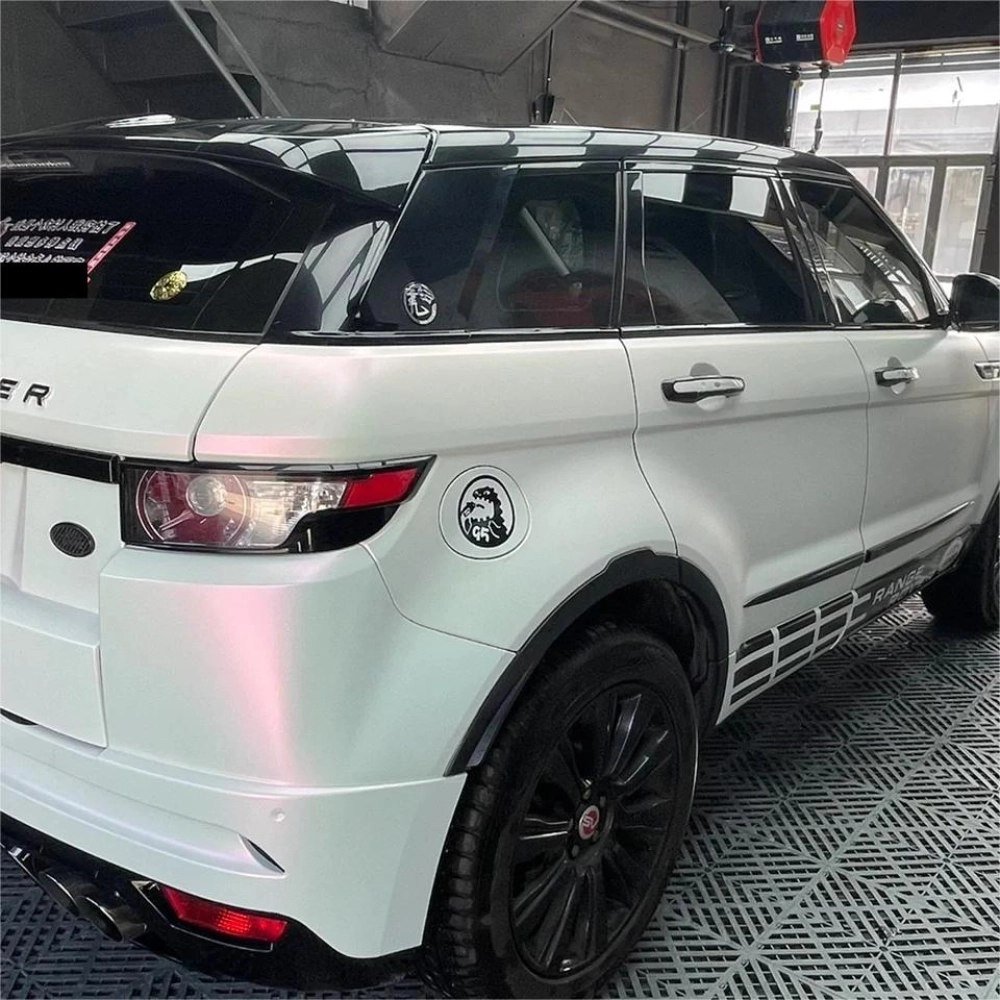
The same white pink iridescent car wrap may look noticeably different on the hood, door and rear quarter panel even though every panel comes from the same roll.
That isn’t necessarily a defect. It is part of what gives colour-effect wraps their depth.
Four conditions dramatically change the appearance
Direct sunlight
Pink reflections usually become easier to see. Curved areas such as fenders, shoulders and bumpers can display stronger transitions because light reaches those surfaces at different angles.
Overcast daylight
The car may look considerably closer to pearl white, with pink appearing primarily along body lines and reflections.
Indoor lighting
LEDs and directional showroom lighting can create surprisingly strong pink, violet or pearlescent highlights.
Night lighting
Streetlights, headlights and parking-garage LEDs can isolate individual colour-shift zones, creating a completely different appearance from daytime.
That variability is precisely why we recommend evaluating a physical sample outside before choosing any iridescent wrap for a complete vehicle.
White Pink Iridescent vs Pearl White vs Pink vs Chameleon Wrap
Not every driver who searches for an iridescent finish actually needs a strong colour-shift film.
Here is the more useful comparison.
| Finish | Primary Appearance | Colour Shift | Visual Impact | Daily-Driver Friendly |
|---|---|---|---|---|
| Gloss White | Clean white | Very low | Low | Excellent |
| Pearl White | White with pearlescent depth | Low | Moderate | Excellent |
| White Pink Iridescent | White + blush/rose reflections | Medium | High | Excellent |
| Solid Pink | Consistent pink | Very low | High | Moderate |
| Pink-Purple Chameleon | Pink/purple shift | High | Very high | Moderate |
| Full-Spectrum Iridescent | Multiple rainbow colours | Very high | Extreme | Depends on preference |
The distinction is important.
A pearl white wrap adds depth to white.
A pink wrap changes the car’s identity to pink.
A strong chameleon wrap makes colour shifting the main visual feature.
A white pink iridescent car wrap sits between all three.
That is arguably its greatest advantage.
The “Two Personality” Effect
From a design perspective, one of the most interesting characteristics of white-to-pink film is what we call the two-personality effect.
In low-contrast conditions, the vehicle retains the clean visual character associated with white.
Move the car into stronger sunlight and the personality changes.
Pink reflections begin appearing across the fenders, doors and quarter panels.
That creates something conventional paint colours rarely achieve:
the vehicle can look restrained from a distance but highly customised when viewed up close or in changing light.
This characteristic makes the colour particularly interesting for owners who want something more distinctive than pearl white without moving into neon pink or extreme rainbow finishes.
How Does ALUKOVINYL White Pink Look on a Real Car?
ALUKOVINYL’s Gloss Metallic Chameleon Diamond Pollen Pink White finish provides a useful real-world example of this colour family.
Customer-submitted installations on the product page include a 2026 Tesla Model Y wrapped in the Pink White colour-shifting finish, demonstrating how the effect changes across the Model Y’s curved panels.
That example highlights something product swatches cannot fully communicate.
A small flat sample might show only white and pink.
Once installed over a three-dimensional vehicle, however, different sections of the body reflect light simultaneously at different angles.
The hood might appear predominantly pearl white.
The front fender may show pink.
The doors may transition between both.
The rear quarter panel can display another variation entirely.
In other words, vehicle geometry becomes part of the colour.
That leads to an important question.
Which Cars Look Best With a White Pink Iridescent Car Wrap?
Although virtually any properly prepared vehicle can be wrapped, some body designs display iridescent effects better than others.
Tesla Model 3 / Model Y
Tesla’s minimalist styling works exceptionally well with white-to-pink colour shifts.
Large uninterrupted door panels provide a clean canvas, while the curved fenders and roofline introduce enough variation to reveal the pink reflections.
The Model Y customer installation mentioned above is a useful example of this interaction between body geometry and colour-changing film.
Best for: Clean, futuristic builds.
Porsche 911
The 911 offers almost the opposite design philosophy.
Its pronounced front fenders, rounded rear quarters and flowing body surfaces create continuous changes in reflection.
Rather than looking like a simple white Porsche with pink highlights, the vehicle can develop a much more sculptural appearance as the colour moves across those curves.
Best for: Premium and elegant builds.
BMW M3 / M4
Modern BMW M cars combine sharp creases with muscular arches.
That creates strong boundaries between light and shadow, helping separate the white base from the pink shift.
Black wheels and carbon-fibre exterior components can further increase contrast.
Best for: Aggressive performance builds.
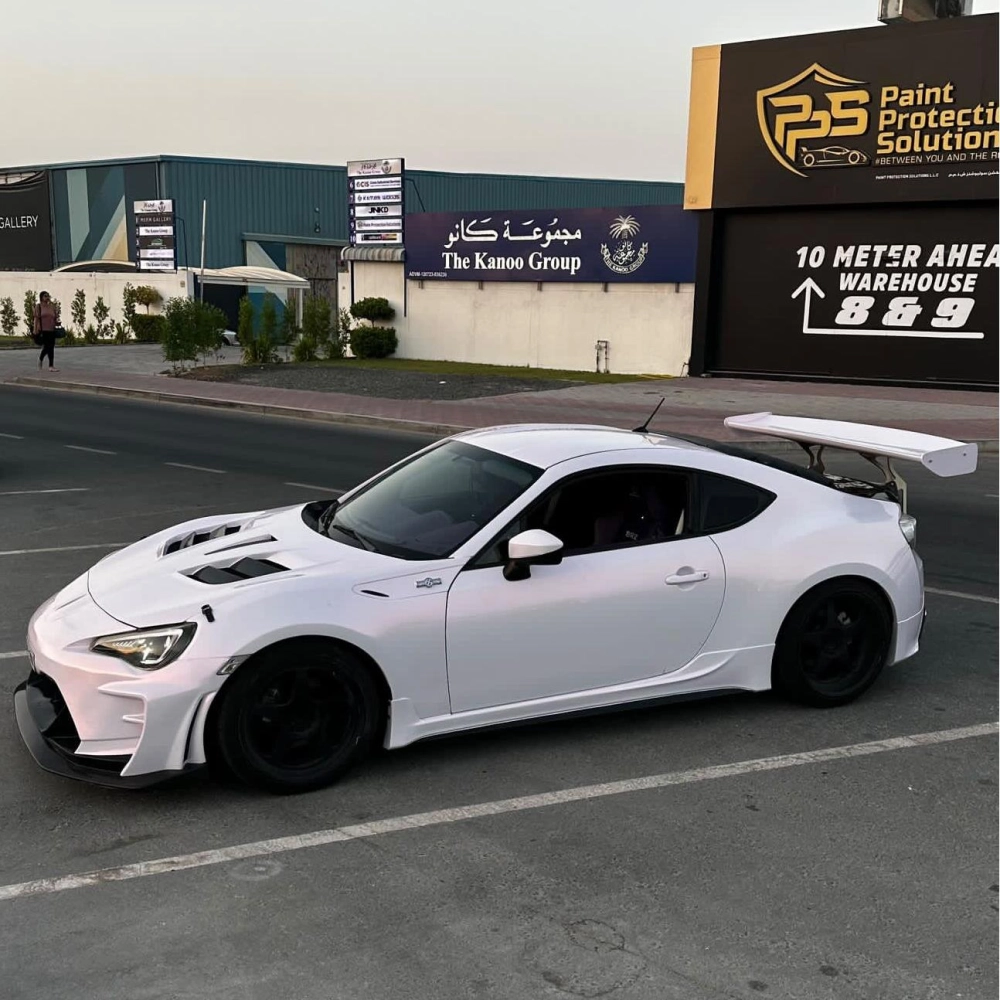
Toyota GR86 / Subaru BRZ
The GR86 and BRZ are particularly interesting candidates because their proportions already suit personalised street builds.
A white pink iridescent finish can add a strong visual identity without requiring graphics or oversized decals.
Best for: JDM-inspired and street-style projects.
Nissan GT-R
The GT-R’s broad shoulders and angular surfaces make colour-shift effects easy to notice.
Under direct sunlight, different surfaces can show white, pink and intermediate tones simultaneously.
Best for: High-impact performance builds.
Lamborghini Huracán
Highly sculpted exotic cars naturally amplify directional finishes.
The dramatic surfaces of a Huracán can produce sharper visual transitions than relatively flat-bodied vehicles.
Best for: Show-car applications.
Curved Cars vs Boxy Cars: An Overlooked Difference
Here is something buyers rarely consider before choosing iridescent vinyl:
Body geometry influences how dramatic the colour shift appears.
Imagine two vehicles wrapped using exactly the same film.
Vehicle A has broad, flat doors.
Vehicle B has heavily sculpted fenders and deep character lines.
The second vehicle will often appear to have more colour variation because its surfaces face the light source at more angles simultaneously.
Therefore:
More curves → more simultaneous colour transitions
Flatter panels → larger areas of relatively consistent colour
Neither is necessarily better.
They simply produce different aesthetics.
This is one reason we recommend judging an iridescent wrap on a vehicle similar in shape to yours rather than relying exclusively on studio photographs.
White Pink Iridescent vs Avery Dennison ColorFlow
A useful industry benchmark for colour-changing vinyl is Avery Dennison Supreme Wrapping Film ColorFlow.
Avery’s ColorFlow technical documentation lists an approximately 81-micron face film, approximately 111-micron film-plus-adhesive construction, 200% elongation under the referenced test method and expected durability of up to five years for vertical exposure under specified conditions.
Those specifications shouldn’t be interpreted as universal numbers for every iridescent vinyl.
Instead, they demonstrate an important principle:
Professional colour-shift films are engineered systems where the face film, pigments/effect layers, adhesive, installation technique and environmental exposure all influence performance.
3M makes a similar point regarding its Wrap Film Series 2080. According to 3M, real-world graphic performance depends on factors including substrate preparation, application method, sun-exposure angle, environment and maintenance.
So when comparing ALUKOVINYL, Avery Dennison, 3M or another wrap brand, don’t compare colour alone.
Evaluate:
- colour consistency
- adhesive behaviour
- conformability
- surface finish
- installation requirements
- directional characteristics
- expected outdoor performance
- maintenance requirements
- price per full vehicle
The “best” wrap depends on whether your priority is installer familiarity, warranty structure, colour uniqueness, budget or access to a particular effect.
Pros and Cons of White Pink Iridescent Car Wrap
Pros
1. More distinctive than ordinary white
You retain the clean character of white while gaining a much more customised appearance.
2. Less overwhelming than solid bright pink
Pink appears as part of the reflection rather than necessarily dominating the entire vehicle.
3. Excellent photographic potential
Sunlight, golden hour and artificial lighting can produce very different visual results from the same vehicle.
4. Works with many styling themes
Black wheels, silver wheels, white wheels and carbon-fibre accents can all complement the finish.
5. Reversible customisation
A professionally installed vinyl wrap provides a removable alternative to permanently repainting a vehicle, subject to the condition and suitability of the underlying paint.
Cons
1. Harder to judge online
A photograph captures only one combination of lighting, angle and camera processing.
2. Panel direction matters
Pearlescent and metallic effect films can display orientation-dependent variation. Avery specifically recommends maintaining consistent film orientation for these types of finishes.
3. Installation requires experience
Complex bumpers, mirrors, recesses and heavily stretched sections require careful technique.
4. Light colours show contamination
Road grime, insects and environmental contaminants can become visible relatively quickly against the white base.
5. The colour isn’t predictable under every light source
Someone wanting exactly the same shade of pink at all times would probably be happier with a conventional solid pink wrap.
Installation Matters More With Iridescent Film
Colour-effect vinyl makes installation discipline particularly important.
One panel installed in the opposite orientation may reflect differently from the neighbouring panel.
For that reason, installers should mark roll direction before cutting individual sections and maintain orientation across the vehicle wherever the film construction requires it.
Avery’s documentation specifically warns that metallic and pearlescent films can show visible colour variation when installed in different directions and recommends using the same production lot where possible.
Avoid unnecessary overstretching
Stretching is necessary around complex vehicle geometry, but excessive distortion can alter the appearance and performance of effect films.
Professional installers therefore try to distribute tension rather than forcing a large amount of stretch into one small area.
Bumpers, deep recesses, mirrors and sharp corners deserve particular attention.
Surface preparation is critical
Vinyl cannot compensate for poor substrate condition.
Before installation, the vehicle should be thoroughly cleaned and contaminants removed. Damaged clear coat, peeling paint, rust or poorly repaired panels should be evaluated before wrapping.
Professional film manufacturers likewise specify substrate cleaning and preparation procedures before installation.
How Long Does a White Pink Iridescent Car Wrap Last?
There isn’t one credible lifespan number that applies to every wrap, vehicle and climate.
Film construction, installation quality, UV exposure, climate, parking conditions, horizontal versus vertical surfaces and maintenance all affect service life.
For context, Avery lists up to five years expected durability under vertical exposure for the referenced ColorFlow film, while 3M explicitly notes that exposure angle, environmental conditions and maintenance influence performance life.
That distinction matters because a roof and hood receive very different solar exposure from a door.
A garage-kept weekend vehicle can also age differently from a daily driver parked outdoors year-round.
Therefore, treat any universal claim such as “this wrap always lasts X years” cautiously.
Ask instead:
What is the expected performance for this particular film, installed on this vehicle, in my climate and usage conditions?
That is a much more useful question.
How to Keep White Pink Iridescent Vinyl Looking Good
Maintenance affects both appearance and longevity.
Avery Dennison recommends gentle washing with mild solutions and warns that brush-type automatic car washes can scratch a wrap or catch exposed edges. Its care documentation also recommends dealing with contaminants such as bird droppings, insects and tree sap promptly.
3M similarly recommends regular cleaning and careful hand washing or appropriate brushless washing for its vehicle wrap films.
For an iridescent white finish:
Wash regularly. Dirt is particularly noticeable against light colours.
Remove contaminants quickly. Bird droppings, bugs and tree sap should not remain on the surface unnecessarily.
Use non-abrasive materials. Microfibre towels and wrap-compatible cleaning products are preferable to aggressive brushes.
Be careful around edges. High-pressure water directed aggressively toward seams can contribute to lifting.
Park indoors when practical. Reducing unnecessary environmental exposure can help preserve appearance.
Is White Pink Iridescent Better Than a Full Rainbow Wrap?
It depends entirely on the desired personality.
A full-spectrum rainbow wrap says:
“Look at the colour shift.”
A white pink iridescent wrap says:
“Look closer—the white isn’t actually just white.”
That difference makes white-pink especially appealing for builds aiming for a premium rather than extremely flamboyant appearance.
If you already have an aggressive aero kit, large wing and bold wheels, a full rainbow finish may complement the build.
If the car has elegant factory lines and relatively minimal modifications, white-to-pink can allow the body design itself to remain the focus.
Who Should Choose White Pink Iridescent?
Choose it if you:
- like pearl white but want something more unusual;
- want pink without making the vehicle permanently appear bright pink;
- enjoy colours that change under different lighting;
- want a clean but highly personalised build;
- frequently photograph or create content around your car;
- prefer subtle colour shifting over extreme rainbow effects.
Consider another finish if you:
- want an identical colour in virtually every lighting condition;
- strongly prefer understated OEM-looking colours;
- don’t want to maintain a light-coloured exterior;
- want the vehicle to appear unmistakably pink all the time.
Frequently Asked Questions
Is white pink iridescent car wrap actually white or pink?
It can appear as both. White or pearl is generally the visual foundation, while pink becomes more or less prominent depending on lighting, viewing angle and vehicle geometry.
Does white pink iridescent vinyl change colour?
Yes. Its main attraction is the changing visual relationship between the white base and pink or related reflections. The exact shift depends on the specific film.
Will it look pink at night?
Sometimes, but not consistently. Streetlights, LEDs, headlights and other directional sources can create concentrated pink reflections, while poorly illuminated areas may appear much closer to white.
Is an iridescent wrap difficult to install?
It can be more demanding than a conventional solid colour because installation direction and stretch can influence visual consistency. Experienced professional installation is recommended for full vehicles.
Can I put white pink iridescent vinyl over a white car?
Potentially, yes, provided the paint surface is suitable for wrapping. However, the original paint colour should not replace proper evaluation of the wrap’s opacity and edge coverage.
Does vinyl wrap protect the original paint?
A vinyl wrap creates a physical layer over compatible painted surfaces and can help shield them from minor everyday environmental exposure. However, conventional colour-change vinyl should not be treated as equivalent to dedicated paint protection film when impact resistance is the primary objective.
How should I wash an iridescent wrapped car?
Use gentle, wrap-compatible cleaning methods. Avoid abrasive scrubbing and aggressive brush-type automatic washes. Manufacturer-specific maintenance instructions should always take priority.
Should I order a sample before buying a full roll?
For an iridescent colour, we strongly recommend it.
Look at the sample in direct sun, shade, indoor lighting and nighttime artificial light. Rotate it rather than viewing it from only one position.
A five-minute outdoor sample test can tell you more about an iridescent colour than dozens of edited product photos.
Final Verdict: Is White Pink Iridescent Worth Choosing?
For the right build, absolutely.
The strength of a white pink iridescent car wrap isn’t simply that it changes colour. Plenty of chameleon films can do that.
Its advantage is restraint.
White keeps the vehicle clean and sophisticated. Pink adds personality. Iridescence connects the two without forcing you to choose one permanent visual identity.
On a Tesla Model Y it can look futuristic. On a Porsche 911 it can feel elegant. On a BMW M4 it becomes aggressive. On a GR86 it can lean heavily into modern JDM styling.
Most importantly, the colour responds to the vehicle rather than simply covering it.
Curves, sunlight, shadows and viewing angle all become part of the final design.
Explore White Pink Iridescent Wraps at ALUKOVINYL
If you’re considering a white-to-pink build, explore the ALUKOVINYL range of car wrap colours and compare pearl, chameleon and iridescent finishes before making your final choice.
For a more distinctive transformation, consider the Gloss Metallic Chameleon Diamond Pollen Pink White finish, which combines a light base with dynamic pink colour-shifting reflections.