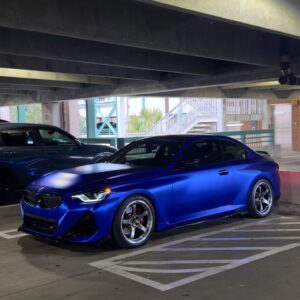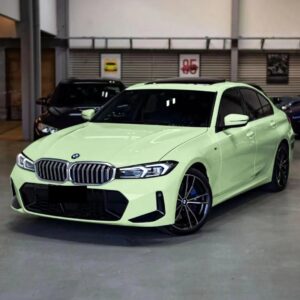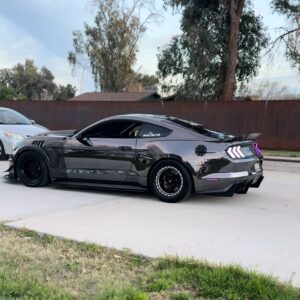
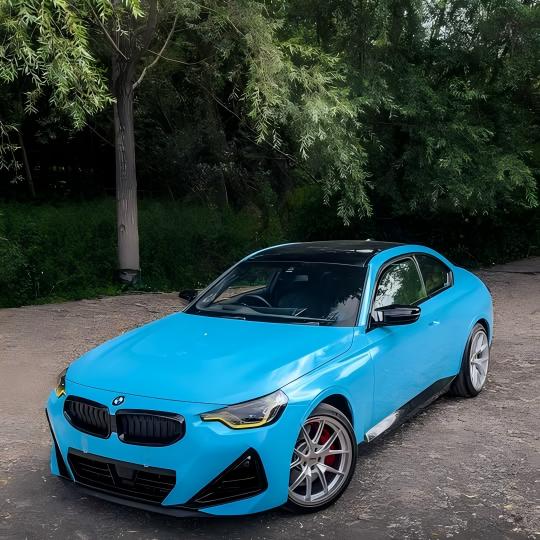
A sky blue car sits in an interesting space between subtle and attention-grabbing. It is brighter and fresher than navy, softer than electric blue, and usually easier to live with than highly saturated turquoise or cyan.
But choosing a sky blue car wrap is not simply a matter of choosing “light blue.”
Gloss level, metallic particles, color depth, and color-shifting pigments can make two sky blue wraps look completely different once they are installed on a full vehicle.
At ALUKOVINYL, the sky blue range includes five noticeably different interpretations:
- Gloss Crystal Sky Blue
- Gloss Light Sky Blue
- Matte Metallic Sky Blue
- Gloss Metallic Sparkle Sky Blue
- Gloss Metallic Chameleon Green Sky Blue
This guide compares how those five finishes behave visually, which vehicles tend to suit them best, their advantages and disadvantages, and what you should consider before turning your car sky blue.
What Is the Best Sky Blue Car Wrap?
For most drivers, Gloss Crystal Sky Blue is the most balanced sky blue car wrap because it combines a clean light-blue tone with a deep gloss finish. Gloss Light Sky Blue is better for a brighter and simpler OEM-inspired appearance, while Matte Metallic Sky Blue creates a more understated modern look. Sparkle Sky Blue adds visible metallic character, and Chameleon Green Sky Blue is the best choice for drivers who want the color to shift noticeably with viewing angle and light.
Sky Blue Car Wrap Comparison
| Sky Blue Wrap | Visual Character | Light Reaction | Best For | Attention Level |
|---|---|---|---|---|
| Gloss Crystal Sky Blue | Clean, deep, premium | High gloss reflection | Modern sports cars & EVs | ★★★☆☆ |
| Gloss Light Sky Blue | Bright, fresh, simple | Clean reflections | Daily drivers & compact cars | ★★★☆☆ |
| Matte Metallic Sky Blue | Soft, sophisticated | Diffused reflections | Performance cars & SUVs | ★★★☆☆ |
| Gloss Sparkle Sky Blue | Metallic, energetic | Sparkles in direct light | Coupes & show builds | ★★★★☆ |
| Chameleon Green Sky Blue | Dynamic, color-shifting | Blue-to-green variation | Exotic & custom builds | ★★★★★ |
The important takeaway is that there is no universal “best” sky blue. The right choice depends on whether you want your car to look OEM+, elegant, sporty, metallic or highly customized.
Why Is Sky Blue Becoming an Interesting Car-Wrap Color?
Dark blue has been a conventional automotive color for decades. Sky blue does something different.
Because it has significantly more visual brightness than navy or midnight blue, it exposes body lines instead of hiding them. On cars with sculpted doors, wide rear quarters or complex bumpers, this can make the design easier to read.
At the same time, sky blue is not as visually aggressive as fluorescent blue or chrome.
That creates what we consider a useful middle ground:
High color identity + relatively low visual aggression.
It can therefore work on everything from a Tesla Model 3 to a Porsche 911.
Wrapping also offers a fundamentally different route from permanently repainting a vehicle. A quality wrap is removable, and manufacturers such as 3M note that professionally installed wrap film can be removed without damaging sound OEM paint when the film is used and removed according to its recommended conditions.
1. Gloss Crystal Sky Blue — Best Overall Sky Blue Car Wrap
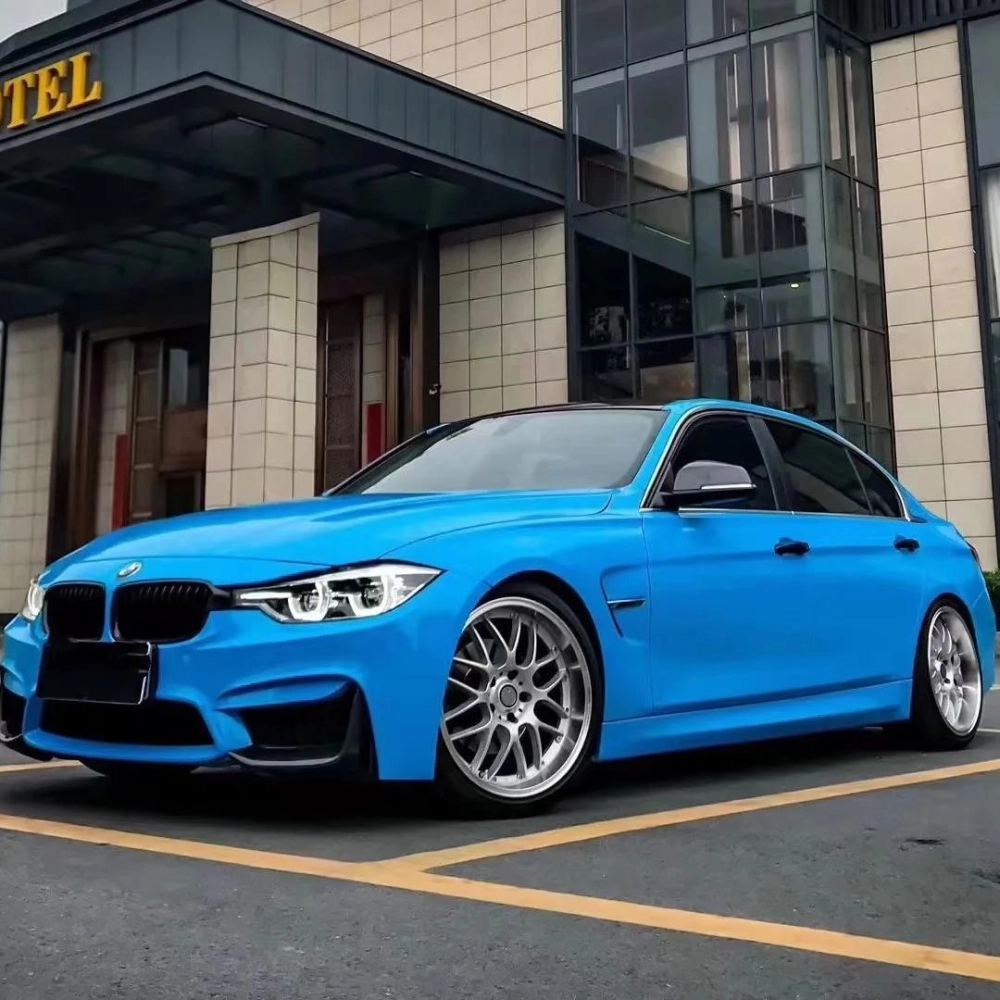
Best for: Tesla Model 3/Y, Porsche 911, BMW M3/M4, Toyota Supra, Mercedes-AMG models
If your mental picture of the ideal sky blue car is something clean, glossy and almost paint-like, Gloss Crystal Sky Blue is the logical starting point.
ALUKOVINYL’s Gloss Crystal Sky Blue uses a PET-based gloss construction and is designed to create a smooth, highly reflective surface. The current product specification lists expected durability of 5–7 years under stated conditions, although actual service life always depends on installation, exposure and maintenance.
What Makes Crystal Sky Blue Different?
The important word here is crystal.
Rather than relying heavily on obvious metallic particles, the finish emphasizes surface clarity and color depth.
Under overcast conditions, the vehicle can appear like a relatively soft pastel blue.
Move the same car into strong sunlight and the gloss surface creates brighter highlights across:
- fender arches
- shoulder lines
- hood contours
- quarter panels
- bumper surfaces
That makes Crystal Sky Blue particularly effective on cars with complex surfacing.
Why We Like It on a Tesla Model 3
The Tesla Model 3 is a good example.
Its body has relatively few traditional styling details, so the color itself becomes a major part of the design.
A very dark color can visually flatten some of those surfaces. Crystal Sky Blue does the opposite: light reflecting across the blue surface helps reveal the transitions between the hood, fenders and side panels.
ALUKOVINYL’s product gallery also contains customer examples of Gloss Crystal Sky Blue installed on a Tesla Model 3, making it more than a purely theoretical pairing.
Pros
- Paint-like glossy appearance
- Easy to combine with black trim
- Shows body lines clearly
- Modern without being excessively flashy
- Works across sports cars, EVs and luxury sedans
- Strong option for photography
Cons
- Gloss surfaces show dust and water spots more readily
- Surface preparation becomes especially important
- Less dramatic than sparkle or chameleon films
- Reflections can make the shade appear lighter in strong sunlight
Our Verdict
Best all-round sky blue.
If someone likes sky blue but is uncertain which finish to choose, this is the safest starting point.
2. Gloss Light Sky Blue — Best for a Clean OEM+ Look
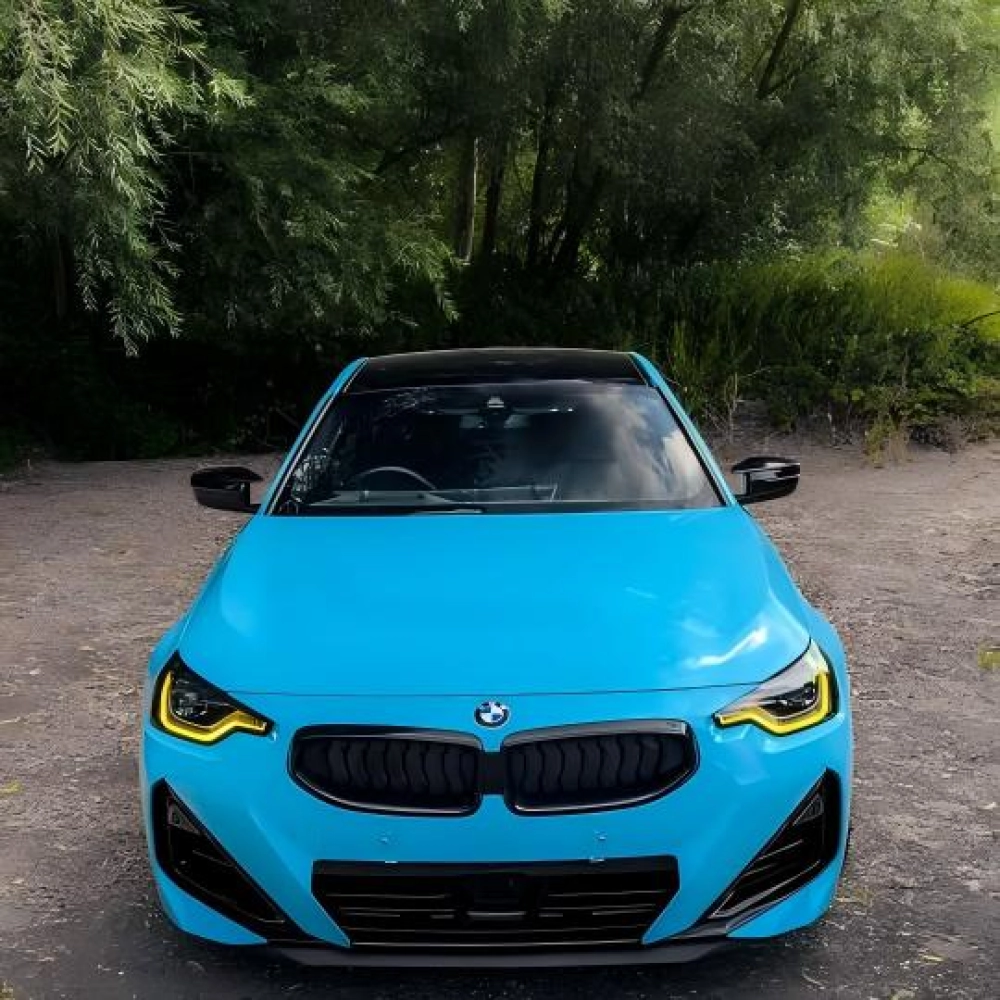
Best for: BMW 3 Series, VW Golf GTI, Honda Civic, Tesla Model Y, MINI Cooper
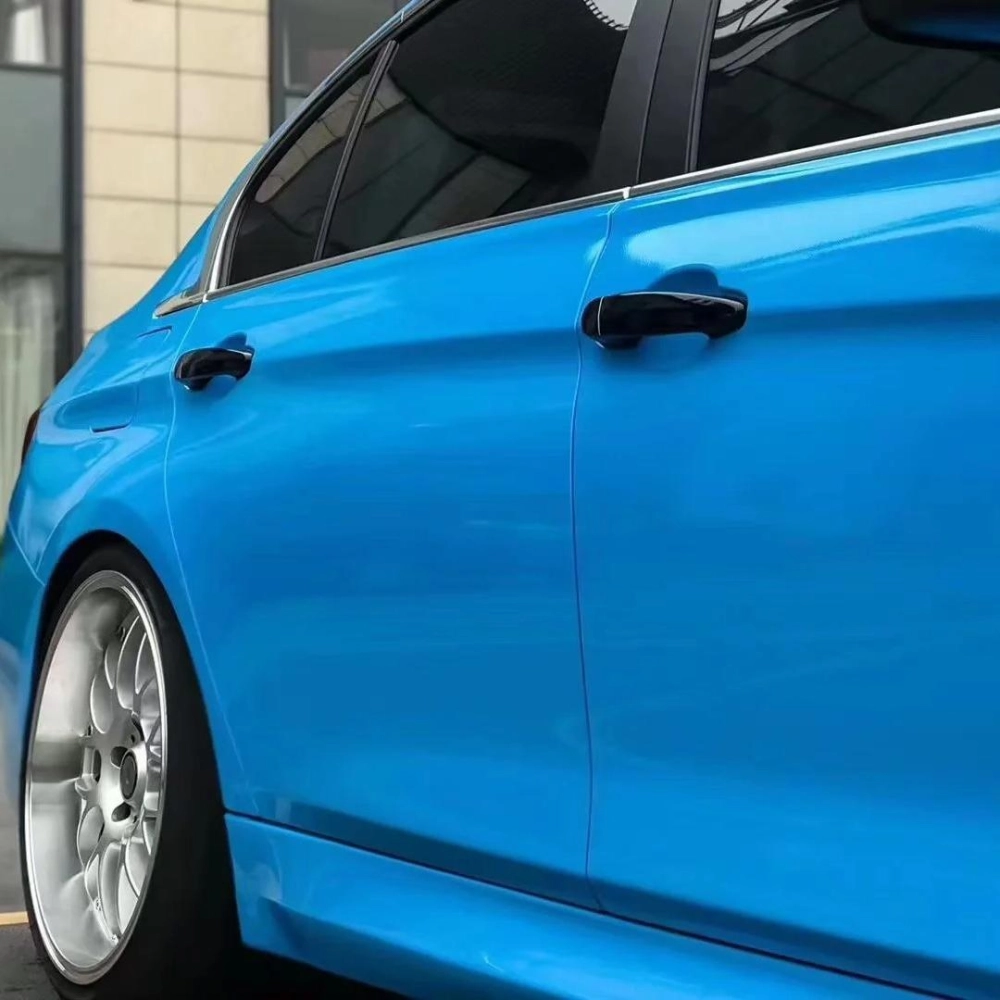
At first glance, Gloss Light Sky Blue and Gloss Crystal Sky Blue may appear similar.
On a complete vehicle, however, the visual intent is different.
Gloss Light Sky Blue focuses more strongly on the actual light-blue color rather than creating additional visual complexity.
Think:
fresh + bright + clean.
Instead of:
metallic + dramatic + custom.
That makes it particularly useful for an OEM+ build.
What Does OEM+ Mean?
In automotive customization, an OEM+ style attempts to make a modification look as though the manufacturer itself could have offered it.
Gloss Light Sky Blue fits that philosophy well.
Combine it with:
- factory black trim
- silver wheels
- gloss black wheels
- subtle lowering
- factory aero components
and the car can remain relatively sophisticated despite having a much less common exterior color.
Gloss Light vs Crystal Sky Blue
Choose Gloss Light Sky Blue if color purity matters most.
Choose Gloss Crystal Sky Blue if you want more perceived depth and a richer gloss effect.
The distinction may look small on a sample, which is why viewing a physical swatch in sunlight, shade and artificial lighting is useful before ordering an entire roll.
Pros
- Clean and refreshing color
- Easy to coordinate with wheel colors
- Works well on everyday vehicles
- Less visually complicated than metallic effects
- Suitable for both small and large cars
Cons
- May appear significantly lighter under strong sun
- Less exotic than sparkle or chameleon finishes
- Road contamination may be easier to see than on darker colors
Our Verdict
Best sky blue wrap for an OEM-inspired build.
This is the version we would consider for someone who wants people to notice the color before noticing that the vehicle has been wrapped.
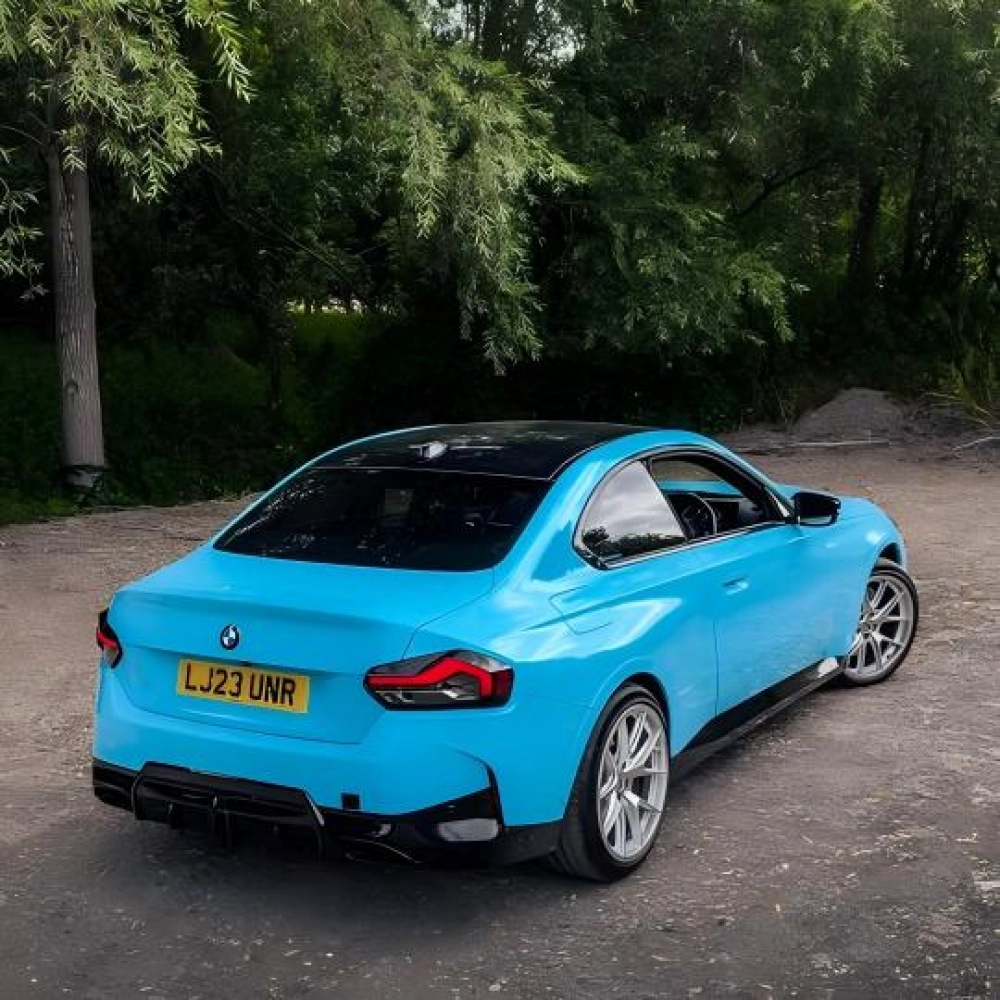
3. Matte Metallic Sky Blue — Best Understated Performance Look
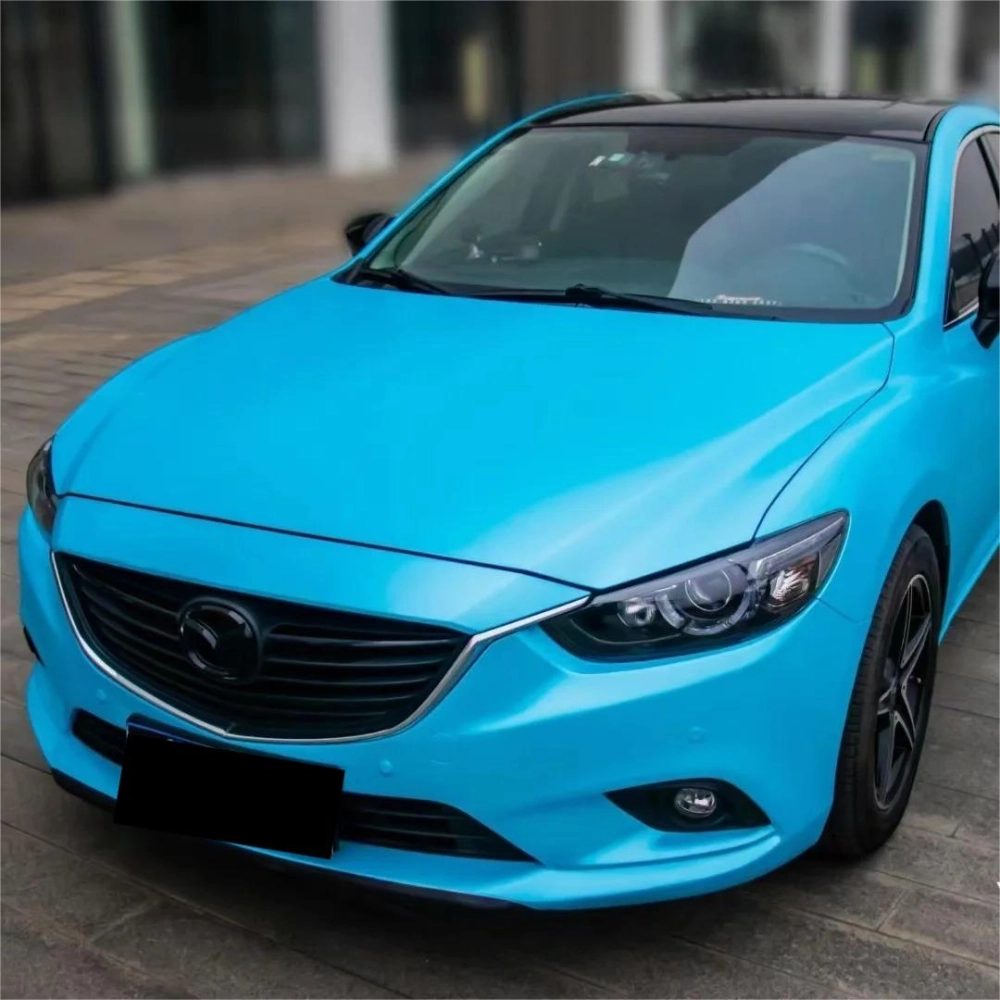
Best for: BMW M2, Audi RS3, Nissan GT-R, Ford Mustang, Porsche Cayman
Matte changes the personality of sky blue more than you might expect.
Glossy sky blue feels fresh and playful.
Matte sky blue feels technical.
The reduced specular reflection means you see fewer mirror-like highlights across the body. Instead, light spreads more softly across the panel.
ALUKOVINYL’s Matte Metallic Sky Blue combines this muted surface with metallic characteristics, preventing the finish from becoming visually flat.
Why Matte Works on Performance Cars
Performance cars often have aggressive geometry:
large intakes, flared arches, spoilers, diffusers and strong shoulder lines.
A matte finish allows those shapes to become part of the visual identity rather than having every panel dominated by reflections.
For example, consider a BMW M2 with:
- Matte Sky Blue body
- gloss black roof
- carbon-fiber accents
- dark wheels
- black grille details
The contrast creates a substantially more aggressive result than the same blue in a traditional gloss finish.
Matte Sky Blue Requires Different Care
This is important.
You should not treat matte vinyl exactly like glossy automotive paint.
Avoid trying to polish a matte surface to remove marks because localized polishing can change the sheen and create inconsistent glossy areas.
Major film manufacturers make similar distinctions in their maintenance recommendations. 3M recommends non-abrasive cleaning and warns against products that can damage film surfaces, while Avery Dennison emphasizes regular cleaning and appropriate wrap-care products.
Pros
- Distinctive without using an extreme color
- Excellent contrast with carbon fiber and black trim
- Reduces strong reflections
- Gives sky blue a more serious character
- Particularly suitable for performance builds
Cons
- Cannot be polished like conventional glossy paint
- Oils and fingerprints may be more noticeable
- Requires finish-appropriate cleaning
- Repairing a damaged panel requires careful color/batch matching
Our Verdict
Best sky blue for a performance-oriented build.
If ordinary pastel blue feels too soft, matte metallic changes the equation completely.
4. Gloss Metallic Sparkle Sky Blue — Best for Sunlight
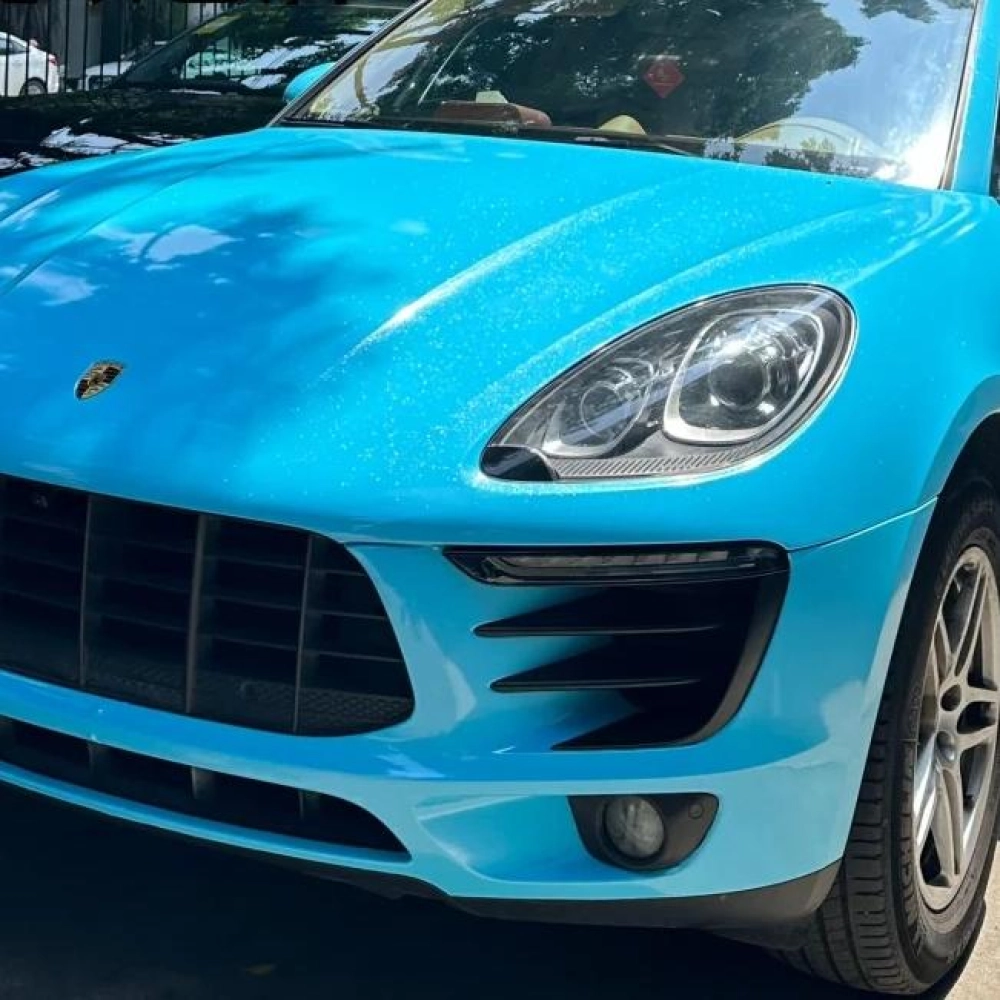
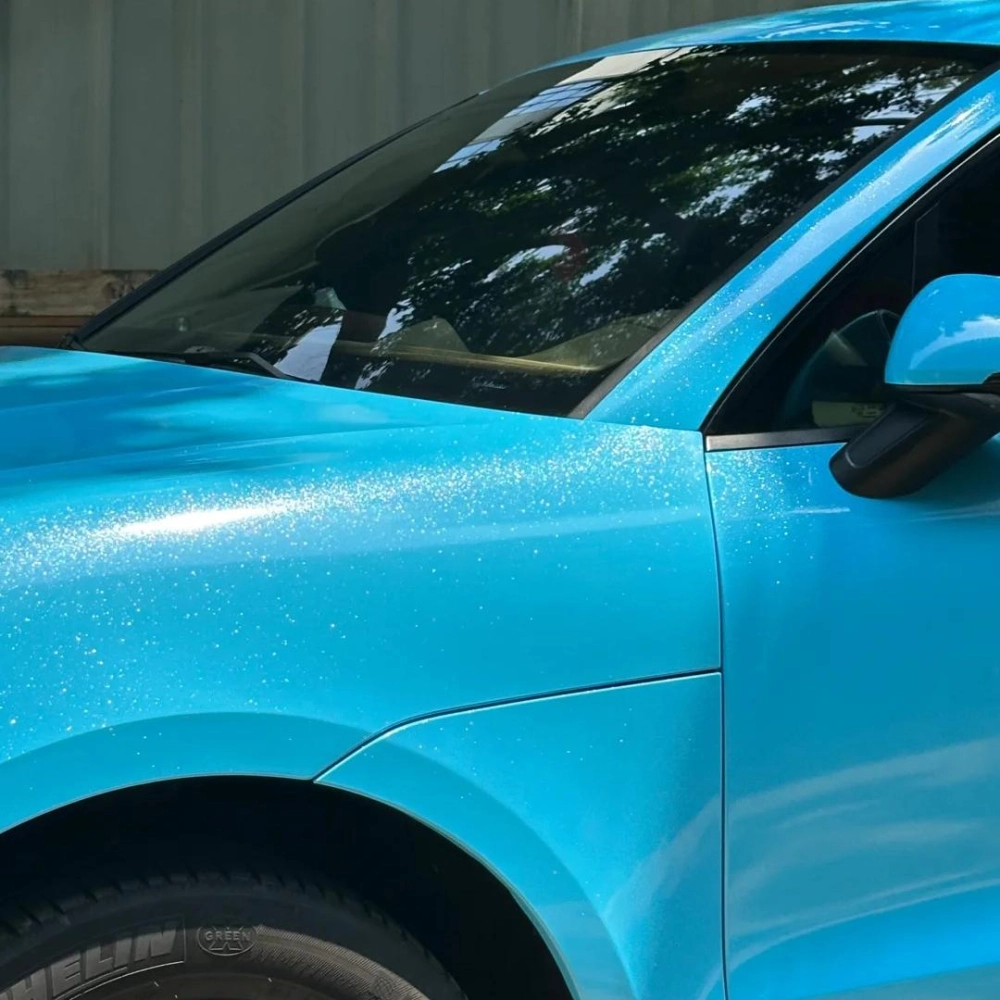
Best for: Toyota GR86, Subaru BRZ, Corvette, Mustang, Nissan Z, modified coupes
A static online photograph does not fully explain a sparkle wrap.
Why?
Because sparkle is fundamentally dependent on light.
ALUKOVINYL’s Gloss Metallic Sparkle Sky Blue combines three visual characteristics:
sky blue base + gloss surface + metallic sparkle.
In diffuse shade, the car may look relatively close to a conventional metallic light blue.
Under direct sunlight or bright artificial lighting, the metallic effect becomes substantially more visible.
This creates what installers and designers often think of as a more dynamic finish—the appearance changes as either the vehicle, viewer or light source moves.
Sparkle vs Crystal Sky Blue
This distinction matters when shopping online.
Crystal Sky Blue
Focus:
Color depth and surface clarity.
Visual result:
Cleaner and smoother.
Sparkle Sky Blue
Focus:
Metallic light interaction.
Visual result:
More energetic and customized.
If your car frequently appears at meets, outdoor events or automotive photography sessions, Sparkle Sky Blue has an advantage because changing light becomes part of the design.
Best Wheel Combinations
Our preferred combinations include:
Gloss black wheels: strongest contrast.
Silver wheels: cleaner European/OEM appearance.
Gunmetal wheels: balances sporty and premium aesthetics.
White wheels: much more aggressive tuner/JDM character.
Pros
- Strong sunlight performance
- More depth than basic light blue
- Excellent for automotive photography
- Works particularly well on coupes
- Noticeable without reaching chrome-level intensity
Cons
- Metallic effect is less visible in flat lighting
- Harder to evaluate accurately from screen photos
- Can look busier on vehicles with excessive exterior accessories
- Panel orientation can influence perceived metallic appearance
Our Verdict
Best sky blue car wrap for drivers who want the car to come alive outdoors.
5. Gloss Chameleon Green Sky Blue — Most Dramatic Option
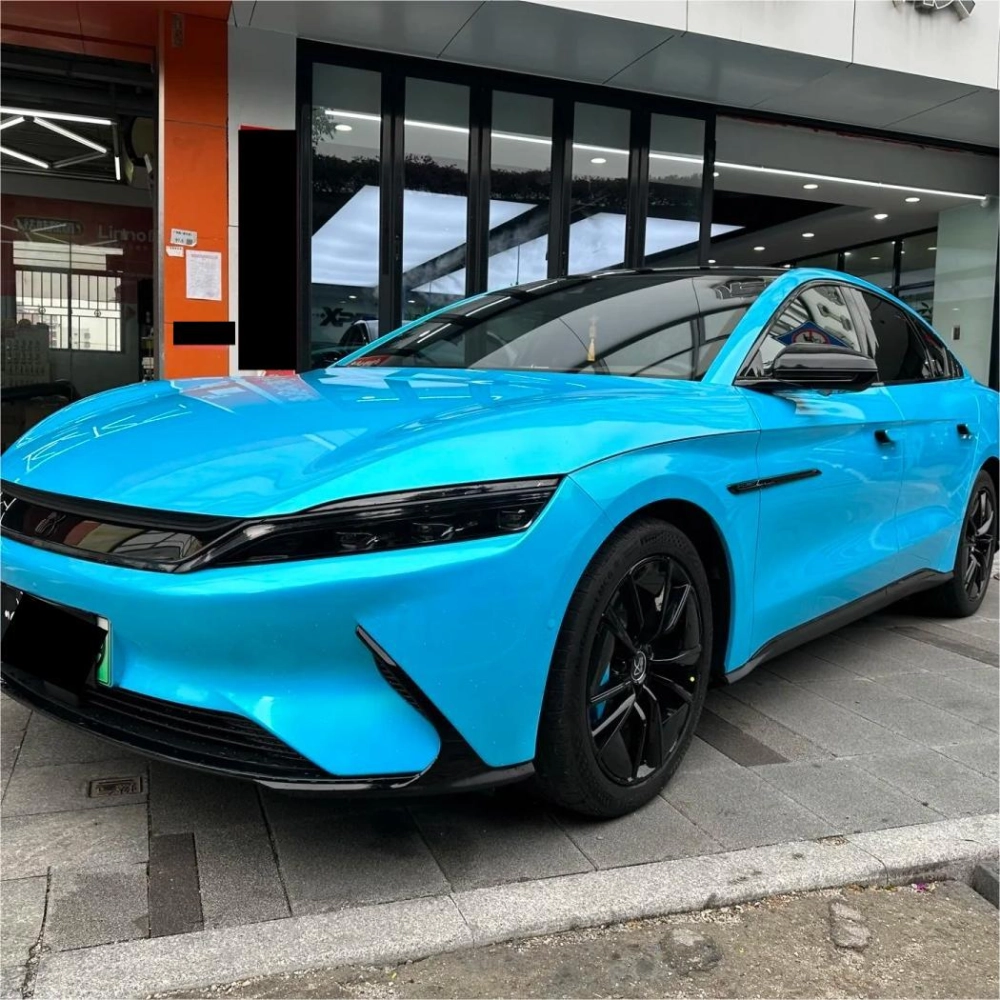
Best for: Lamborghini, McLaren, Nissan GT-R, Supra, Corvette, widebody builds
This is where “sky blue” stops behaving like a conventional color.
A Gloss Metallic Chameleon Green Sky Blue uses color-shifting characteristics to produce different perceived hues depending on lighting and viewing angle.
One section can appear predominantly sky blue while another begins to reveal green characteristics.
That effect becomes especially obvious across curved surfaces.
Why Body Shape Matters More With Chameleon Film
Imagine looking at the rear quarter panel of a wide sports car.
The upper surface reflects light at one angle.
The vertical section reflects it at another.
The wheel arch curves through several angles.
With conventional blue, these areas mostly differ in brightness.
With a chameleon finish, they can differ in both brightness and perceived hue.
This means vehicle geometry becomes part of the color.
That is why we generally prefer chameleon finishes on cars with strong three-dimensional surfaces rather than extremely flat body designs.
Where It Works Best
A Toyota Supra is a good example.
Its large rear haunches, sculpted doors and curved front fenders give the film many different surface orientations.
As you walk around the vehicle, those angles can reveal different portions of the blue-green effect.
Pros
- Highest visual impact of these five choices
- Appearance changes with viewing angle
- Excellent on highly sculpted cars
- Strong show-car potential
- Much more unusual than standard sky blue
Cons
- Not ideal for someone seeking an OEM appearance
- Color is harder to judge from a single photograph
- Matching replacement panels can require extra attention
- May visually compete with complex graphics or excessive modifications
Our Verdict
Best sky blue option for maximum individuality.
If your objective is simply to own a blue car, choose another finish.
If your objective is for people to walk around the car to see what the color is doing, this is the one.
Which Sky Blue Car Wrap Looks Best on Different Cars?
Vehicle architecture matters almost as much as color preference.
Tesla Model 3 / Model Y
Best: Gloss Crystal Sky Blue
The smooth body benefits from strong gloss reflections, while black glass and trim create natural contrast.
BMW M2 / M3 / M4
Best: Matte Metallic Sky Blue
Aggressive body lines and dark performance components pair particularly well with the muted blue finish.
Porsche 911 / Cayman
Best: Gloss Crystal or Sparkle Sky Blue
The curved fenders allow highlights and metallic particles to follow the body’s shape beautifully.
Toyota Supra
Best: Chameleon Green Sky Blue
The Supra’s highly sculpted surfaces give color-shifting film plenty of different viewing angles.
GR86 / BRZ
Best: Sparkle Sky Blue
A compact coupe can carry a more visually energetic finish without becoming overwhelming.
SUV
Best: Gloss Light Sky Blue
Large vehicles have significantly more visible surface area. A simple gloss light blue can therefore provide enough visual impact without requiring a complex effect.
Sky Blue vs Baby Blue vs Tiffany Blue: What’s the Difference?
These colors are frequently confused online.
They belong to a similar light-color family but have different visual tendencies.
Sky Blue
Usually feels clean, airy and moderately saturated. It resembles a clear daytime sky.
Baby Blue
Generally appears softer and more pastel.
Tiffany-style Blue
Typically introduces noticeably more green/cyan character.
If you want a blue that remains clearly recognizable as blue without becoming dark, sky blue is usually the most versatile middle ground.
Gloss vs Matte Sky Blue: Which Is Easier to Own?
Neither finish is objectively better.
They prioritize different visual characteristics.
Choose Gloss If You Want:
- stronger reflections
- paint-like appearance
- maximum color brightness
- easier integration into OEM-style builds
Choose Matte If You Want:
- softer reflections
- a more customized appearance
- stronger contrast with glossy carbon or black components
- a more technical/performance aesthetic
One practical consideration is surface care.
Matte finishes should not be aggressively polished to chase gloss or remove defects. Gloss finishes are more forgiving visually in some situations, although they tend to reveal water spots, dust and fine surface contamination more clearly.
How Long Can a Sky Blue Car Wrap Last?
There is no responsible single lifespan figure for every wrapped vehicle.
ALUKOVINYL currently lists an expected durability of 5–7 years for several of its Sky Blue products under its stated product conditions.
Real-world lifespan, however, depends heavily on:
- UV exposure
- climate
- installation quality
- vehicle storage
- panel orientation
- maintenance
- contaminants
- frequency of washing
This distinction is supported by the wider wrap industry.
3M advises storing wrapped vehicles indoors or in shade when possible because reducing heat and UV exposure helps preserve film.
Avery Dennison similarly notes that vinyl exposed continuously to contamination, UV and heat can degrade more quickly.
ORAFOL goes even further in its technical guidance by distinguishing expected service life according to climate and panel orientation. Horizontal surfaces can experience more demanding exposure than vertical panels.
So instead of asking:
“Will my sky blue wrap last exactly five years?”
A better question is:
“What conditions will my particular wrapped car experience during those five years?”
A garage-kept weekend car and a daily-driven vehicle parked outdoors in intense sun should not be expected to age identically.
How to Keep a Sky Blue Car Looking Fresh
Light colors can remain impressive for years, but contamination is particularly noticeable when allowed to accumulate.
A sensible maintenance routine includes:
- Wash the vehicle regularly.
- Remove bird droppings, insects, fuel and tree sap promptly.
- Prefer hand washing or appropriate touchless washing.
- Avoid abrasive brushes.
- Use pH-appropriate wrap-safe cleaning products.
- Keep the vehicle under cover when practical.
- Follow the film manufacturer’s instructions for the specific finish.
Avery Dennison’s North American maintenance guidance recommends cleaning vehicle wraps approximately every two weeks for optimal appearance, while its other regional guidance specifies at least monthly cleaning depending on conditions. This variation itself demonstrates an important point: maintenance frequency should reflect environment and vehicle use rather than an arbitrary universal schedule.
3M likewise recommends hand washing when possible and warns that brush-style car washes can dull, scratch or potentially lift film edges.
A Professional Detail Many Buyers Miss: Horizontal Panels Age Differently
This is one of the most important factors rarely discussed when choosing wrap colors.
Your hood and roof do not experience the environment in exactly the same way as your doors.
Horizontal or near-horizontal surfaces generally receive greater direct solar exposure and can retain environmental contamination more readily.
Avery Dennison specifically notes that horizontal wrap areas in polluted environments can experience reduced durability because they trap contaminants while receiving increased UV exposure.
ORAFOL’s technical guidance also assigns different expected service-life figures according to orientation and climate.
This matters when evaluating a sky blue wrap several years after installation.
If the hood ages faster than a vertical door panel, it does not necessarily mean that the blue pigment itself was defective. Panel orientation, heat, UV exposure and contamination history all need to be considered.
For cars that spend significant time outdoors, protecting horizontal surfaces from prolonged sun exposure whenever practical can therefore make a meaningful difference.
What Should You Check Before Ordering a Sky Blue Wrap?
Do not make the final decision from one website image.
Digital screens introduce too many variables:
- display calibration
- screen brightness
- photography exposure
- white balance
- surrounding reflections
- editing
- ambient lighting
ALUKOVINYL itself notes on its product pages that screen images and finishes are for reference and that physical samples provide a more accurate representation.
We recommend examining your preferred sky blue in at least three environments:
Direct sunlight
Reveals metallic particles, sparkle and maximum brightness.
Shade
Shows the base color more accurately without extreme reflections.
Indoor/artificial lighting
Shows how the vehicle may look in garages, parking structures and at night.
This is especially important when comparing Crystal, Sparkle and Chameleon Sky Blue, because their differences depend heavily on light interaction.
Pros and Cons of Wrapping a Car Sky Blue
Advantages
Distinctive without being extreme
Sky blue is uncommon enough to attract attention without reaching the visual intensity of fluorescent or chrome colors.
Highlights vehicle design
Light blue can reveal curves and body lines that darker colors visually suppress.
Multiple personalities
Changing the finish can transform the same basic color from elegant to aggressive.
Strong contrast
Sky blue pairs naturally with black, carbon fiber, silver and gunmetal exterior components.
Reversible customization
A properly installed and professionally removed automotive wrap allows a dramatic color transformation without permanently repainting sound factory paint.
Disadvantages
Light changes the color
A sky blue car may look significantly different between midday sun and an indoor garage.
Maintenance still matters
Vinyl is not maintenance-free.
Film cannot repair damaged paint
Wrap should be installed over suitable, properly prepared surfaces.
Color matching requires planning
Production batches can vary slightly. Ordering sufficient material—and some additional material for future repairs—can reduce matching problems later.
Our Final Ranking: Which Sky Blue Should You Choose?
After comparing all five finishes, we would divide them by personality rather than simply declaring one winner.
Best Overall — Gloss Crystal Sky Blue
Choose it for a premium, versatile and highly polished sky blue appearance.
Best OEM+ — Gloss Light Sky Blue
Choose it when you want the car to look as though a manufacturer might have offered the color.
Best Performance Style — Matte Metallic Sky Blue
Choose it for aggressive cars, dark wheels and carbon-fiber components.
Best in Sunlight — Gloss Metallic Sparkle Sky Blue
Choose it when metallic light interaction is part of the appeal.
Most Unique — Gloss Metallic Chameleon Green Sky Blue
Choose it when a conventional blue is simply not dramatic enough.
Ultimately, the best sky blue car is not determined by which shade looks brightest on a computer screen.
It is determined by how the color interacts with your car’s shape, your preferred style and the environment where you actually drive it.
FAQ About Sky Blue Car Wraps
Is sky blue a good color for a car?
Yes. Sky blue offers a useful balance between visibility and sophistication. It is significantly brighter than navy but generally less aggressive than fluorescent or chrome blue, making it suitable for both daily drivers and customized performance cars.
What is the best sky blue car wrap?
For a broadly versatile appearance, Gloss Crystal Sky Blue is an excellent choice. Drivers wanting a cleaner OEM-inspired finish may prefer Gloss Light Sky Blue, while Matte Metallic, Sparkle and Chameleon versions provide increasingly customized effects.
Does a sky blue car wrap look different in sunlight?
Yes. Gloss reflections, metallic particles and chameleon pigments all react differently to light. Sparkle and chameleon films in particular can change noticeably depending on viewing angle and illumination.
Is matte sky blue harder to maintain?
Not necessarily harder, but it requires different care. Avoid abrasive polishing or products that alter the uniform matte surface. Clean contaminants promptly and use products appropriate for matte automotive film.
Does vinyl wrap protect factory paint?
A vinyl color-change wrap creates a physical layer between the paint and some everyday environmental exposure, but it should not be treated as equivalent to dedicated paint protection film. Its primary purpose is aesthetic customization.
Will sky blue vinyl fade in the sun?
All exterior materials experience environmental aging over time. UV intensity, heat, storage and panel orientation influence how quickly that occurs. Major wrap manufacturers including 3M, Avery Dennison and ORAFOL recommend reducing prolonged heat/UV exposure and maintaining the film correctly to maximize service life.
Can I put sky blue wrap over scratched paint?
Minor imperfections may sometimes be wrapped, but vinyl does not repair the substrate and can reproduce underlying defects through the film. Peeling clear coat, rust, poorly bonded respray or severely damaged paint should be corrected before wrapping.
Should I choose sky blue or baby blue?
Choose sky blue if you want a clearer, slightly more saturated blue appearance. Baby blue generally produces a softer, more pastel aesthetic.
How much vinyl do I need to wrap my car?
The required amount depends on vehicle dimensions, panel complexity and installer experience. Always allow additional material for bumpers, complex curves, installation errors and future repairs rather than calculating only the vehicle’s visible surface area.
Find Your Sky Blue
One color family. Five completely different personalities.
A sky blue car can be clean and factory-inspired, muted and aggressive, metallic and sparkling, or even shift toward green as you walk around it.
That is why choosing a wrap should begin with more than a color name.
Explore the ALUKOVINYL Sky Blue Car Wrap collection to compare Gloss Crystal Sky Blue, Gloss Light Sky Blue, Matte Metallic Sky Blue, Gloss Metallic Sparkle Sky Blue and Gloss Metallic Chameleon Green Sky Blue.
For even more options, browse the Blue Car Wrap collection, or explore ALUKOVINYL car wrap films to build a completely different look.
Choose the finish that works with your car—not just the color that looks best on a screen.