If you are choosing between Matte Satin Silver PPF and PET Matte Satin Chrome Silver vinyl wrap, the decision is not simply about which material looks better.
The two films are designed around different priorities.
PET Matte Satin Chrome Silver vinyl wrap is primarily an appearance-driven product: it offers a highly reflective, electroplated-style silver finish at a relatively lower price, creating an eye-catching chrome appearance that can make a vehicle look dramatically different.
Matte Satin Silver PPF is primarily a protection-driven product: it uses a TPU-based PPF construction to combine a satin silver appearance with the flexibility and protective characteristics associated with modern paint protection film.
In simple terms:
Choose PET Matte Satin Chrome Silver vinyl wrap for maximum visual impact and lower upfront cost. Choose Matte Satin Silver PPF when easier installation, paint protection, and a more durable PPF construction are higher priorities.
Neither material is universally better.
The right choice depends on whether your project prioritizes appearance, budget, installation difficulty, protection, or long-term ownership value.
This article compares the two technologies from a material, installation, performance, cost, and real-world application perspective.
Matte Satin Silver PPF vs PET Matte Satin Chrome Silver Vinyl Wrap: Quick Answer
For buyers who want the shortest possible answer:
| Factor | Matte Satin Silver PPF | PET Matte Satin Chrome Silver Vinyl Wrap |
|---|---|---|
| Main purpose | Protection + color change | Visual customization |
| Base material | TPU-based PPF | PET-based specialty vinyl |
| Appearance | Satin silver | More reflective electroplated chrome effect |
| Brightness | Moderate | Very high |
| Chrome effect | Subtle / limited | Strong |
| Installation | Generally easier | More difficult |
| Installation method | Wet or dry, depending on product | Primarily dry installation |
| Paint protection | Yes, PPF-oriented | Limited compared with PPF |
| Price | Higher | Lower |
| Visual impact | Refined | Extremely eye-catching |
| Best for | Daily drivers and protection-focused builds | Show cars, short-term styling and budget-conscious projects |
The fundamental difference is therefore:
PET wins on visual intensity and upfront price. TPU wins on installation flexibility and protection-oriented performance.
What Is Matte Satin Silver PPF?
Matte Satin Silver PPF is a colored paint protection film designed to provide a silver or satin-metallic appearance while functioning as a protective layer over automotive paint.
Unlike conventional clear PPF, which attempts to preserve the original factory color, colored PPF changes the vehicle’s appearance.
The important distinction is that the film is still engineered around the basic concept of PPF.
Modern TPU PPF products can use multiple layers, including:
- TPU base film
- Color layer
- Protective top coat
- Adhesive
- Release liner
The exact construction varies by manufacturer.
Current industry products demonstrate how complex modern TPU PPF constructions can be. For example, Tinybot publishes a colored TPU PPF construction consisting of a TPU base film, polyurethane color layer, adhesive, and liner, with a stated total thickness of 7.78 mil excluding the release liner for one of its color PPF products.
TeckWrap similarly publishes detailed specifications for its TPU PPF products. Its current matte PPF, for example, lists a total thickness of approximately 270 ± 10 μm, product elongation of 280%, UV resistance of 98%, and a self-healing surface. TeckWrap also states that the product underwent accelerated UV testing and reports an SGS-tested color stability result under ASTM G154 Cycle 1.
These numbers should be treated as manufacturer-reported specifications for those specific products, not as universal specifications for every TPU PPF on the market.
That distinction is important when comparing materials.
What Is PET Matte Satin Chrome Silver Vinyl Wrap?
PET Matte Satin Chrome Silver vinyl wrap is a specialty automotive wrap designed primarily to create a highly reflective silver, satin-chrome or electroplated appearance.
The use of PET in specialty automotive films is particularly relevant to the appearance.
Compared with conventional PVC color vinyl, PET-based specialty films can produce a very smooth, reflective surface with a strong metallic or electroplated visual character.
This is the main attraction.
Under direct sunlight or strong artificial lighting, PET Matte Satin Chrome Silver can create a much more pronounced reflective effect than a conventional satin silver film.
For a show car or a vehicle designed to attract attention, that visual difference can be significant.
However, the same construction and surface characteristics that make the film visually impressive can also make installation more demanding.
The Biggest Difference: Chrome Appearance vs. PPF Performance
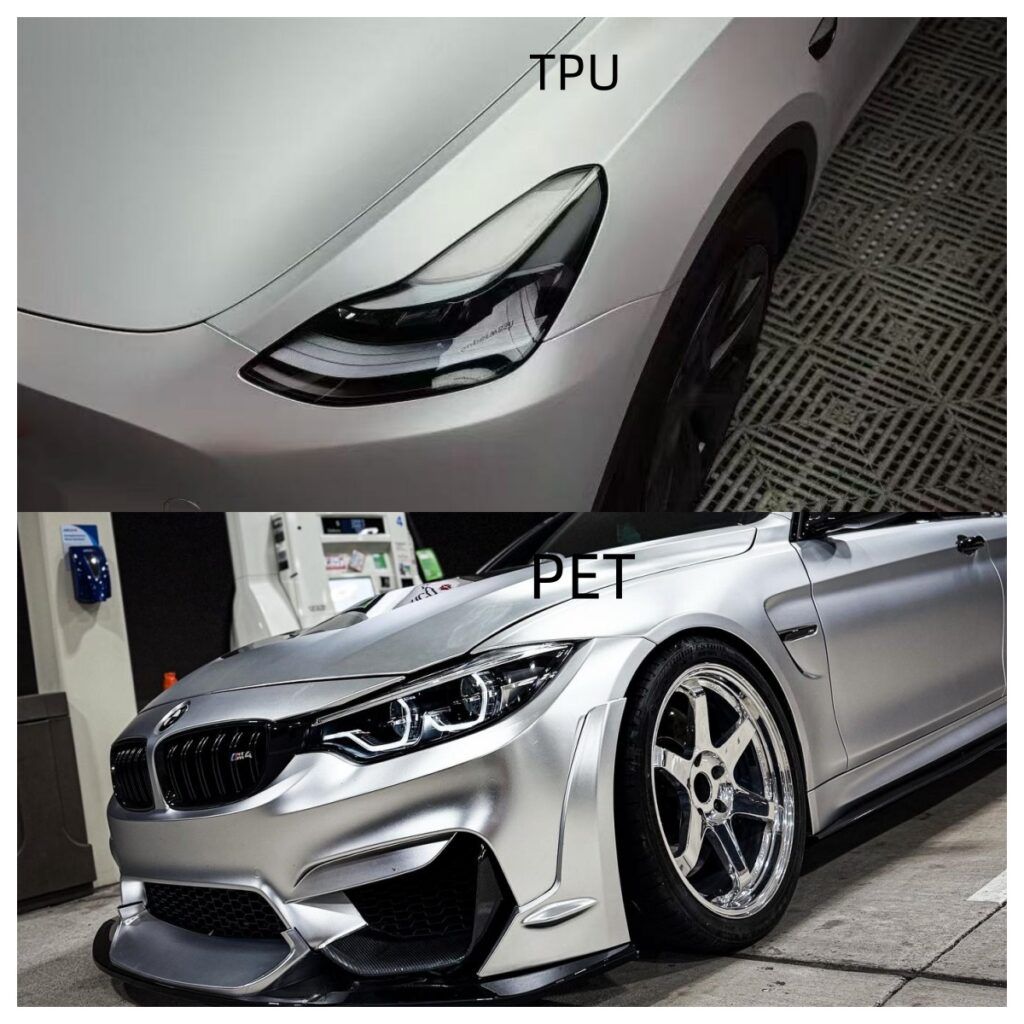
If you place the two materials side by side, the difference is immediately apparent.
PET Matte Satin Chrome Silver is designed to catch your eye.
Matte Satin Silver PPF is designed to balance appearance with protection.
PET can produce:
- Stronger reflections
- More pronounced electroplated appearance
- Higher visual contrast
- More dramatic metallic highlights
- A more “show car” appearance
TPU Matte Satin Silver generally provides:
- A softer satin-metallic appearance
- Less mirror-like reflection
- A more refined surface
- A more conventional PPF appearance
- Greater emphasis on protection and installation flexibility
This means the “better-looking” option depends on the intended style.
If you want a vehicle that immediately attracts attention under sunlight, PET chrome can have the advantage.
If you want a premium silver finish that looks more understated while protecting the underlying paint, TPU PPF may be the better match.
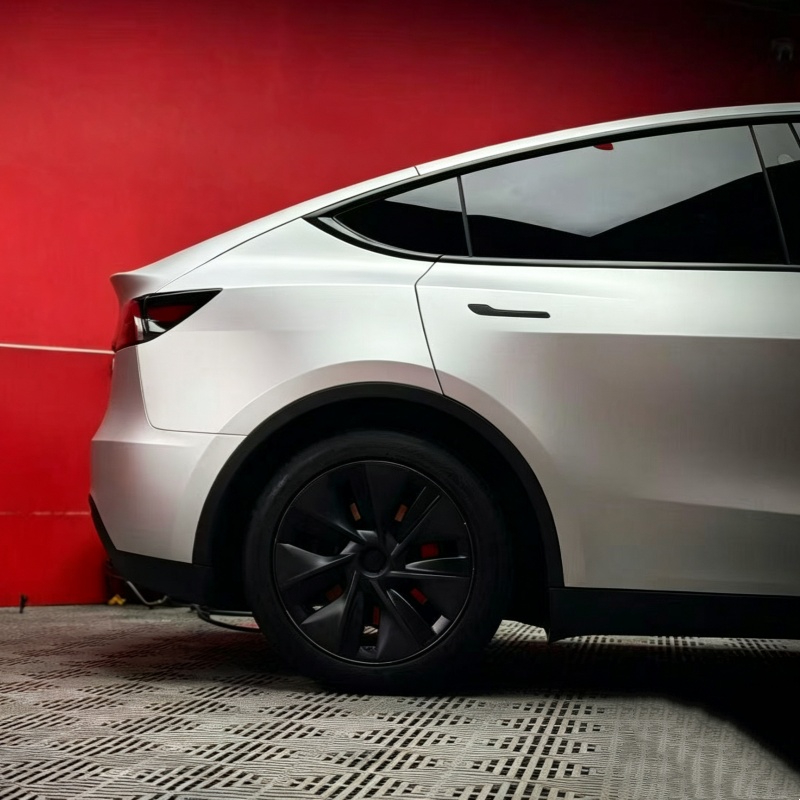
Matte Satin Silver PPF vs PET Matte Satin Chrome Silver vinyl wrap comparison
Why PET Matte Satin Chrome Silver Looks Brighter
The visual difference is largely related to how the film’s surface and optical layers interact with light.
A highly reflective film can produce stronger specular reflection, creating the characteristic “electroplated” effect.
This is why PET chrome-style materials can appear almost metallic or liquid-like under strong lighting.
The visual effect is particularly noticeable on:
- Hood panels
- Roofs
- Fenders
- Doors
- Trunk lids
- Large smooth body panels
Curved panels can create additional highlights because the reflected light changes across the surface.
For a show vehicle, this can be a major advantage.
The vehicle can look dramatically different from conventional silver vinyl or satin silver PPF.
But this visual advantage should not be confused with durability.
A brighter surface does not automatically mean a more durable film.
PET Matte Satin Chrome Silver: The Main Advantages
1. Lower Upfront Cost
One of the biggest reasons buyers choose PET chrome-style vinyl is price.
Compared with premium TPU color PPF, PET specialty vinyl can offer a more accessible way to achieve a high-end metallic appearance.
This makes it attractive for:
- Budget-conscious builds
- Short-term projects
- Show vehicles
- Promotional vehicles
- Social-media vehicles
- Customers who change colors frequently
The important point is that lower material cost does not necessarily mean lower visual impact.
In fact, PET chrome can look more dramatic than a considerably more expensive PPF.
2. Extremely Eye-Catching Appearance
This is the strongest argument for PET.
The electroplated effect can produce a reflective surface that ordinary satin silver films cannot easily replicate.
Under direct sunlight, the surface can create strong highlights and reflections.
For owners who want:
“I want people to notice my car.”
PET Matte Satin Chrome Silver can be an excellent styling solution.
3. Strong Metallic Character
Traditional satin silver tends to diffuse reflected light.
Chrome-style PET films can create stronger directional reflections.
This produces a more sophisticated metallic appearance when the vehicle is photographed or displayed under controlled lighting.
PET Matte Satin Chrome Silver: The Main Disadvantages
1. More Difficult Installation
The strongest drawback of PET chrome-style films is installation.
Highly reflective specialty films can be less forgiving than conventional vinyl.
Installers may have to pay particular attention to:
- Surface contamination
- Stretching
- Wrinkles
- Trapped air
- Panel direction
- Edge finishing
- Pressure marks
- Tool marks
A conventional vinyl installer may therefore find a specialty chrome PET film significantly more demanding.
The film’s appearance can make small installation imperfections more noticeable.
This is one reason why specialty chrome films should ideally be installed by someone familiar with the material rather than treated like a standard color-change vinyl.
2. The Electroplated Appearance Can Decline Over Time
The chrome/electroplated visual effect is another important limitation.
Outdoor automotive films are exposed to:
- UV radiation
- Rain
- Humidity
- Temperature cycling
- Road contaminants
- Washing chemicals
- Bird droppings
- Tree sap
- Road salt
- Air pollution
Over time, these factors can affect the appearance of specialty metallic and chrome finishes.
The result may include:
- Reduced brightness
- Loss of visual depth
- Fading
- Surface degradation
- Changes in metallic appearance
The exact rate varies by product, climate, vehicle storage, maintenance, and exposure.
Therefore, it would be inaccurate to claim that every PET chrome film has one fixed lifespan.
A more useful statement is:
PET chrome-style films generally require more attention to environmental exposure and long-term appearance than a premium TPU PPF designed around protection and weather resistance.
Matte Satin Silver PPF: The Main Advantages
1. Easier to Work With
TPU PPF is designed to be flexible and conformable.
Modern PPF products are engineered for installation over complex vehicle surfaces, including:
- Hoods
- Fenders
- Bumpers
- Mirrors
- Curved panels
- Recessed areas
For example, TeckWrap’s current TPU PPF specifications report product elongation ranging from approximately 280% to 390% across several products, demonstrating the high elongation characteristics that modern TPU PPF can provide.
This does not mean every TPU PPF has the same elongation.
But it illustrates why TPU is widely used in modern PPF applications.
2. Wet or Dry Installation Flexibility
Depending on the specific product construction, TPU color PPF can support either wet or dry installation approaches.
This gives professional installers more flexibility when dealing with different panels and working conditions.
Dry application can be useful when:
- Rapid positioning is needed
- The adhesive system is designed for repositioning
- The installer wants to minimize liquid
- A clean installation environment is available
Wet installation can be useful when:
- Large panels require more positioning time
- Complex surfaces need controlled movement
- The installer wants greater repositioning flexibility
The actual application method should always follow the manufacturer’s technical instructions.
For comparison, TeckWrap’s current TPU PPF products specify wet installation using slip and tack solutions, while its color PPF range can use low-tack repositionable adhesive systems and micro-grooved liners for dry installation.
This illustrates an important point:
Installation method is determined by the adhesive and liner system, not simply by the fact that a film is “TPU.”
3. Better Protection-Oriented Construction
The primary reason to choose PPF is protection.
3M’s Paint Protection Film Series 100, for example, is specifically marketed to protect vehicle paint from rock chips, scratches, insects, road tar, stains, and outdoor weathering including UV radiation. It also incorporates self-healing technology for minor scratches and carries a 10-year consumer warranty under its stated conditions.
This provides a useful industry benchmark for what modern PPF is designed to accomplish.
However, this should not be interpreted as proof that every TPU color PPF offers the same performance.
Product-specific specifications and warranties should always be checked.
Matte Satin Silver PPF: The Main Disadvantages
1. Higher Price
The biggest disadvantage is cost.
A premium TPU PPF contains more functional layers and is designed around protection rather than simply appearance.
As a result, it generally costs more than a specialty PET vinyl wrap.
If the customer’s only goal is to achieve a silver chrome appearance, paying extra for PPF may not make financial sense.
2. Less Dramatic Chrome Effect
This is the trade-off.
TPU Matte Satin Silver can look premium, refined, and sophisticated.
But it generally does not reproduce the same strong electroplated effect as PET chrome.
If the customer expects a mirror-like chrome appearance, they may be disappointed by a satin silver PPF.
The correct expectation is:
TPU = refined satin silver.
PET = stronger chrome drama.
3. Higher Material Investment
If a vehicle is being wrapped purely for appearance, the additional cost of PPF may not be justified.
However, if the customer also values paint protection, the economics change.
This is why total project objectives matter more than material price alone.
TPU Matte Satin Silver PPF vs PET Matte Satin Chrome Silver: Detailed Comparison
| Category | TPU Matte Satin Silver PPF | PET Matte Satin Chrome Silver Vinyl |
| Primary purpose | Protection + appearance | Appearance |
| Base technology | TPU PPF | PET specialty vinyl |
| Finish | Matte/satin silver | Satin chrome/electroplated |
| Reflectivity | Moderate | Very high |
| Visual impact | Refined | Extremely high |
| Chrome effect | Limited | Strong |
| Installation difficulty | Generally easier | More demanding |
| Installation flexibility | Wet or dry depending on system | More dependent on dry installation |
| Paint protection | PPF-oriented | More limited |
| Surface protection | Stronger | Primarily decorative |
| Price | Higher | Lower |
| Long-term value | Better when protection matters | Better for lower-cost styling |
| Best use | Daily drivers, premium builds | Show cars, short-term projects |
| Main weakness | Higher cost, less chrome | Installation difficulty and appearance aging |
Which Film Is Better for a Daily Driver?
For a daily driver, Matte Satin Silver PPF is generally the more logical choice if paint protection is important.
Daily vehicles encounter significantly more environmental exposure than show cars.
Consider a typical commute:
Highway driving → stone debris → insects → rain → UV → washing → parking outdoors
PPF is specifically designed around this type of exposure.
A conventional decorative wrap can still provide a useful sacrificial surface over paint, but it should not automatically be considered equivalent to a purpose-built PPF.
For a vehicle that will remain in the same finish for several years, the additional investment in TPU PPF may therefore make more sense.
Which Film Is Better for a Show Car?
This is where PET Matte Satin Chrome Silver becomes much more attractive.
A show car is often judged by:
- Visual impact
- Surface reflection
- Color uniqueness
- Photography
- Lighting response
- Overall styling
In these situations, the strong electroplated appearance can outweigh the disadvantages of installation difficulty and potentially shorter visual longevity.
For a six-month promotional project, for example, a lower-cost PET chrome film can make more economic sense than investing in a premium PPF that the owner does not intend to keep for many years.
Which Film Is Better for Professional Installers?
The answer depends on the type of customer base.
A shop specializing in:
show cars + dramatic styling + lower material budgets
may find PET chrome attractive.
A shop specializing in:
PPF + premium vehicles + paint protection + long-term ownership
may prefer TPU color PPF.
For installers, the biggest consideration is not simply material price.
It is also:
installation time + material waste + rework + customer expectations + warranty exposure.
A film that costs less per roll but takes substantially longer to install is not necessarily cheaper at the project level.
A Realistic Example: Porsche 911
Consider a Porsche 911 owner who wants a silver transformation.
Option A: PET Matte Satin Chrome Silver
The customer wants maximum visual impact.
The car will be photographed frequently and may be displayed at events.
The owner expects to keep the finish for a relatively short period.
In this situation, PET chrome can make sense.
The lower material cost and stronger electroplated appearance directly match the project’s objective.
Option B: TPU Matte Satin Silver PPF
Another Porsche owner drives the vehicle every day and plans to keep the same appearance for several years.
The owner cares about:
- Paint protection
- Easier installation
- Surface durability
- Long-term maintenance
- Premium material quality
In this case, TPU PPF is the more logical choice.
The important lesson is that the same vehicle can justify completely different materials depending on the owner’s priorities.
What Do Current PPF Specifications Tell Us?
One reason TPU PPF is increasingly used for premium automotive protection is that manufacturers can publish measurable performance characteristics rather than relying only on appearance claims.
For example, TeckWrap’s current PPF range publishes:
- Total thickness
- Application-layer thickness
- Tensile strength
- Elongation
- Adhesion
- UV resistance
- Self-healing performance
- Weathering results
Its G85 Premium PPF lists 339 μm total thickness, 21 MPa tensile strength, 375% product elongation, and ≥95% UV resistance. TeckWrap also reports accelerated weathering equivalent to nine years for its ESTANE TPU base and an SGS-tested color stability result under ASTM G154 Cycle 1 for that product.
Its matte M75 PPF lists 270 ± 10 μm total thickness, 280% elongation, and 98% UV resistance, along with a self-healing surface.
Tinybot’s colored TPU PPF documentation similarly publishes specific layer construction and performance information, including TPU thickness, polyurethane color thickness, adhesive thickness, hydrophobicity, self-healing temperature, and anti-yellowing testing.
These figures are useful because they demonstrate how modern PPF can be evaluated through measurable properties.
But they should not be used to imply that one manufacturer’s results automatically apply to another manufacturer’s product.
Always compare the actual technical data sheet for the film you are buying.
What About UV and Weathering?
This is particularly important when comparing chrome-style PET vinyl with TPU PPF.
Exterior automotive films are exposed to UV radiation, moisture, temperature changes, road contamination, and cleaning chemicals.
A premium PPF manufacturer may therefore provide accelerated-weathering data.
For example, TeckWrap reports accelerated weathering equivalent to nine years for the ESTANE TPU base used in several of its current PPF products, while 3M provides a 10-year consumer warranty for its Series 100 PPF under specified conditions.
These are useful industry reference points, but they are not proof of a specific lifespan for ALUKOVINYL Matte Satin Silver PPF.
For PET chrome vinyl, buyers should similarly avoid assuming a fixed lifespan without product-specific weathering data.
Instead, consider the film’s:
- UV exposure
- Storage conditions
- Climate
- Cleaning frequency
- Chemical exposure
- Installation quality
- Surface construction
A vehicle parked outdoors in strong sun year-round will experience a very different environment from a garage-kept show car.
Why “More Expensive” Does Not Automatically Mean “Better”
This comparison illustrates a common mistake in the automotive aftermarket.
A more expensive film does not necessarily produce a more impressive appearance.
In fact:
PET chrome may be more visually impressive than TPU PPF.
At the same time:
TPU PPF may be more technically appropriate for a daily-driven vehicle.
Therefore, the right question is not:
“Which material is better?”
A better question is:
“Which material is better for this specific vehicle, budget, appearance goal, and ownership period?”
That is the decision professional installers should help customers make.
Maintenance Considerations
Regardless of the material, maintenance influences appearance.
For specialty chrome finishes, harsh chemicals and aggressive washing can accelerate surface degradation.
For PPF, maintenance should also follow the manufacturer’s recommendations.
For example, TeckWrap advises using matte-safe cleaners on its matte PPF and avoiding pressure washing during the initial curing period.
General best practices include:
- Use automotive-safe shampoo.
- Avoid aggressive brushes.
- Do not allow bird droppings or tree sap to remain for extended periods.
- Use clean microfiber towels.
- Avoid unnecessary high-pressure spraying directly at film edges.
- Follow the manufacturer’s post-installation curing instructions.
Maintenance cannot eliminate material aging, but it can help preserve appearance.
FAQ: Matte Satin Silver PPF vs PET Matte Satin Chrome Silver
Is Matte Satin Silver PPF better than PET Matte Satin Chrome Silver?
Not universally. TPU PPF is generally the better choice when protection, installation flexibility, and long-term use are priorities. PET chrome is better when maximum visual impact and lower upfront cost are the main goals.
Which one is brighter?
PET Matte Satin Chrome Silver is generally much brighter and more reflective. Its electroplated appearance is one of its main selling points.
Which one has a stronger chrome effect?
PET Matte Satin Chrome Silver generally provides the stronger chrome/electroplated effect.
Matte Satin Silver PPF typically has a more restrained satin-metallic appearance.
Is TPU PPF easier to install?
Generally, TPU PPF is more flexible and conformable, but installation difficulty depends heavily on the exact adhesive, liner, thickness, panel geometry, and installer technique.
Some TPU color PPF systems can be installed wet or dry, depending on their construction.
Is PET chrome vinyl cheaper?
Generally, yes. One of the biggest advantages of PET chrome vinyl is its lower material cost compared with premium color PPF.
Does PET chrome vinyl fade?
Specialty chrome films can experience changes in appearance from UV exposure, moisture, chemicals, and environmental aging. However, the exact rate varies by product and conditions, so a fixed lifespan should not be assumed without manufacturer-specific testing.
Does Matte Satin Silver PPF protect the paint?
PPF is specifically designed around paint protection. Modern TPU PPF products can provide protection against common hazards such as scratches, stone chips, contamination, and environmental exposure, although actual performance depends on the specific film and installation.
Which one is better for a show car?
If maximum visual impact is the priority, PET Matte Satin Chrome Silver is often the more attractive option because of its strong electroplated appearance.
Which one is better for a daily driver?
If paint protection and long-term usability are priorities, Matte Satin Silver PPF is generally the more suitable option.
Which one should I choose if I want a chrome look but also want PPF?
You should first decide how important the chrome effect is.
If the strongest possible electroplated appearance is essential, PET chrome may be the better match.
If protection is more important and a softer satin silver appearance is acceptable, TPU color PPF is the more logical choice.
Final Verdict: Matte Satin Silver PPF or PET Matte Satin Chrome Silver?
There is no single winner.
The two films solve different problems.
Choose PET Matte Satin Chrome Silver Vinyl Wrap if you want:
- Lower upfront cost
- Extremely bright appearance
- Strong electroplated effect
- Maximum visual impact
- A show-car aesthetic
- A shorter-term styling project
Choose Matte Satin Silver PPF if you want:
- PPF-oriented paint protection
- Easier and more flexible installation
- Wet or dry application depending on the product system
- A premium satin silver appearance
- Better suitability for daily driving
- A product designed around protection as well as styling
The trade-off can be summarized in one sentence:
PET gives you more visual drama for less money; TPU gives you more protection-oriented performance and installation flexibility at a higher price.
If your priority is a dramatic chrome appearance, explore ALUKOVINYL’s car wrap options, including the PET Matte Satin Chrome Silver finish.
If paint protection is the primary objective, compare the available PPF wrap solutions.
For customers who want the combination of color change and paint protection, explore color PPF.
And if you specifically want a satin silver TPU protection film, see ALUKOVINYL’s Matte Satin Silver PPF product page.
The best material is ultimately the one that matches the vehicle’s intended use, budget, desired appearance, installation capability, and expected ownership period.