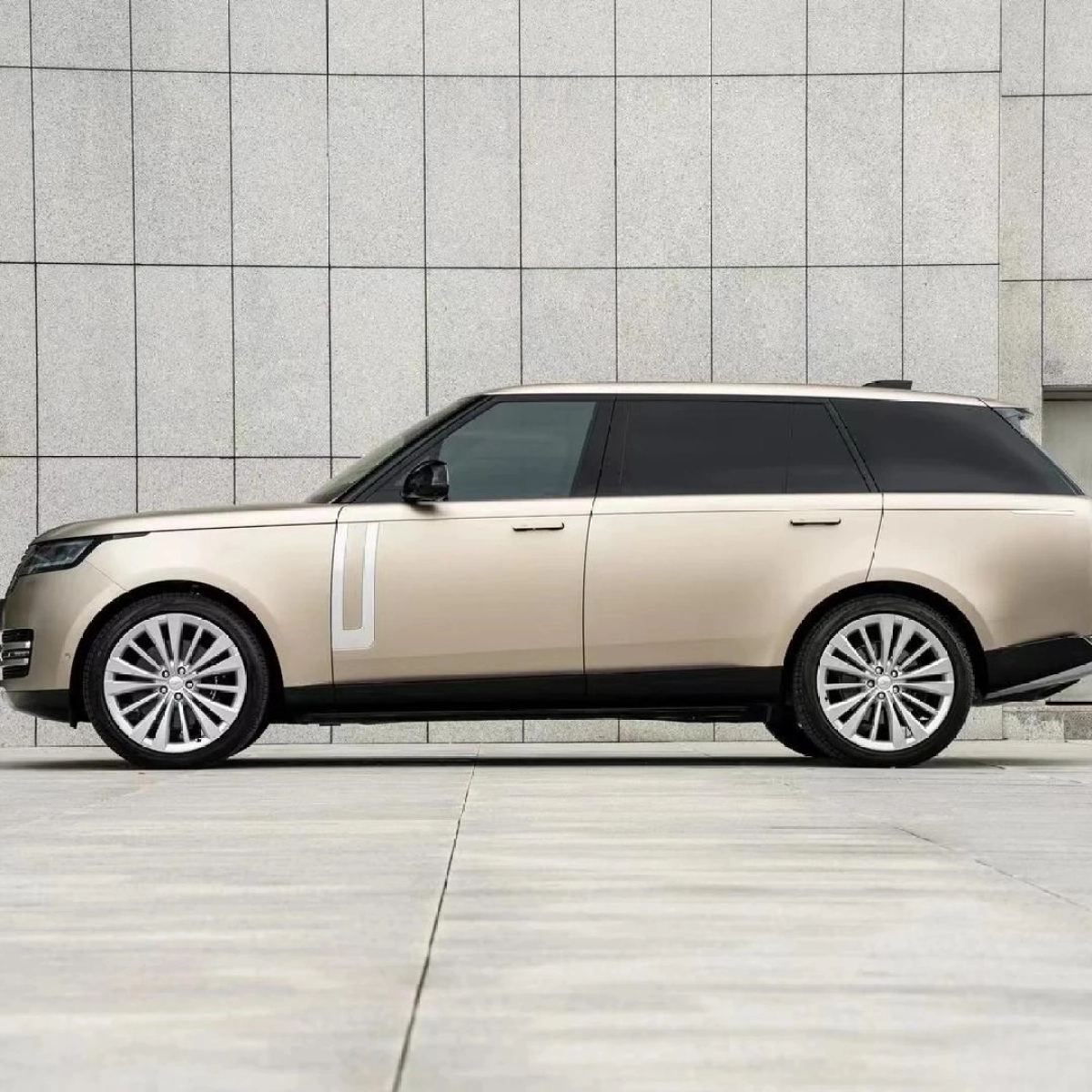
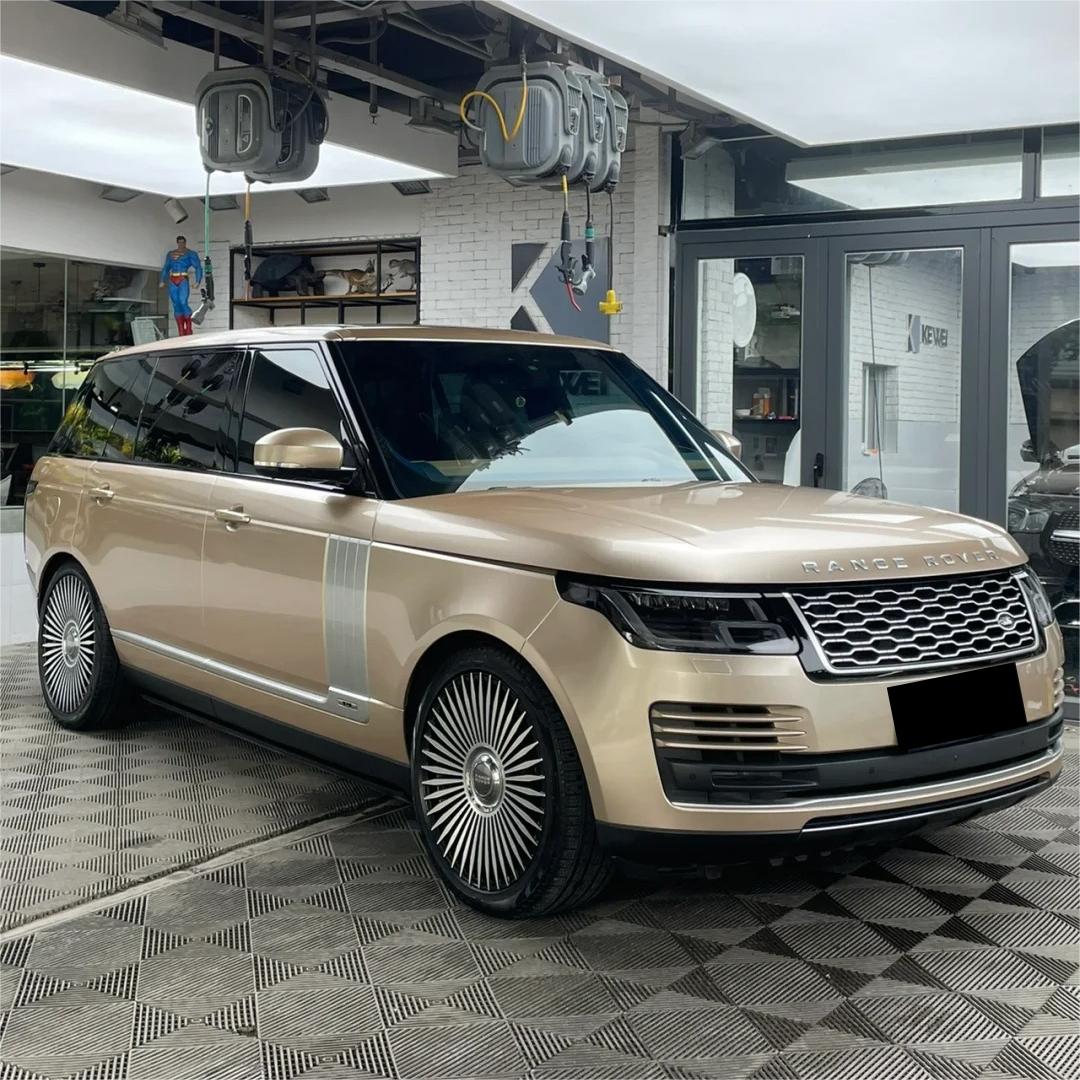
Gold cars have a reputation for being bold. Champagne gold is different.
Instead of the strong yellow tone of traditional gold, a champagne gold car sits somewhere between warm gold, beige, silver and cream. That softer balance is exactly why champagne gold can work surprisingly well on everything from a BMW coupe to a Mercedes-Benz sedan, Porsche SUV or Tesla.
There is one problem, though: not every champagne gold looks the same.
ALUKOVINYL currently offers three closely related champagne-gold vinyl finishes:
- Gloss Metallic Champagne Gold Car Wrap
- Gloss Metallic Champagne Light Gold Car Wrap
- Matte Satin Metallic Champagne Gold Car Wrap
Although their names sound similar, their visual personalities are noticeably different.
This guide compares the three colors by brightness, warmth, reflection, body-line definition, maintenance and vehicle compatibility to help you decide which version makes the most sense for your build.
Manufacturer Disclosure: ALUKOVINYL manufactures and sells automotive vinyl wrap, including the three products discussed in this article. Product-specific specifications therefore come from our own technical and product information. To provide broader context, this guide also references publicly available information from established automotive-film manufacturers including 3M and Avery Dennison. Actual film performance depends on installation, exposure, climate and maintenance.
Featured Snippet: What Is a Champagne Gold Car?
A champagne gold car has a light, muted gold exterior with beige, silver or cream undertones rather than the strong yellow appearance associated with traditional gold.
When created with metallic vinyl, fine reflective particles add depth as lighting changes. A gloss champagne gold car appears brighter and more paint-like, while satin champagne gold diffuses reflections for a softer and more understated appearance.
For drivers considering a vinyl transformation, the three ALUKOVINYL options can be summarized like this:
| Champagne Gold Wrap | Appearance | Reflection | Best For |
|---|---|---|---|
| Gloss Metallic Champagne Light Gold | Pale, silver-influenced champagne | High | Modern, clean builds |
| Gloss Metallic Champagne Gold | Richer, warmer champagne | High | Luxury and premium builds |
| Matte Satin Metallic Champagne Gold | Muted, soft metallic champagne | Low–medium | Understated/custom builds |
Quick decision: Choose Champagne Light Gold if you want the lightest look, Gloss Metallic Champagne Gold if you want the strongest classic champagne character, and Matte Satin Metallic Champagne Gold if you want softer reflections.
Why Is Champagne Gold Different From a Normal Gold Car?
The most important difference is saturation.
Traditional gold wraps often make yellow or orange-gold the dominant visual signal. Champagne gold reduces that saturation and introduces neutral tones.
Think of the spectrum roughly as:
Silver → Champagne Light Gold → Champagne Gold → Rich Gold → Yellow Gold
That difference sounds minor on a sample, but it becomes much more noticeable across an entire vehicle.
A 5-inch swatch does not have doors, fenders, bumpers and quarter panels reflecting light from different directions. Once installed, metallic particles interact with those changing panel angles and make the vehicle appear lighter or darker depending on where you stand.
This is one reason we strongly recommend looking at physical samples rather than selecting a champagne gold car wrap exclusively from a phone or computer screen.
[IMAGE PLACEHOLDER: Three ALUKOVINYL champagne gold swatches photographed together under identical lighting]
ALUKOVINYL’s Three Champagne Gold Car Wrap Colors Compared
1. Gloss Metallic Champagne Gold: The Balanced Choice
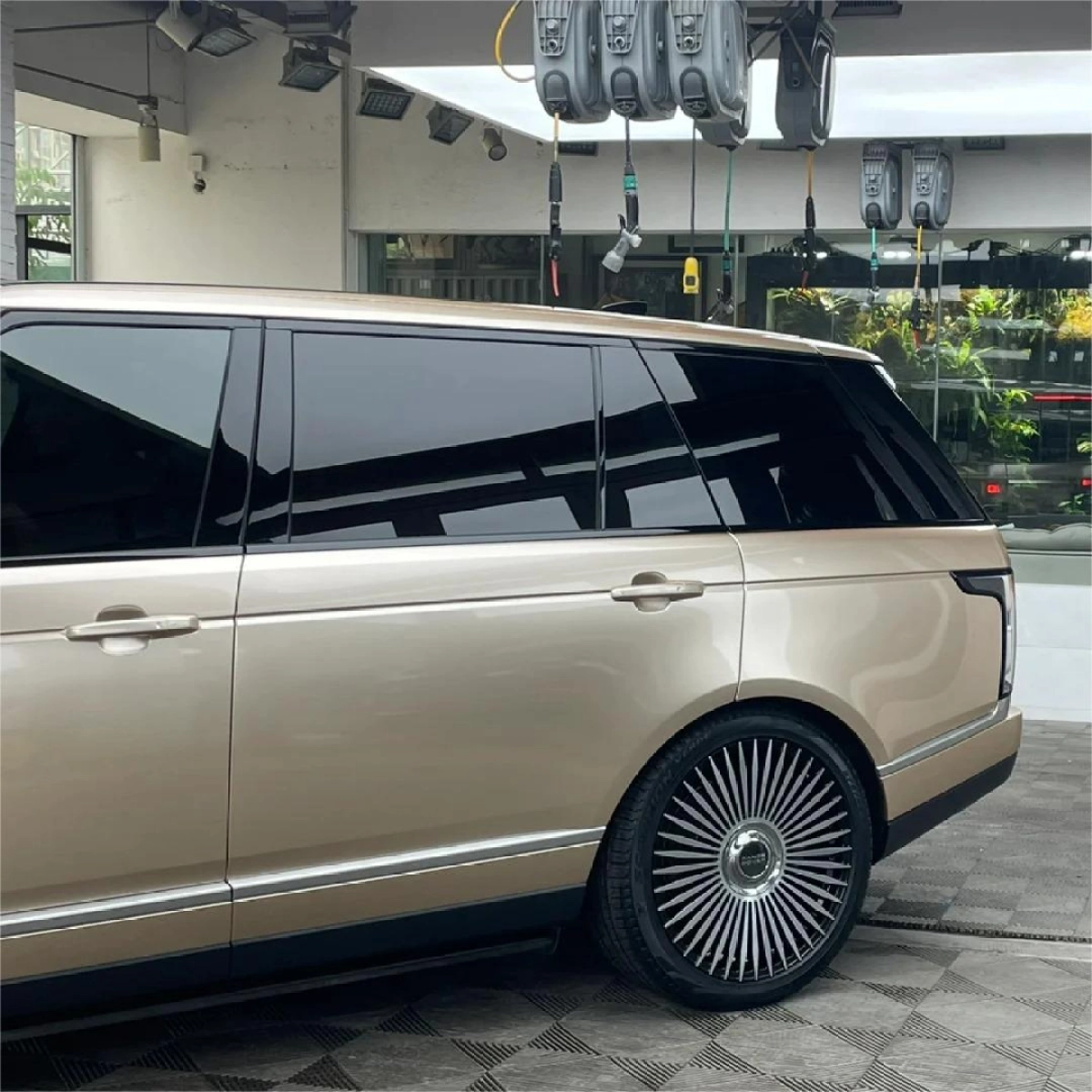
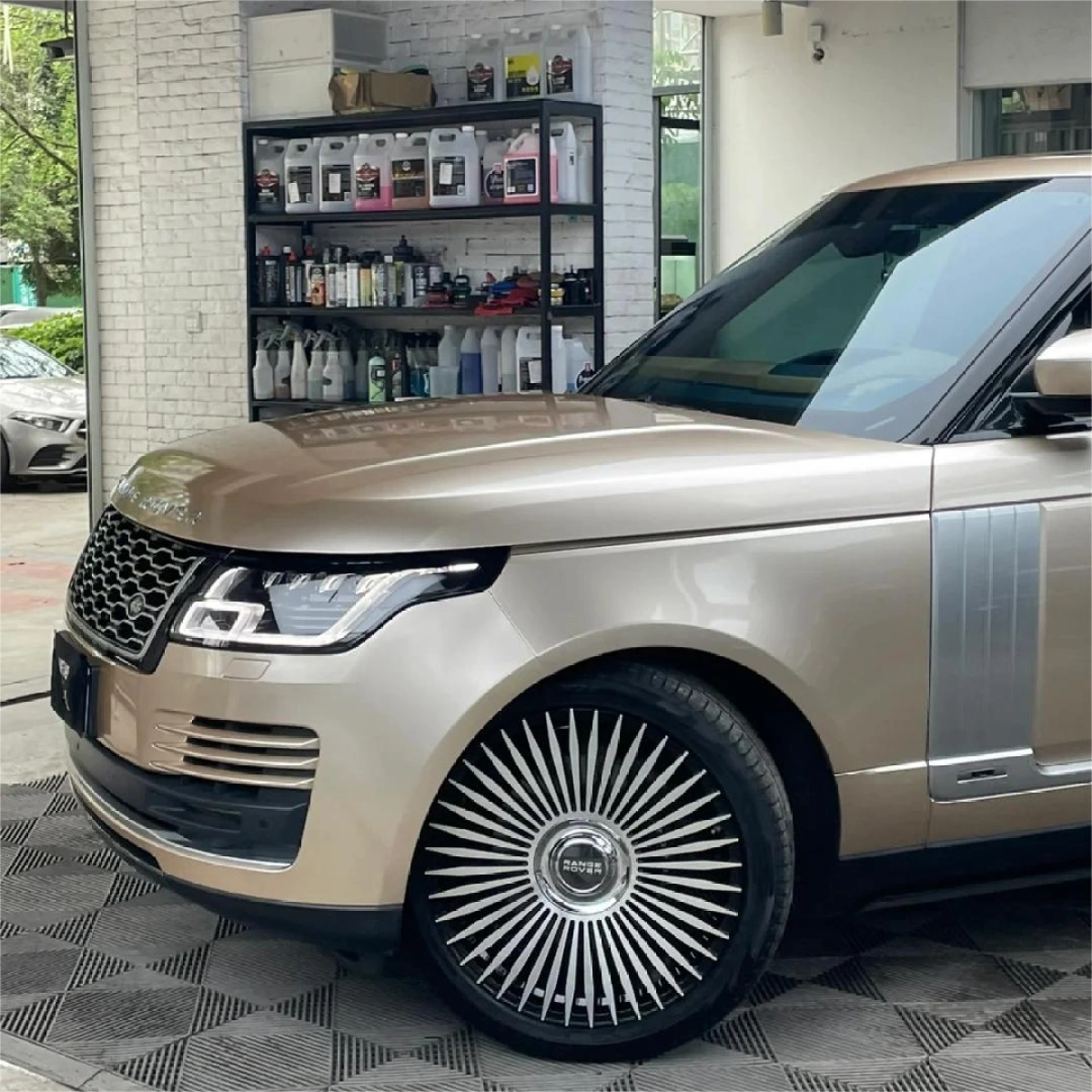
ALUKOVINYL’s Gloss Metallic Champagne Gold Car Vinyl Wrap is the reference point of this comparison.
It combines a warm champagne base with metallic reflection and a glossy surface. Compared with conventional bright gold, it is considerably more restrained; compared with Champagne Light Gold, however, it retains a stronger gold identity.
How does it look?
Under direct sunlight, metallic particles become more visible and the car develops a warmer golden glow.
Move into shade and the appearance becomes more neutral. Beige and muted metallic tones begin competing with the gold.
At night, streetlights and artificial lighting can produce another character again, especially across curved fenders and shoulder lines.
That variability is important because champagne gold is not a color that should be evaluated from one studio photograph.
Where does it work best?
We particularly like this color on vehicles with long, clean body surfaces:
Mercedes-Benz E-Class / S-Class: Champagne gold reinforces the luxury character without needing a loud chrome finish.
BMW 5 Series / 7 Series: The metallic reflection emphasizes the shoulder lines while the relatively neutral color keeps the result mature.
Porsche Panamera: A good example of a vehicle where large curved panels can show the metallic depth effectively.
Lexus LC: The complex body sculpture gives champagne gold many different angles from which to reflect light.
Pros
- Strongest traditional champagne-gold identity of the three
- Gloss finish provides a paint-like visual character
- Metallic particles emphasize body contours
- More restrained than bright yellow-gold or mirror chrome
- Works on luxury cars, sports cars and SUVs
Cons
- Gloss surfaces make dust, water spots and contamination easier to notice
- The warmer gold tone may be too prominent for someone looking for an almost-silver finish
- Metallic orientation and panel installation direction require installer attention
- Screen photos cannot reliably represent the exact real-world color
ALUKOVINYL lists the PET version as a gloss/metallic film with air-release adhesive and an expected durability of 5–7 years. This figure should be treated as a product expectation rather than a guarantee for every vehicle: climate, horizontal exposure, installation and maintenance can materially change real-world service life.
Product: Gloss Metallic Champagne Gold Car Wrap
2. Gloss Metallic Champagne Light Gold: The Modern Alternative
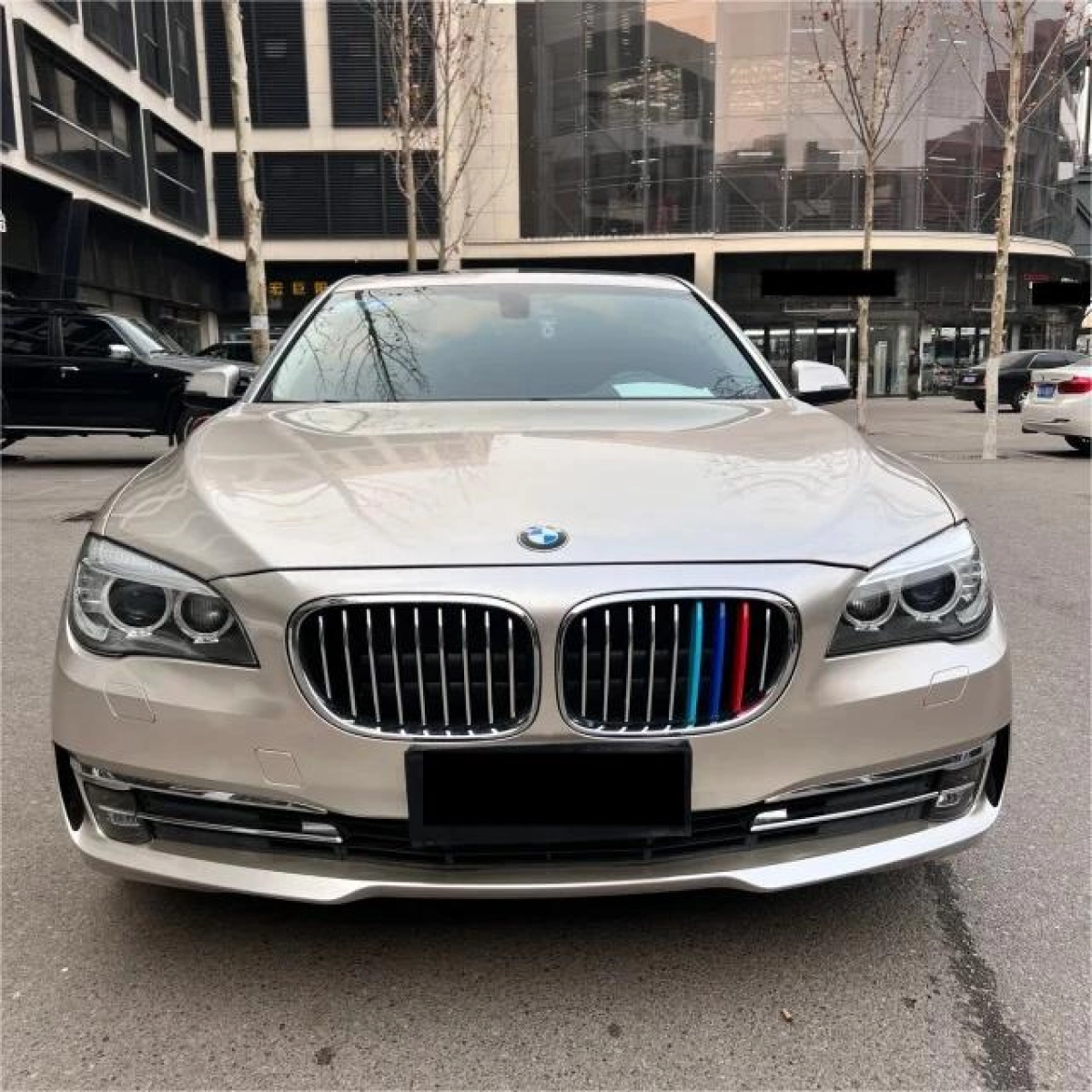
Put Champagne Light Gold beside regular Champagne Gold and the difference becomes clearer.
The easiest way to describe Gloss Metallic Champagne Light Gold is that it moves one step toward silver.
It retains enough warmth to avoid looking like a conventional silver car, but it is less saturated and visually lighter than the standard Champagne Gold.
That distinction makes it particularly interesting for contemporary vehicles.
Why does lighter champagne gold feel different?
Color is only half the equation.
A gloss surface creates strong environmental reflections. When that highly reflective surface is combined with a lighter base color, the vehicle can appear exceptionally bright under open daylight.
Instead of shouting “gold,” it can initially read as a warm metallic neutral.
That gives Champagne Light Gold a more ambiguous character:
In bright sun: pale gold and metallic highlights.
In overcast conditions: champagne-silver.
In shade: beige-silver or warm grey influences can become more noticeable.
This changing identity is arguably the strongest reason to choose it.
Vehicles that suit Champagne Light Gold
Tesla Model 3 / Model S: Their minimalist surfaces pair naturally with a cleaner, less saturated metallic color.
Porsche Taycan: The pale champagne tone works particularly well with the Taycan’s modern design language.
BMW i4: Champagne Light Gold can add warmth without overpowering the car’s sharper lines.
Range Rover: On a large luxury SUV, the lighter tone avoids making the vehicle visually heavier.
Pros
- Lightest and most neutral of the three choices
- Contemporary rather than traditional gold appearance
- Strong gloss reflection
- Suitable for minimalist and luxury builds
- Easier to pair visually with black, silver or carbon-look accents
Cons
- May appear closer to silver/beige in certain lighting
- Buyers wanting an obvious gold car may find it too subtle
- Gloss finish requires regular cleaning to maintain its best appearance
- Differences between digital photos and physical film can be significant
ALUKOVINYL specifies the PET film for dry application and lists an expected durability of 5–7 years, subject to real-world conditions.
Product: Gloss Metallic Champagne Light Gold Car Wrap
3. Matte Satin Metallic Champagne Gold: The Most Understated Choice
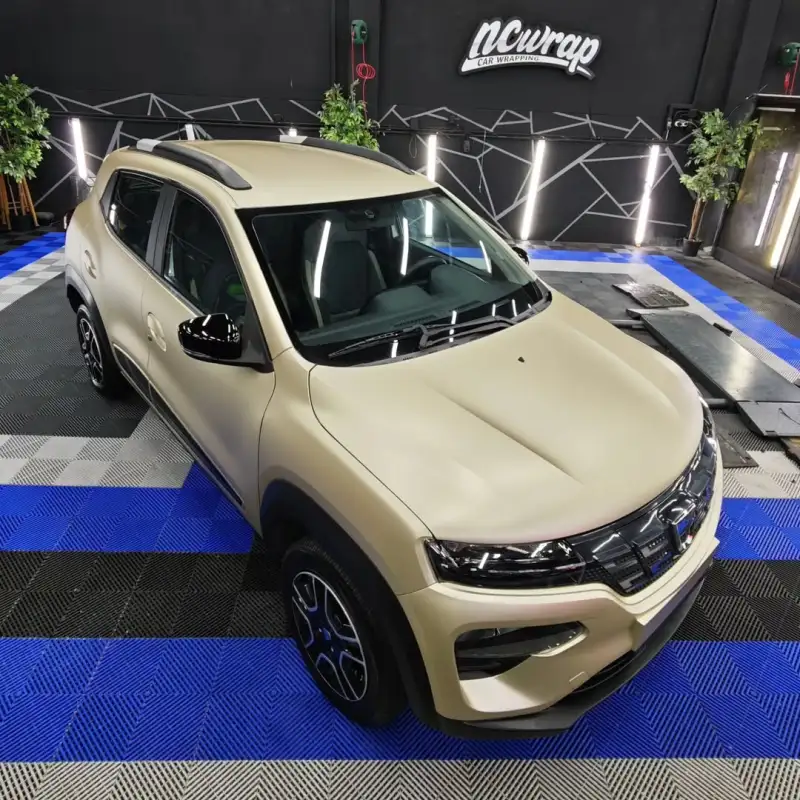
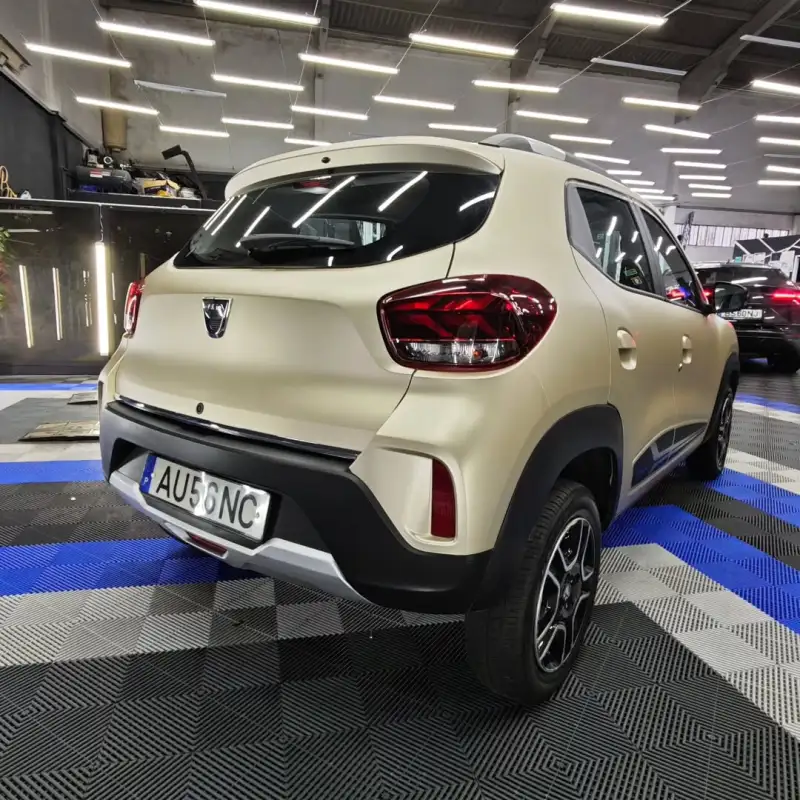
The third option changes more than the color.
Matte Satin Metallic Champagne Gold changes the way light interacts with the entire vehicle.
Gloss surfaces produce sharper reflections. Satin surfaces scatter those reflections, making highlights broader and softer.
As a result, the same champagne-gold family can suddenly feel considerably more restrained.
This is why finish selection can matter as much as color selection.
Matte or satin?
Although the product name contains both terms, visually it should be understood as a low-reflection metallic finish rather than a completely flat, non-reflective color.
The metallic component still responds to sunlight. What disappears is the sharp mirror-like reflection associated with gloss.
The result is a softer champagne appearance with enough metallic activity to prevent the vehicle from looking visually flat.
Which cars work particularly well?
Mercedes-AMG GT: Satin champagne can contrast effectively with aggressive body proportions.
BMW M3 / M4: A muted luxury color creates an interesting counterpoint to an aggressive performance-car design.
Lamborghini Urus: Satin metallic champagne reduces some of the visual intensity of a large SUV while retaining an exotic custom character.
Mercedes-Benz G-Class: Large flat panels provide a strong canvas for satin finishes.
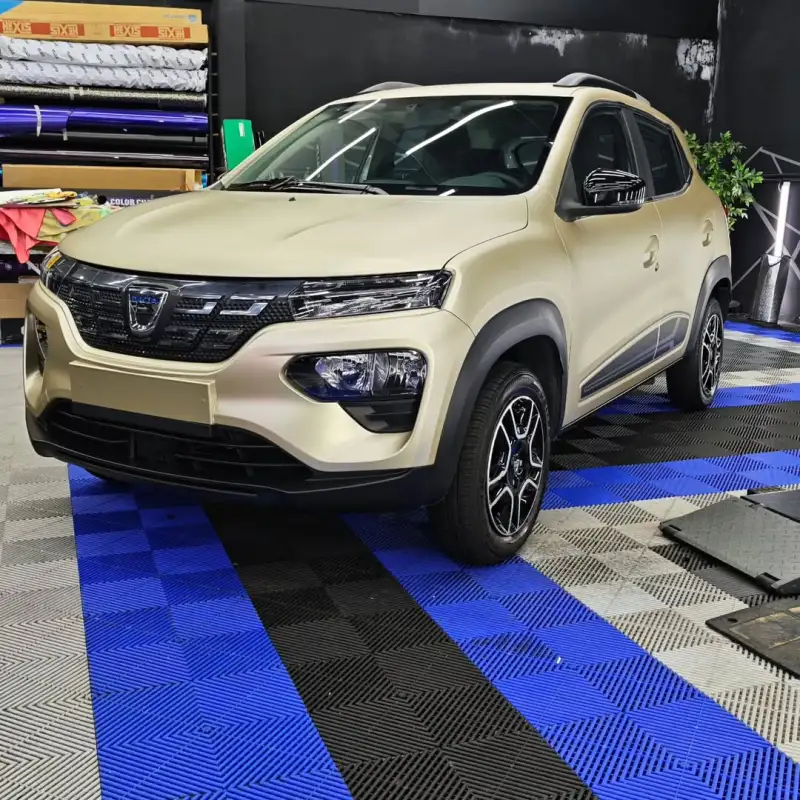
ALUKOVINYL also has useful real-world evidence for this finish rather than relying solely on studio renders. The product page includes customer-installed vehicles and a commercial detailing van finished in Matte Metallic Champagne Gold, giving buyers additional reference points for how the material looks on larger surfaces.
[IMAGE PLACEHOLDER: Real ALUKOVINYL customer vehicle in Matte Satin Metallic Champagne Gold]
Pros
- Most understated of the three finishes
- Softer reflections can make complex bodywork easier to read
- Metallic particles prevent the finish from appearing completely flat
- Distinctive without the visual intensity of chrome gold
- Works particularly well with black trim and wheels
Cons
- Does not deliver the wet, paint-like reflections of gloss
- Satin/matte surfaces require appropriate cleaning practices
- Polishing products intended for gloss paint should not automatically be used
- Localized contamination or fingerprints may be more noticeable from certain angles
3M’s published wrap-care guidance similarly notes that matte finishes can show fingerprints more prominently and recommends appropriate non-abrasive cleaning rather than aggressive polishing.
Champagne Light Gold vs Champagne Gold vs Satin Champagne Gold
Here is the practical comparison.
| Feature | Champagne Light Gold | Champagne Gold | Satin Champagne Gold |
|---|---|---|---|
| Gold intensity | ★★☆☆☆ | ★★★★☆ | ★★★☆☆ |
| Brightness | ★★★★★ | ★★★★☆ | ★★★☆☆ |
| Surface reflection | High | High | Low–Medium |
| Metallic depth | Medium | High | Medium |
| Understated appearance | High | Medium | Very High |
| Paint-like appearance | Very High | Very High | Low |
| Best design direction | Modern | Luxury | Custom / Stealth Luxury |
These ratings describe the relative visual differences among these three ALUKOVINYL colors, not laboratory performance scores.
There is no universally “best” champagne gold. The correct decision depends primarily on how visible you want the gold component and how much reflection you want from the surface.
Our Most Important Observation: Choose the Finish Before the Exact Gold
Many buyers begin by asking:
“Which champagne gold color do I like?”
A better first question may be:
“Do I want my car to reflect its surroundings sharply or softly?”
This distinction can have a greater impact on the finished vehicle than the relatively small hue difference between two neighboring champagne colors.
If you love reflections of buildings, clouds and lights running across your doors, start with gloss.
If you want the body itself—not reflected scenery—to dominate visually, start with satin.
Only after making that decision should you decide whether the underlying champagne tone should be lighter or warmer.
This finish-first approach is particularly useful when selecting a wrap online.
How Champagne Gold Changes in Different Lighting
One reason champagne gold is difficult to photograph is that metallic automotive colors are highly dependent on illumination.
Direct Sunlight
Metallic particles become much more obvious.
Gloss Champagne Gold usually shows the strongest warm-gold character, while Champagne Light Gold remains paler.
Cloudy Weather
Without intense directional sunlight, all three colors become more muted.
This is where beige, cream and silver undertones can become easier to see.
Indoor Garage Lighting
Artificial lights can significantly change the perceived warmth of champagne colors. Warm lighting may amplify gold; cool LEDs can make the same wrap appear more silver.
Night
Streetlights create concentrated highlights rather than illuminating an entire panel.
Gloss finishes therefore produce sharp points and streaks of reflection, whereas Satin Champagne Gold diffuses those highlights.
Practical advice: evaluate a physical sample outdoors, in shade and under artificial light before ordering a complete roll.
Does a Champagne Gold Car Wrap Protect the Paint?
A vinyl wrap creates an additional physical layer over the painted panel and can help isolate the covered surface from everyday contamination and light surface contact.
However, vinyl wrap should not be marketed as equivalent to paint protection film (PPF).
This distinction matters.
Standard color-change vinyl is primarily designed to transform appearance. It is much thinner and serves a different purpose from TPU PPF engineered specifically around impact and paint-protection performance.
If resistance to stone chips and physical impacts is your primary objective, consider PPF rather than choosing a vinyl wrap solely for protection.
That distinction makes the purchasing decision clearer:
Choose vinyl wrap primarily for: color transformation, finish customization and reversible styling.
Choose PPF primarily for: paint protection, with clear or colored options depending on the product.
How Long Does Champagne Gold Vinyl Wrap Last?
ALUKOVINYL currently lists an expected durability of 5–7 years for its PET Champagne Gold, Champagne Light Gold and Matte Metallic Champagne Gold products.
That number needs context.
Major film manufacturers also distinguish durability according to film construction, color, orientation and environmental exposure. Avery Dennison, for example, publishes different durability figures across its Supreme Wrapping Film portfolio and notes shorter published durability for some metallic products than for standard black/white films.
3M likewise notes that exposure angle affects warranty conditions and recommends indoor or shaded storage where possible to reduce heat and UV exposure.
Therefore, no responsible lifespan estimate should ignore:
- UV intensity
- Climate and temperature
- Garage vs outdoor parking
- Horizontal vs vertical panels
- Installation quality
- Film stretching
- Chemical exposure
- Washing method
- Maintenance frequency
A garage-kept vehicle driven occasionally is not experiencing the same environment as a daily-driven vehicle parked outdoors in Arizona or Florida.
That is why “5–7 years” should be interpreted as an expected product range under suitable conditions—not a promise that every panel on every vehicle will look identical after seven years.
PET-Backed Gloss Vinyl: What Actually Matters?
Two of the biggest visual goals for modern gloss vinyl are surface smoothness and reflection clarity.
PET release liners are increasingly used with high-gloss automotive films because a very smooth liner can help preserve a smooth adhesive-side surface before installation.
However, buyers should avoid assuming that PET automatically means better film in every respect.
A liner is only one component of the system.
Professional wrapping performance also depends on:
- Face-film construction
- Adhesive characteristics
- Initial tack
- Repositionability
- Air-release design
- Conformability
- Stretch management
- Post-heating
- Installer technique
For comparison, Avery Dennison emphasizes repositionability and slideability through its Easy Apply RS adhesive system, while 3M’s Wrap Film Series 2080 is engineered as a complete automotive wrapping system.
The useful question is therefore not simply “PET or paper?” but:
How does the complete film-and-adhesive system behave during installation and after environmental exposure?
That is a more meaningful professional comparison.
ALUKOVINYL vs 3M vs Avery Dennison vs Other Champagne Gold Wraps
ALUKOVINYL is not the only manufacturer offering metallic automotive colors.
3M Wrap Film Series 2080 and Avery Dennison Supreme Wrapping Film are established professional vehicle-wrap systems with extensive technical documentation, installer networks and published performance information.
Avery currently advertises more than 140 Supreme Wrapping Film colors and technologies designed around repositionability, slideability and conformability. Its published documentation also provides finish-specific durability information.
3M similarly publishes installation, maintenance and warranty guidance for Wrap Film Series 2080.
RAXTiFY currently markets both Gloss Metallic Champagne Gold and Satin Metallic Champagne Gold alternatives, demonstrating that champagne gold has become a broader aftermarket color category rather than a single-brand shade.
Where ALUKOVINYL takes a different approach is color depth and selection. The current catalog contains more than 500 colors and finishes, including three closely spaced Champagne Gold vinyl options rather than forcing buyers to choose one interpretation of the color.
That variety is valuable—but technical documentation and long-term field evidence remain important when comparing any wrap brand.
For professional shops, we recommend comparing physical samples, adhesive behavior, installation requirements, technical specifications, warranty terms and local support rather than selecting a film based solely on online color photography.
Which Champagne Gold Should You Choose?
Instead of declaring one color the winner, use your desired result to narrow the choice.
You want a very light, modern luxury car
Start with Gloss Metallic Champagne Light Gold.
Its silver influence makes it especially suitable for contemporary EVs, luxury sedans and minimalist builds.
You want people to immediately recognize the car as champagne gold
Consider Gloss Metallic Champagne Gold.
It maintains a stronger gold identity while avoiding the extreme saturation of yellow gold or mirror chrome.
You want something less reflective and more unusual
Consider Matte Satin Metallic Champagne Gold.
Its lower-gloss surface changes the personality of the color and can create a more restrained custom appearance.
Champagne Gold Car Wrap: Best Wheel and Trim Combinations
The wrap is only one part of the finished design.
Gloss black wheels + champagne gold create the strongest contrast and work particularly well on performance-oriented cars.
Silver wheels + Champagne Light Gold create a more OEM-inspired luxury appearance.
Bronze wheels + Champagne Gold can work, but the bronze and gold undertones should be compared carefully before installation to avoid competing warm tones.
Carbon-look accents + Satin Champagne Gold can give performance vehicles a stronger visual edge.
Chrome trim is more complicated. It can complement pale champagne finishes, but blacking out the trim often gives the vehicle a cleaner and more contemporary appearance.
Pros and Cons of a Champagne Gold Car Wrap
Advantages
Champagne gold occupies an unusually useful position between neutral and statement colors. It is more distinctive than silver, white or beige without necessarily becoming as visually aggressive as chrome gold.
Metallic particles also give curved panels additional visual depth, particularly under directional sunlight.
Vinyl provides a reversible color transformation without requiring a permanent repaint, and multiple gloss/satin options make it possible to adjust both hue and reflectivity.
Disadvantages
Champagne colors are difficult to judge accurately on screens.
Metallic orientation means installation direction should be carefully controlled across adjacent panels.
Gloss finishes show contamination and water spotting more readily, while satin finishes require finish-appropriate care.
Vinyl also should not be confused with TPU PPF when substantial impact protection is the priority.
Finally, real-world durability varies considerably according to climate, exposure and maintenance.
How to Maintain a Champagne Gold Vinyl Wrap
Wash the vehicle regularly rather than allowing road contamination to remain on the surface for extended periods.
Hand washing with a mild automotive detergent and microfiber materials is generally the safest approach. If an automatic wash is necessary, touchless systems are preferable to abrasive brush washes.
3M’s published maintenance guidance recommends hand washing where possible and warns that brush-type car washes may scratch or dull film and potentially contribute to edge lifting.
Also avoid treating satin and gloss surfaces identically.
Products designed to increase gloss can alter the appearance of satin finishes. Test unfamiliar cleaners on an inconspicuous area before applying them across the entire vehicle.
Whenever possible, covered or indoor parking can also reduce long-term UV and heat exposure.
FAQ About Champagne Gold Cars
What color is a champagne gold car?
Champagne gold is a muted metallic gold with beige, silver or cream undertones. It is generally lighter and less yellow than traditional gold.
Is champagne gold closer to silver or gold?
It depends on the formulation and lighting. Champagne Light Gold can lean toward warm silver, while classic Champagne Gold maintains a stronger gold appearance.
Does champagne gold look different in sunlight?
Yes. Metallic particles reflect directional light, so champagne gold can appear brighter and warmer in direct sun and more neutral in shade.
Which ALUKOVINYL champagne gold is the lightest?
Gloss Metallic Champagne Light Gold is the lightest of the three compared in this guide.
What is the difference between Gloss Champagne Gold and Satin Champagne Gold?
Gloss produces sharper reflections and a more paint-like appearance. Satin diffuses reflections, producing a softer and more muted finish.
Is champagne gold good for a BMW?
It can work particularly well on BMW sedans and coupes because metallic champagne highlights the brand’s strong shoulder lines without requiring an extremely bright color.
What cars look good in champagne gold?
Luxury sedans, GT cars, modern EVs and premium SUVs are natural candidates. Examples include the BMW 5 Series, Mercedes-Benz E-Class, Porsche Panamera, Porsche Taycan, Tesla Model S and Range Rover. The final result depends more on wheel, trim and finish combinations than on vehicle brand alone.
Is champagne gold difficult to maintain?
Not particularly, but finish matters. Gloss requires attention to water spots and surface contamination, while satin should be cleaned without gloss-enhancing or abrasive products.
How long does a champagne gold car wrap last?
ALUKOVINYL lists an expected durability of 5–7 years for these three PET products. Actual service life varies with UV exposure, climate, panel orientation, installation and maintenance.
Should I order a sample first?
Yes. Champagne gold is particularly sensitive to lighting and display differences, making a physical sample highly advisable before purchasing enough material for a complete vehicle.
Final Thought: There Is More Than One Champagne Gold
A champagne gold car does not have to look obviously “gold.”
That is precisely what makes this color family interesting.
Gloss Metallic Champagne Light Gold sits closest to modern warm silver.
Gloss Metallic Champagne Gold delivers the clearest balance between luxury gold and a restrained neutral.
Matte Satin Metallic Champagne Gold changes the equation again by reducing reflection and emphasizing the vehicle’s physical shape.
Rather than asking which of the three is objectively best, decide what you want the car to do with light.
Do you want sharp reflections? Start with gloss.
Do you want subtlety? Look at satin.
Do you want champagne to lean toward silver? Choose Light Gold.
Do you want a stronger gold identity? Start with classic Champagne Gold.
That approach makes choosing among three very similar swatches considerably easier.